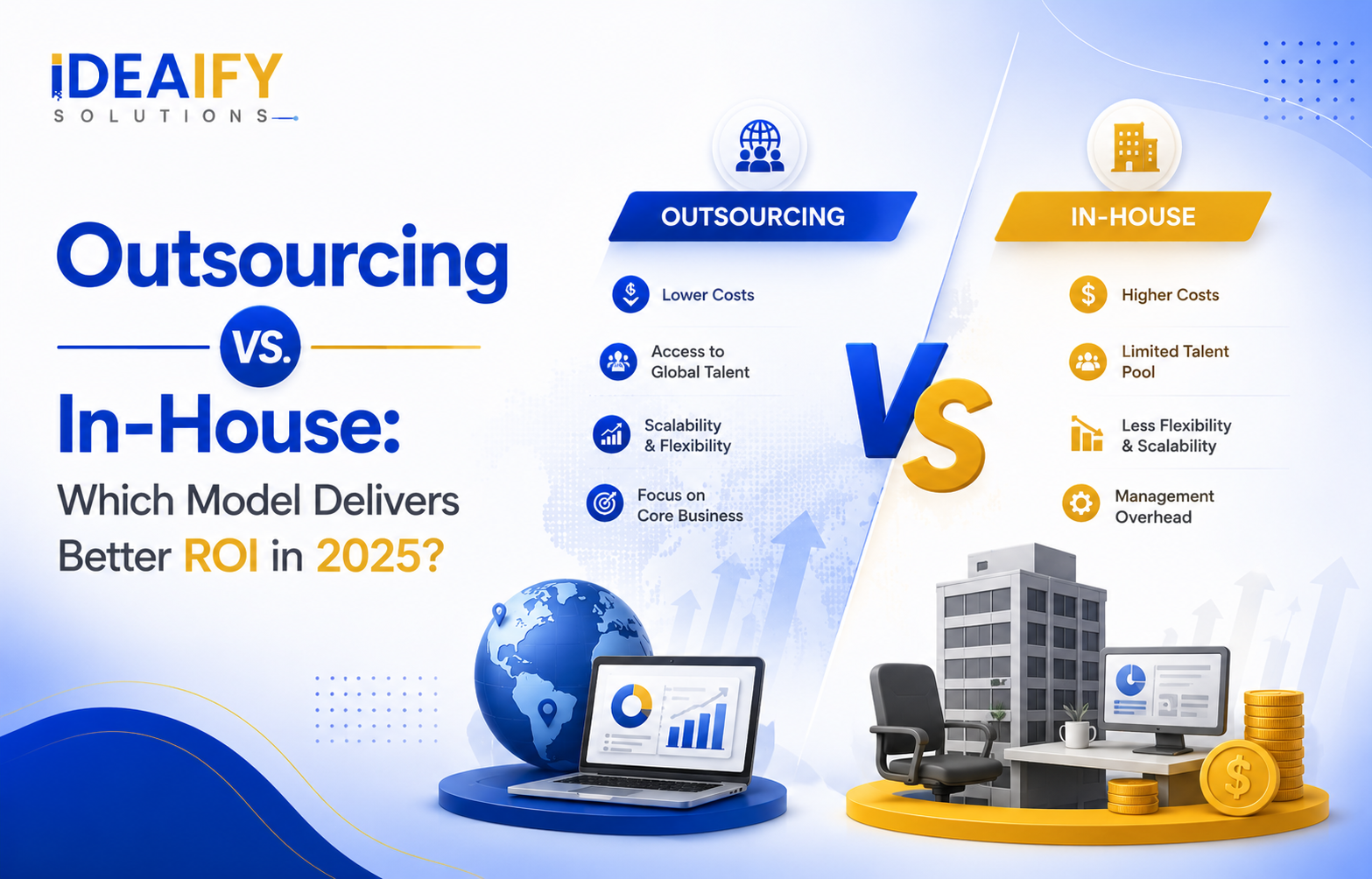
Outsourcing ROI benchmarks vary significantly across industries. In 2025, outsourcing or in-house development will be a key factor in decision-making for companies navigating the complexities of today’s tech world. A competitive job market, increased global collaboration, and rising cost pressures have fueled this debate between in-house and outsourcing, making it more timely than ever before.
The 2025 business world keeps changing at a record pace. Startups are constantly under pressure to scale quickly while staying profitable. One of the largest questions of debate yet unanswered remains: do you outsource or bring in an in-house team? It’s not a simple answer, which hinges on your objectives, resources, as well as development stage.
This article by Ideaify Solutions, we will strive to give you insights to help you decide on your best business strategy for 2025.
Understanding ROI in Today’s Business Context
The ability to accurately measure returns and profitability is vital for any organization in an increasingly competitive commercial landscape. Specifically, Return on Investment (ROI) ranks as one of the most significant philosophies to achieve as a business leader, especially in the SaaS industry, where decisions regarding the allocation of resources can create or hinder growth opportunities.
Most executives appreciate that ROI is significant; however, understanding the intricacies and assessing effectively why and how ROI is useful for decision making requires a deeper dive. ROI is not just about cost efficiency anymore, as discussed in preparing for 2025, it’s about innovation, value, and scalability in time. When evaluating ROI, entrepreneurs need to consider time spent, productivity gained, and quality produced, as opposed to solely measuring their financial savings.
Short-Term vs. Long-Term ROI
Generally, marketers consider short-term ROI initially. The outsourced ROI team could work on the eventual return that you receive from a given marketing effort or campaign. Long-term ROI, being a more accurate indicator of your marketing efforts’ success, might be handled best by an in-house team. It quantifies your marketing efforts’ cumulative impact over a period of time. This could encompass a slow but steady increase in customer loyalty, sustained boost in brand awareness, or a slow but steady increase in market share.
The In-House Model Explained
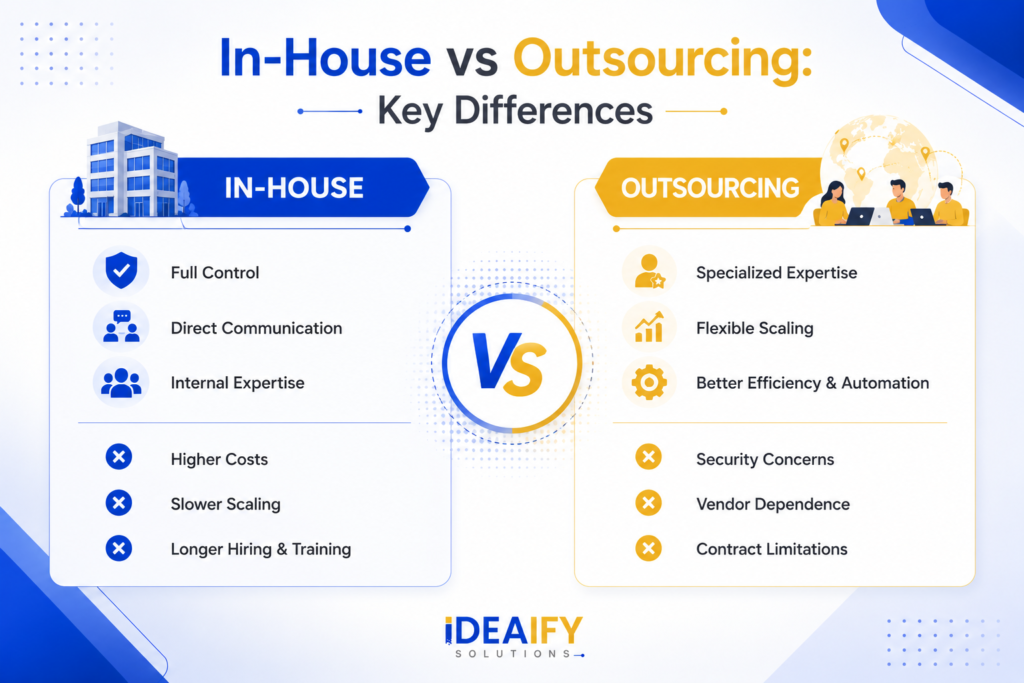
In-house implies that a business uses its own employees or hires staff to design, deploy, and manage applications, data, as well as the system’s infrastructure transition. It uses its organization’s resources but does not rely on a third party.
Advantages of In-House Teams
- Overall decision-making, processes, and data processing control.
- No outside dependencies with team communications being straightforward.
- Development of in-house expertise with education and job experience.
Disadvantages of In-House Teams
- Elevated expenses in Training, infrastructural development, as well as recruiting experts.
- Longer onboarding and execution horizons.
- Errors in planning might cause downtime or risk of non-compliance.
The Outsourcing Model Explained
Outsourcing means hiring an external partner, often remote teams, to handle specific business functions like IT, marketing, or customer support.
Advantages of Outsourcing
- Outreach gives access to proficiency in such tasks as Artificial Intelligence, cybersecurity, and finance.
- It provides operational flexibility, like being easier to grow or shrink back to demand.
- It helps productivity like advanced automation, modernization, etc, and provides better performing capabilities.
Disadvantages of Outsourcing
- Service delivery may be behind time or less than expected
- Confidentiality; security may be vulnerable
- The contract could be inflexible to change
ROI Comparison: In-House vs. Outsourcing
Financial Breakdown
In 2025, the typical cost of having an internal employee (including benefits and workspace) is about 1.8x more than outsourcing. It can be very expensive to have an internal support team, considering all the associated costs including recruiting, salaries, benefits, infrastructure, and ongoing training costs.
Outsourcing remote teams can help you achieve cost efficiency by reducing or removing many of these fixed costs (i.e. hiring, training, infrastructure). You only pay for what you need, usually at a lower hourly rate, and you don’t pay for employee recruiting or managing. In addition to keeping costs down, outsourcing is a smart option for companies that want to prioritize quality support and offer it to customers as much as possible.
Productivity and Scalability
A Deloitte study conducted in 2024 determined that outsourced remote teams delivered projects 25% faster than in-house teams, which is fantastic if you require 24/7 customer service support or need to hire an entire team overnight. Vendors typically operate across time zones and geographies, which allows them to provide 24/7 services to your customers and adjust headcount as needed.
This is valuable if you have a customer service department, tech help desk, or any other function that requires real-time service. On the other hand, in-house teams delivered 15% higher quality scores which is lesser than outsourced teams.
So, depending on your priorities, outsourcing ROI matters when determining whether you require speed or depth.
Case Study: SaaS Startup Success
India’s premier e-commerce company, Flipkart, which started as a SAAS company, took the bold step of outsourcing ROI. tThe firm engaged over 50,000 Kirana stores all over India to act as pick-up and delivery points online. This offloading of the last-mile delivery was a strategic move to minimize logistics expense giving cost efficiency while not slowing down delivery time for places that had less traditional infrastructure in place. This move gave Flipkart a 48% market share and has over 400 million users, while they focus on their core platform but expand through local and engaged associations. Technology companies such as Apple, Microsoft, and Google also use this hybrid tactic of outsourcing support and back office work while keeping R&D and strategic work internal.
The Role of Remote Teams in 2025
In the dynamic world of information technology (IT), organizations face a crucial decision about whether to hire an in-house team of IT professionals or pursue remote outsourcing. The question of whether to outsource information technology resources is not simply a consideration for startups but one that established companies also grapple with in order to optimize the delivery of their IT functions. In considering either option, it is best to weigh the pros and cons of a remote teams vs. in-house model.
Factors That Influence ROI
- Assess Productivity Gains
Outsourcing ROI has become one of the best operational and productivity enhancers, and processes efficiencies. It is also critical to measure productivity improvements, such as faster service times and enhanced service quality, in order to know how outsourcing is ultimately benefiting overall business productivity.
- Analyze Cost Savings
While there are certainly strategic advantages from outsourcing, cost efficiency or optimization continues to be a motivating factor to contractors looking to partner with third-party vendors. And to assess the ultimate outsourcing ROI, it is important to quantify the cost savings from outsourcing vs. the cost of performing the function internally. This extended analysis should consider the full costs of all relevant costs, including salaries for employees, infrastructure, and overheads.
- Calculate Revenue Growth
Outsourcing can greatly influence revenue growth, since it allows businesses to focus on their core activities and take on growth opportunities. To measure the true impact of outsourcing on the bottom line, it is important to review revenue growth pre- and post-outsourcing.
How to Choose the Right Model for Your Startup
Consider the following important questions:
- What is your primary goal, i.e, speed, control, or cost?
- Can you budget fixed costs associated with full-time employees?
- Do you require specialized skills on a temporary basis, or as a permanent part of your team?
A simplistic takeaway: outsource for flexibility, and in-house for ownership.
Future Outlook: Blended Is the Future
Starting in 2025 and beyond, blended teams, some in-house and some outsourced, will become the norm. The emphasis will shift from “who does the work” to “how well work is done”, all due to AI-enabled workflow management, real-time analysis of work performance, and productivity.
Final Thoughts: What’s Best for Your Business in 2025?
There is no single answer to the in-house vs. outsourcing remote team question, especially in 2025, when speed, flexibility, and access to talent will matter more than ever. The right development model for your organization is contingent upon its current stage, internal capabilities, timelines, and long-term goals, particularly when choosing in-house software development versus outsourcing.
Evaluating your options requires thinking through some factors, namely your budget, timeline for hiring, your need for control, your scalability needs, and your ability to supervise both hybrid and/or distant teams. In-house development may come with additional cost and limit scaling, but there is deeper alignment and continuity. Outsourcing will provide agility and cost-effectiveness, and gain you access to specialized skills, especially when timelines and/or resources are tight.
You will want to consider your firm’s objectives, risks, and resources. A frank and candid evaluation of what your business really requires will inform the right model not only for this project, but for future growth as well.