
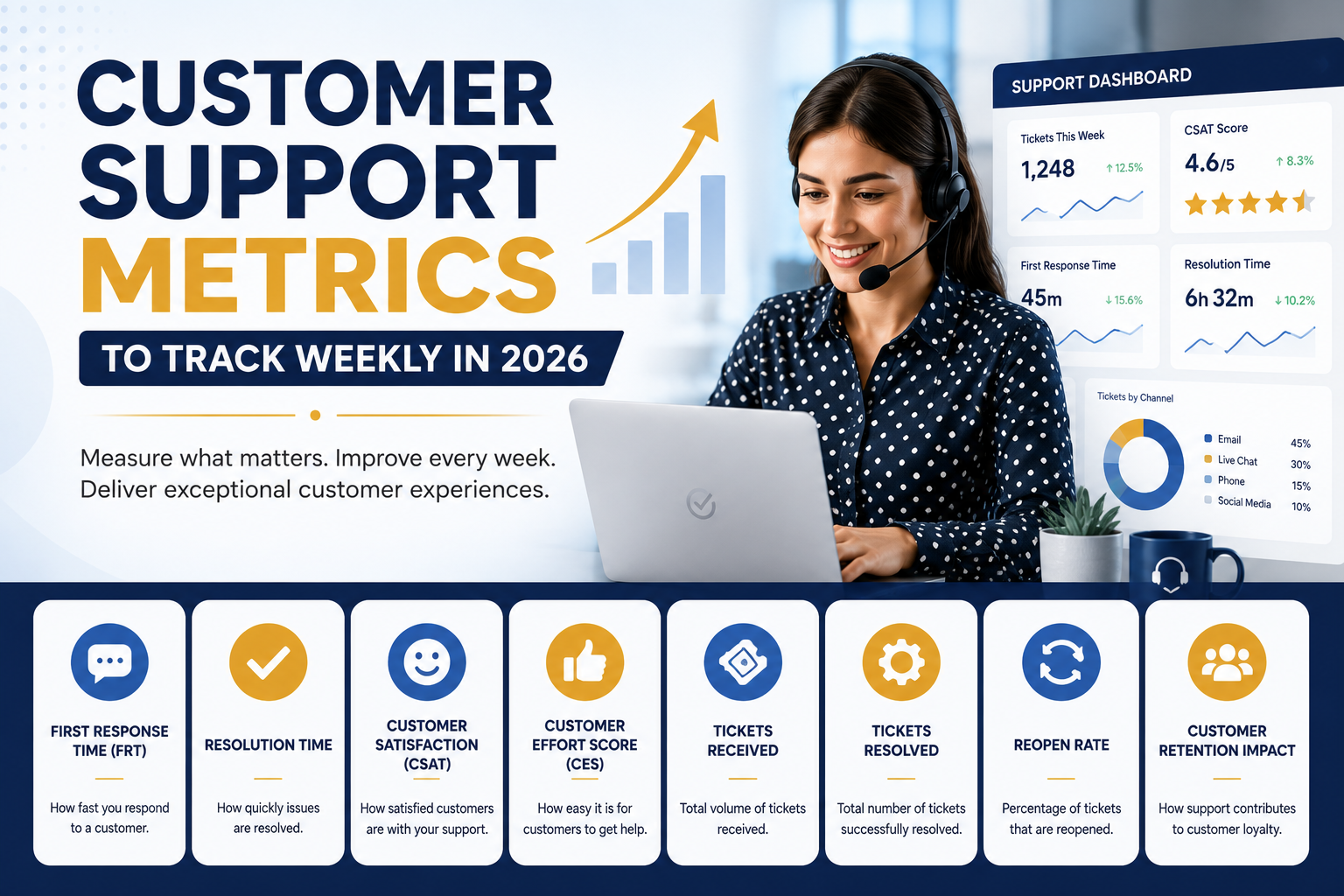
Customer expectations have never been higher.
Whether you’re running a fast-growing SaaS company or a thriving eCommerce business, customers expect quick responses, accurate solutions, and seamless support across every channel. A single delayed reply or unresolved issue can quickly impact customer loyalty, online reviews, and recurring revenue.
Many support teams track dozens of reports each month, but waiting until month-end often means problems have already affected the customer experience. The most effective organizations monitor customer support metrics every week, allowing them to identify trends, address bottlenecks, and improve performance before small issues become major challenges.
Weekly reporting also creates a culture of continuous improvement. Rather than reacting after customer satisfaction drops, support leaders can make informed decisions based on real-time operational data.
In this guide, we’ll explore the most important CX KPIs, explain why metrics like FRT and CSAT matter, and show how outsourced customer support teams can help businesses consistently improve these numbers.
Why Weekly Support Metrics Matter
Customer support is no longer just a cost center. It has become a competitive advantage.
Every customer interaction influences:
- Customer retention
- Brand reputation
- Upsell opportunities
- Customer lifetime value
- Referral potential
Tracking support performance weekly helps businesses:
- Detect service issues early
- Improve team productivity
- Maintain consistent service quality
- Optimize staffing levels
- Make data-driven operational decisions
Instead of relying on assumptions, leaders gain clear visibility into how their support operation is performing
The Most Important Customer Support Metrics to Track Weekly
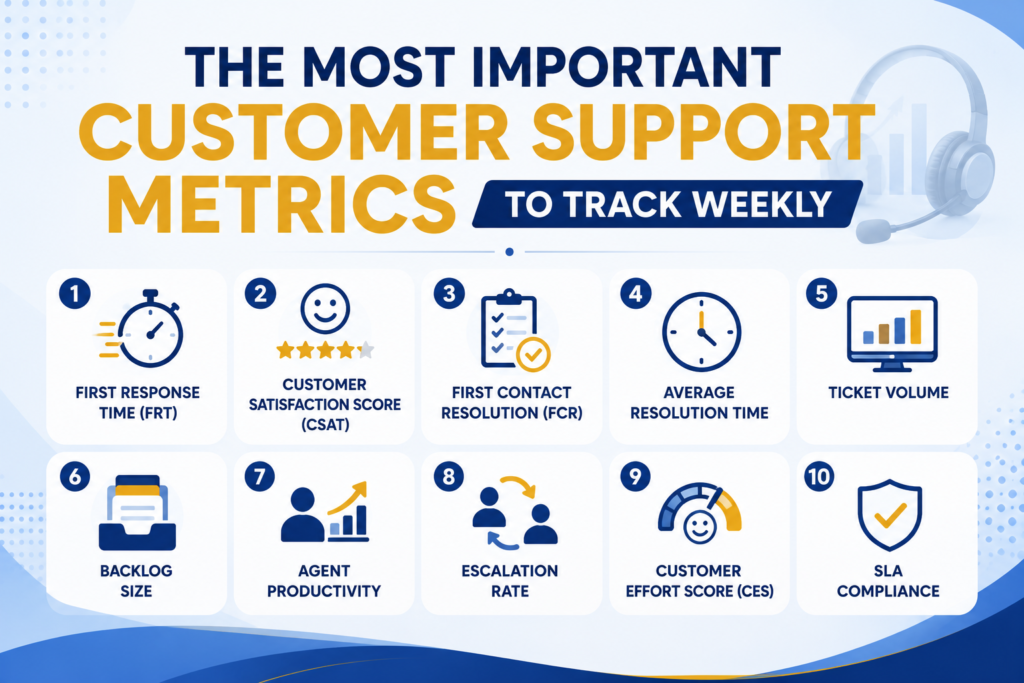
Not every metric deserves equal attention.
The following KPIs provide the clearest picture of support performance and customer experience.
1. First Response Time (FRT)
First Response Time (FRT) measures how long customers wait before receiving the first reply after submitting a support request.
It is one of the most closely watched customer support metrics because speed strongly influences customer perception.
Why FRT Matters
Customers appreciate immediate acknowledgment, even if their issue requires additional investigation.
A fast first response:
- Builds trust
- Reduces customer frustration
- Improves satisfaction
- Prevents duplicate tickets
Example
| Support Channel | Recommended Weekly Target |
| Live Chat | Under 1 minute |
| Under 2 hours | |
| Social Media | Under 1 hour |
| Phone | Under 60 seconds |
Consistently monitoring FRT helps support managers identify staffing gaps and workload imbalances before service levels decline.
2. Customer Satisfaction Score (CSAT)
CSAT measures how satisfied customers are after interacting with your support team.
Typically collected through a short post-support survey, CSAT provides direct feedback on the customer experience.
Example question:
“How satisfied were you with the support you received?”
Why CSAT Matters
A strong CSAT score often indicates:
- Helpful agents
- Accurate resolutions
- Positive customer interactions
- Efficient service
Weekly monitoring allows leaders to identify trends before customer satisfaction begins to fall.
3. First Contact Resolution (FCR)
First Contact Resolution measures the percentage of issues resolved during the customer’s first interaction.
Higher FCR usually indicates:
- Well-trained agents
- Effective knowledge bases
- Better internal documentation
- Faster customer outcomes
Customers generally prefer resolving issues immediately rather than engaging in multiple follow-ups.
Improving FCR often reduces overall support costs while increasing satisfaction.
4. Average Resolution Time
While FRT measures initial responsiveness, Average Resolution Time tracks how long it takes to completely solve a customer’s issue.
Long resolution times may indicate:
- Escalation delays
- Complex workflows
- Knowledge gaps
- Internal communication issues
Weekly reviews help identify recurring bottlenecks affecting productivity.
5. Ticket Volume
Monitoring ticket volume provides valuable operational insight.
Track:
- Total weekly tickets
- Tickets by channel
- Tickets by product
- Tickets by issue type
- Peak support periods
Understanding ticket trends helps businesses forecast staffing requirements and identify product or service issues generating unnecessary support requests.
6. Backlog Size
Backlog represents unresolved customer requests waiting for attention.
Growing backlogs often signal:
- Understaffing
- Unexpected demand
- Process inefficiencies
- Long resolution times
Rather than waiting until customers complain, weekly backlog monitoring enables proactive resource planning.
7. Agent Productivity
Support leaders should also evaluate team efficiency.
Common productivity metrics include:
- Tickets handled per agent
- Average handling time
- Active conversations
- Resolution rate
- Utilization
Productivity metrics should always be balanced with quality indicators like CSAT and FCR to avoid encouraging rushed interactions.
8. Escalation Rate
Escalation Rate measures how often frontline agents transfer issues to senior specialists.
A high escalation rate may indicate:
- Insufficient training
- Missing documentation
- Product complexity
- Limited decision-making authority
Weekly tracking helps managers identify coaching opportunities.
9. Customer Effort Score (CES)
Customer Effort Score measures how easy it was for customers to resolve their issue.
Customers who experience low effort often become more loyal than those who receive overly complex support.
Reducing customer effort frequently improves both retention and satisfaction.
10. SLA Compliance
If your business operates under Service Level Agreements (SLAs), weekly compliance reporting is essential.
Track:
- Response SLA achievement
- Resolution SLA achievement
- Missed deadlines
- High-priority ticket performance
Consistent SLA performance strengthens customer confidence and protects contractual commitments.
Sample Weekly Support Dashboard
An effective support dashboard should provide an at-a-glance view of operational health.
| KPI | Weekly Goal | Business Impact |
| First Response Time | Under target | Faster customer engagement |
| CSAT | 90%+ | Higher customer satisfaction |
| First Contact Resolution | 75%+ | Fewer repeat contacts |
| Resolution Time | Continuous improvement | Faster issue resolution |
| Ticket Backlog | Stable or decreasing | Better workload management |
| SLA Compliance | 95%+ | Consistent service delivery |
| Escalation Rate | Low | Better frontline capability |
Rather than overwhelming managers with dozens of reports, focus on the metrics that directly influence customer experience and operational efficiency.
How Weekly Metrics Drive Better Decisions
Support metrics are valuable only when they lead to action.
For example:
If FRT increases each week:
- Review staffing schedules.
- Adjust shift coverage.
- Introduce chatbot triage.
- Prioritize incoming requests.
If CSAT declines:
- Analyze customer comments.
- Review quality assurance recordings.
- Update training materials.
- Identify recurring customer pain points.
Weekly reviews allow leaders to solve problems while they are still manageable.
How Outsourced Customer Support Teams Improve CX KPIs
Many growing SaaS and eCommerce companies partner with outsourced support providers to strengthen operational performance.
An experienced outsourced team can help improve customer support metrics by providing:
Extended Coverage
24/7 or multi-time-zone support reduces response delays and improves FRT.
Flexible Staffing
Additional agents can quickly handle seasonal demand without lengthy hiring processes.
Standardized Processes
Well-documented workflows improve consistency and increase First Contact Resolution.
Specialized Training
Experienced agents are equipped to resolve issues efficiently while maintaining high customer satisfaction.
Performance Reporting
Professional outsourcing partners often provide detailed support dashboards with actionable insights into key CX KPIs.
Rather than replacing internal teams, outsourced support often complements existing operations, allowing businesses to scale service quality without sacrificing consistency
Common Mistakes When Tracking Support Metrics
Even experienced organizations sometimes focus on the wrong indicators.
Avoid these common mistakes:
Measuring Speed Alone
Fast responses are valuable, but speed should never come at the expense of solution quality.
Balance FRT with CSAT and FCR.
Ignoring Trends
One week’s performance rarely tells the full story.
Compare weekly results over time to identify meaningful patterns.
Tracking Too Many Metrics
A dashboard overloaded with dozens of KPIs becomes difficult to interpret.
Focus on metrics that directly influence customer experience and business outcomes.
Failing to Share Results
Support metrics shouldn’t remain within management reports.
Sharing weekly performance encourages accountability and motivates continuous improvement across the team.
How IDEAIFY Solutions Helps Businesses Improve Customer Support Performance
At IDEAIFY Solutions, we understand that exceptional customer support requires more than answering tickets. It requires measurable processes, skilled teams, and consistent performance monitoring.
By providing trained support professionals, scalable staffing solutions, documented workflows, and performance-driven reporting, we help SaaS companies, eCommerce brands, and growing businesses improve critical customer support metrics while delivering a better customer experience.
Our focus is not simply handling more conversations but helping organizations build efficient support operations that scale alongside business growth.
Frequently Asked Questions
1. What are customer support metrics?
Customer support metrics are measurable indicators used to evaluate service quality, operational efficiency, and customer experience. Common examples include First Response Time (FRT), Customer Satisfaction Score (CSAT), and First Contact Resolution (FCR).
2. Why should support metrics be reviewed weekly?
Weekly reviews help identify performance issues early, enabling faster improvements before they negatively impact customer satisfaction or retention.
3. What is the difference between FRT and Resolution Time?
FRT measures how quickly a customer receives the initial response, while Resolution Time measures how long it takes to fully resolve the issue.
4. Which customer support KPI is most important?
There isn’t a single universal KPI. Most organizations prioritize a combination of FRT, CSAT, FCR, Resolution Time, and SLA Compliance to gain a complete view of support performance.
5. How does CSAT improve customer retention?
Satisfied customers are more likely to remain loyal, renew subscriptions, make repeat purchases, and recommend your business to others.
6. How can outsourced support improve customer support metrics?
Outsourced teams provide additional staffing, faster response coverage, standardized processes, and experienced agents that help improve service quality, efficiency, and key CX KPIs.
7. What should a weekly support dashboard include?
A practical support dashboard should track FRT, CSAT, FCR, Resolution Time, Ticket Volume, Backlog Size, SLA Compliance, and Escalation Rate to provide a complete picture of operational performance.
Conclusion
Outstanding customer support is built on consistent measurement and continuous improvement. By tracking essential customer support metrics every week, businesses gain the visibility needed to improve service quality, resolve issues faster, and strengthen customer relationships.
Focusing on core CX KPIs such as FRT and CSAT, alongside First Contact Resolution, ticket backlog, SLA compliance, and agent productivity, allows support leaders to make informed decisions that drive meaningful business outcomes.
For SaaS companies and eCommerce brands, combining disciplined performance tracking with scalable support operations, including experienced outsourced teams when appropriate, creates a strong foundation for sustainable growth. A well-designed support dashboard is more than a reporting tool; it’s a roadmap for delivering exceptional customer experiences week after week.