Managing a business today is like juggling fire sticks while riding a unicycle, there is so much to monitor!
Many people are over-whelmed with marketing tasks and ask how well-known businesses generate leads while still sending individual emails the “old-fashioned” way. Their secret weapon? Digital marketing automation.
Businesses work smarter, not harder, and make more money using this innovative method. Marketing automation software does the leg work for you and automates repetitive tasks. It is just like having an incredibly intelligent, never exhausted, never makes mistakes, assistant to execute your marketing campaigns.
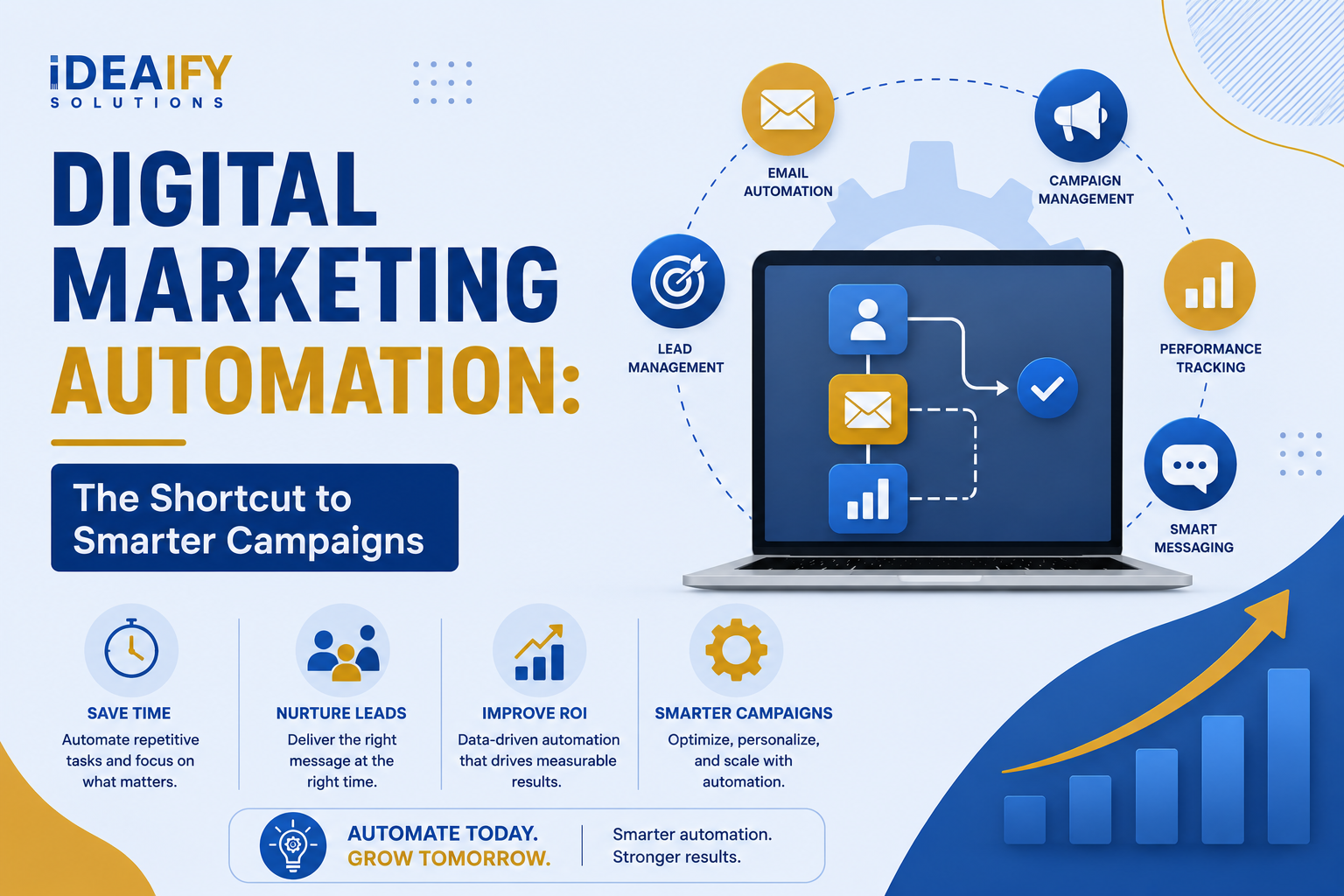
Marketing automation includes email marketing automation, social media scheduling, customer relationship management (CRM), AI-based automation, smart advertisement optimization, and predictive analytics. These systems work in the background to create personalized customer experiences while you focus on strategy and growth.
Digital marketing automation is not just another tool, but rather; it is a strategic advantage that allows growing businesses and agencies to simplify operations, improve engagement while retaining that all-important human element.
Successful marketing automation is more than simply having access to the right tools. It’s about learning how to use those tools to build meaningful connections with people.
Ideaify Solutions is the outsourcing expert that cuts through the complexity of implementing and managing marketing automation in SMEs and agencies, while ensuring integration, improved productivity, and smarter outcomes, all without adding to your internal effort.
At Ideaify, we believe that automation is not about replacing human creativity. Rather, automation unlocks human creativity. Brands can use smart tools, like Hubspot, email workflows, and data points to automate repetitive tasks, while still allowing brands to be personable and cultivate a deeper connection with people.
This article will dive into the tactics of marketing automation that can help businesses work smarter, save time, and design production campaigns that will really connect with mission-driven audiences.
Understanding Marketing Automation
Marketing Automation is one of the newest innovations in the world of marketing and the first time that marketing and technology have become integrated. It is a digital marketing service that helps you measure, optimize, and accomplish all your marketing tasks.
We could also define this as the best integration between all of your windows programs and digital channels such as your website, social media, email accounts, and CRM systems. It causes all of them to act like one channel, analyzing and reporting without mistakes.
Marketing platforms, such as HubSpot, ActiveCampaign, and Mailchimp excel at providing marketers advanced workflows based on user behavior. The real benefits are found in trigger-based automation (functions that happen automatically based on user behavior).
For example, once a user downloads an eBook, they’ll automatically be added to a sequence of follow-up emails that nurture them towards a conversion.
Why Digital Marketing Automation Matters for SMEs and Agencies
Small and medium-sized businesses and digital agencies have various constraints regarding digital marketing, including limited resources, time limitations, and their ongoing efforts to remain competitive.
Marketing automation levels the playing field for small and medium-sized businesses and digital agencies, allowing them to work at the capacity of enterprise-level teams. These tools promote efficiency and productivity as they automate repetitive tasks, such as email workflows, social posts, and lead nurturing, allowing small businesses to concentrate on strategic initiatives.
Digital marketing for small businesses consists of website optimization, high-value content creation, social media utilization, email marketing, and search engine marketing (SEM) that can provide a small business with a voice and online space to define their brand, reach target audiences, and convert followers or readers into customers, all while maintaining a budget.
Once tasks are automated, agencies can devote more attention to strategy and creativity rather than execution.
Email Marketing: The Heart of Marketing Automation
Email marketing automation is a method that uses software to create, send, and manage automatic campaigns. At its core, email marketing automation is all about sending the right message to the right person at the right time, and not always having to manage it in real time.
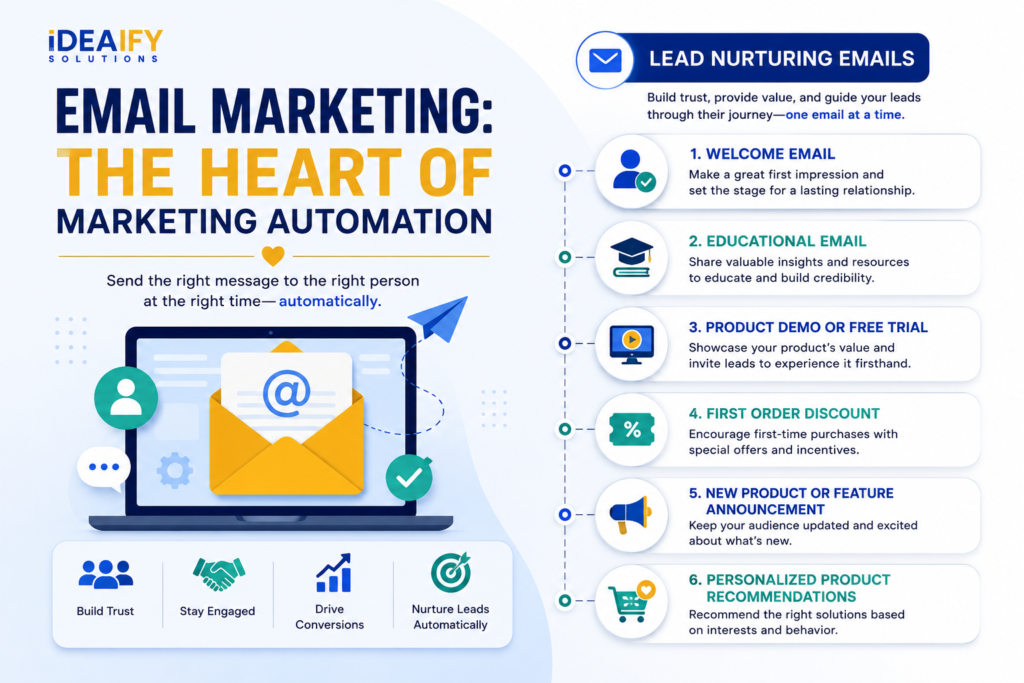
1. Lead Nurturing Email
Lead nurturing emails are messages that are automated and created to build trust and stay engaged with potential customers, even though they have not engaged yet with your brand for a while.
So, this email marketing is all about not asking for a sale immediately. It is about creating value, resolving objections, and helping you to explore your buyer journey on your own time.
Now, do keep in mind, when you send a nurture email, you aren’t asking for a sale, you are keeping a conversation going. So, think of it a little like a chat and not like a place to sell something.
Email lead nurturing is about building trust slowly, by being consistent and respectful. As a result, your brand will be at the top of mind when your customers need something.
Here are some of the best lead nurturing email examples:
- Welcome Lead Nurturing Email Example
- Educational Lead Nurturing Email Templates
- Product Demo or Free Trial Invite: Email Nurture Campaign
- First Order Discount: Email Example for Lead Nurturing
- New Product or Feature Announcement
- Personalized Product Recommendations
How to Create a Lead Nurturing Workflow?
Stick to a clear process to ensure your lead nurturing workflow is organized and results-oriented. Here’s an overview of the steps to take:
Establish Your Objectives: Be clear about what you want to accomplish with your lead nurturing process, whether that’s improving conversion rates or shortening the sales cycle.
Identify Your Audience: Know your leads’ names, pain points, and their position in the buyer’s journey.
Create Relevant Content: Generate content that pertains to what each segment and stage of your audience needs, such as blog posts, white papers, videos or case studies.
Implement Automation: Utilize marketing automation platforms to distribute content based on triggers, such as visits to your website, downloading content, and opening emails, based on each lead’s behaviors.
Review and Optimize: Routinely review the performance of your workflows. Things to consider as you review include open rates, click-through significance, and conversion rates to inform you on how and where to improve.
Each phase builds trust while keeping subscribers engaged.
2. Re-Engagement Campaigns
Do you have inactive subscribers? Not to worry. A re-engagement (or re-activation) email is simply an email that is sent to subscribers who have not opened, clicked, or interacted with your emails in some time. It’s a way for your brand to give them a poke and say, “Hey, want to see more?”
It’s a great way to get them interested again, open up a repair to trust, and remind them what made them subscribe to email from your brand to begin with. It’s part repairing a relationship, part second chance to actively engage – and it often works best when it feels more like a conversation as opposed to a campaign.
3. Post-Purchase Follow-Ups
Retention matters just as much if not more than acquisition. A post-purchase follow up email is any email a company has sent to customers after they have purchased a product or a service. These emails typically contain important information about the purchase and may contain promotional or educational content that helps with retention or encourage the next opportunity to purchase.
For example, both order confirmation and shipping confirmation are the transactional post-purchase emails. You can easily add a thank you email or a review request email as part of your post-purchase email automation.
HubSpot Tips for Smarter Automation
HubSpot’s marketing automation capabilities are here to make your work more effective and efficient. By automating time-consuming tasks and integrating your marketing templates into automations, SMEs and agencies can be freed up to focus on higher-impact strategies that matter. Here are six HubSpot Tips that will save you time while helping you get the most Return on Investment.
1. Automatically Segment and Score Leads with Precision
Stop wasting time trying to manually get your leads sorted! With HubSpot automations, you can configure workflows that will automatically segment leads based on their behaviors, demographics, or pain points. You can even add to this for a more comprehensive approach to lead scoring based on AI, so that your sales team knows exactly which leads to pursue.
How to create this:
- Define your lead scoring considerations, such as page views, downloads, or submissions.
- Automatically update the CRM lists by criteria and scores.
- Notify the sales rep when a lead meets significant criteria.
2. Streamline Email Campaigns With AI-Powered Workflows
Automated workflows powered by AI in HubSpot are changing the way you can automate email, and elevating your marketing and sales processes to a new level. Here is an example of an AI-driven HubSpot email automation workflow in action:
Trigger: A contact downloads an eBook.
Step 1: Immediately send an automated follow-up email to acknowledge the download, and include additional free and valuable content to nurture their interest.
Step 2: Let AI analyze their actions, including clicks, or views of the content. Based on their engagement, AI sends customized recommendations for services two days later, based on their specific needs.
Step 3: If AI predicts a high likelihood of booking a consultation, it will notify your sales team to follow up and eventually book the lead in a timely manner.
It’s smarter, faster, and makes users/clients stick.
3. Align Marketing and Sales Workflows
HubSpot also provides an easy way to identify each lead and pass it on to either the sales team, or marketing team, when appropriate. You’ll define the criteria that will identify a marketing-qualified lead (MQL) or a sales-qualified lead (SQL) within HubSpot, whether it is a content offer downloaded, an appointment booked, or a response to an automated workflow.
After that, it will be simple to move MQLs and SQLs up and down the buyer’s journey based on the criteria you defined in order for them to become either MQLs or SQLs.
4. Automate Reporting
HubSpot’s dashboards can automatically produce performance reports, saving you hours of manual tracking. This automated reporting in HubSpot transforms raw activity into actionable decisions and revenue. The system is only effective when the data is clean, metrics are tied to outcomes, dashboards are designed around questions, and AI help convey insights more quickly
5. Don’t Forget Personalization Tokens
The HubSpot marketing automation solution brings together email workflows, SMS, social media, and more in one seamless interface. By having all your channels in one place, you can engage with leads wherever they are, with the right message, at the right time. Personalize every interaction based on where leads are in their buyer’s journey and build trust with your audience in order to increase conversion.
Balancing Automation and Personalization
A significant challenge that agencies or SMEs can face with a marketing automation system is the ability to ensure it does not seem robotic or detached.
Common examples of an all-automation process without humanization may include, using cold and robotic messaging that does not seem personal. Or overused first-name personalization that does not feel genuine.It can also include irrelevant offers or emails that do not pertain to their preferences, or automated responses where the person reaches out for support and does not feel like they are talking to a human.
By humanizing, being empathetic, and engaging with them in real-time, the business and customer can form meaningful connections, and a business has all the efficiencies of automation options.
For example, “Jimmy, check out our new collection” feels a little bland and impersonal.
instead, you could say, “Jimmy, your favorite running gear is back!” or
“Are you still interested in [product name]? We have something special for you.”
It is grabbing their attention based on something they care about.
Automating Multi-Channel Campaigns
Marketing automation now incorporates not just email, but marketing messaging to ALL customer engagement channels. Multichannel marketing automation incorporates this practice through software to manage campaigns via email, across social media platforms, SMS or anything web related. By leveraging customer data and insights, a marketing team can deliver personalized, timely, and relevant marketing messaging to its target audience and marketing effort at scale.
It ensures whether a customer engages via LinkedIn, visits a website, or receives an email, they feel it is all the same singular pursuit. The process of multichannel marketing automation comes down to when the marketing teams gather customer data; organize that data to create targeted segments and establish automated campaigns triggered by certain behaviors or preferences and then deliver further messaging via all engagement channels based on the targeting.
Leading platforms to execute effective multi-channel marketing includes Martal AI Sales Platform for lead generation; Hubspot a Full marketing suite: email, SEO, ads, blogs, landing pages; Adobe Marketo Engage, Sophisticated lead scoring and AI personalization; Salesforce; which is a very strong marketing platform to align closely the marketing and sales teams together.
The Power of Analytics in Automation
Data serves as the driver of smart marketing automation. Each click, open, and purchase uncovered valuable insights that with the help of analytics marketers could:
- Track the customer journey from start to finish
- Identify workflows that performed better than others
- Optimize the timing and frequency of campaigns
- Anticipate what consumers might do next, thanks to machine learning
With analytics dashboards in HubSpot, teams can visualize trends and adjust strategies on the spot, leading to smarter decisions and more successful campaigns.
Common Mistakes to Avoid in Marketing Automation
The best tool in the world can still fail if used improperly. Here are few mistakes to avoid:
Mistake 1: You’re not personalising
When someone calls your name, it gives an immediate sense of recognition. It is no surprise that a person’s emotional bond with their name is so strong. The digital world has the same dynamic. This is why you should personalize your emails.
Mistake 2: You don’t have a clear (inbound) strategy
Without a well-defined inbound strategy that tightly weaves with your content marketing and social media plan, marketing automation is simply another “gadget” that provides no additional value. Hence, you must start by defining your inbound strategy.
Mistake 3: You’re working without clearly defined goals
Are your marketing automation efforts paying off? It all depends on the goals that you set. If you have not defined goals, now is the time to establish them and group your KPIs by phases that your customers experience: Awareness, Lead Generation, Conversion and Engagement. This will focus your campaign and make it frictionless to link to your goals.
Mistake 4: You use marketing automation as an email tool
A solid automation tool can allow you to manage leads, social media, blogs, landing pages, and more. Don’t simply think of it as an email workflow tool.
Mistake 5: You want to close the sale quickly
No one likes being sold to, especially not the first time you meet them. Remember this as you develop your inbound strategy and use marketing automation. Don’t sell your services right away. Before that, you must gain trust from your potential customers.
The rule of thumb? Automate wisely. Think of automation as a continually evolving strategy rather than a one-time decision.
Future Trends in Marketing Automation
In a few years ahead, marketers will also begin utilizing more advanced machine learning algorithms, as well as natural language processing, to continue improving their marketing automation software. SMEs and agencies will need to be using increasingly advanced marketing automation tools, which will analyze consumer behavior with further precision, driving campaigns that are even more targeted, personalized, and impactful, than they are today.
Let’s dive into a few of the trends that are poised to reshape the marketing automation landscape.
- Deeper integration of AI and machine learning
- Hyper-personalization to enhance customer experiences
- Data-driven forecasting and decision-making
- The dawn of true omnichannel marketing
- Smarter, more sophisticated chatbots
The future will not just be automated, it will also be adaptive.
In a digital-first world, marketing automation is no longer a “good to have,” but a requirement.
Ideaify Solutions is here to enable businesses to work smarter, not harder with more smart automation options. As the leading outsource vendor for digital marketing automation working on behalf of organizations, Ideaify is proficient at implementing the right tools, creating relevant workflows, and managing the campaigns that really matter to businesses, internally.
Ideaify is dedicated to assisting SMEs and agencies transition from hard work to smart work. When HubSpot, email workflows and the human-first approach work synergistically, they create campaigns that foster deep customer connections and convert.
Automation is not about eliminating people from marketing, it’s about liberating people to focus their time on doing the things that matter most: creativity, strategy and connection.
When you partner with Ideaify, you are taking automation to the level of artform – as the creative and intelligence converge to make memorable brand customer experiences.