Artificial intelligence is far from the future experiment that businesses have been dabbling with in small pilots. There has been much written about AI agent trends in 2025, and in 2026 we will start seeing them come to life in the big way.
Agents represent the next generational step forward for AI since the generative AI revolution in the last two years. Instead of simply answering questions, chatting, or generating content (think ChatGPT, for example), they will take actions like automations.
This means performing complex multi-step actions, interacting with third-party systems, and working toward long-term outcomes while minimizing human touchpoints.
At IDEAIFY, we’ve seen what that transformation looks like firsthand on how fast that transformation is accelerating. With 15+ years in outsourcing and IT experience and a team of 50+ certified experts, we help brands, global SaaS companies, and startups move towards AI-enabled operations. And through our experiences, we realize one thing: that 2026 will be a tipping point.
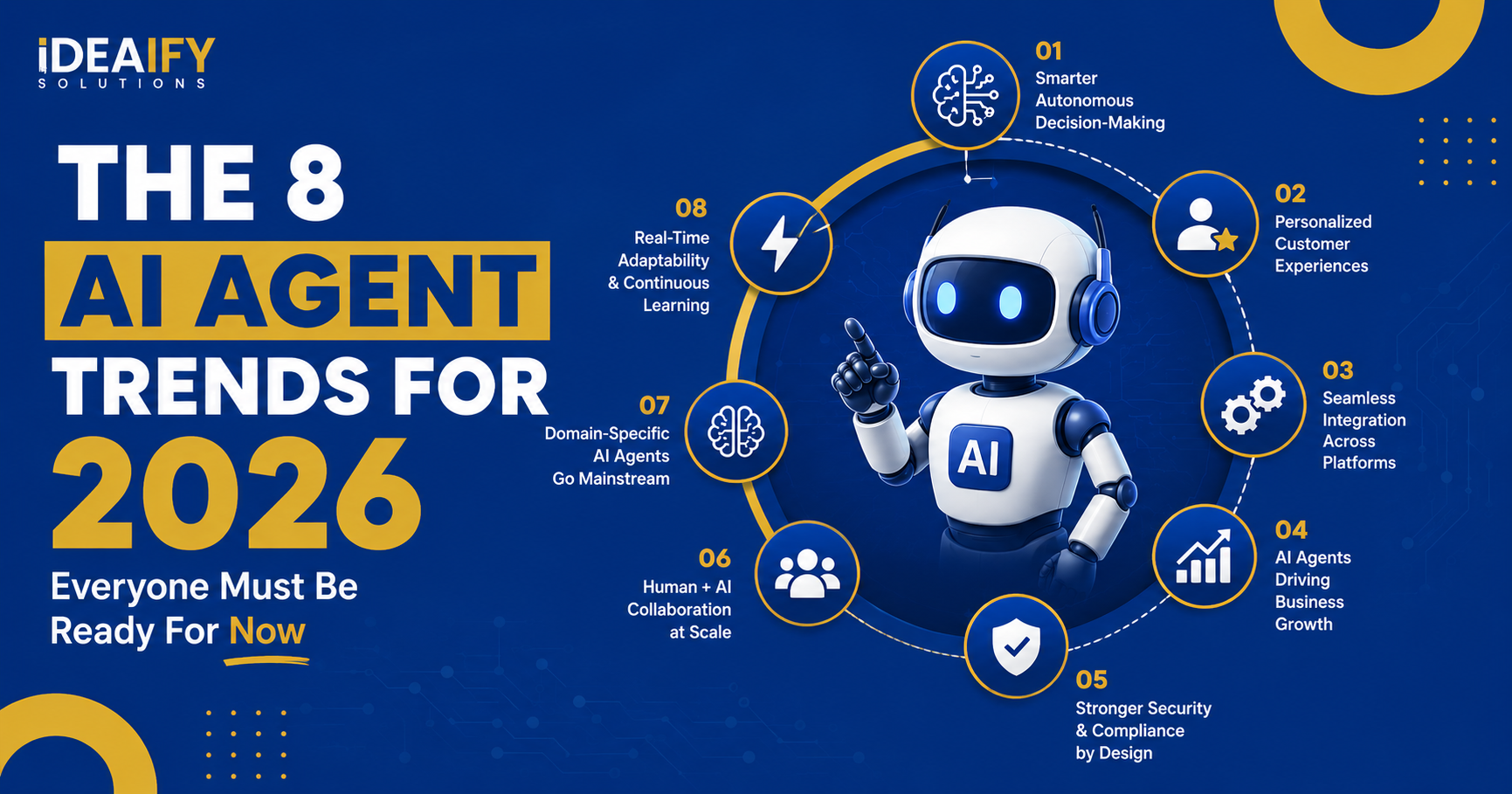
In this article, we’re going to shed some light on eight trends that data-driven companies should be prepared for now.
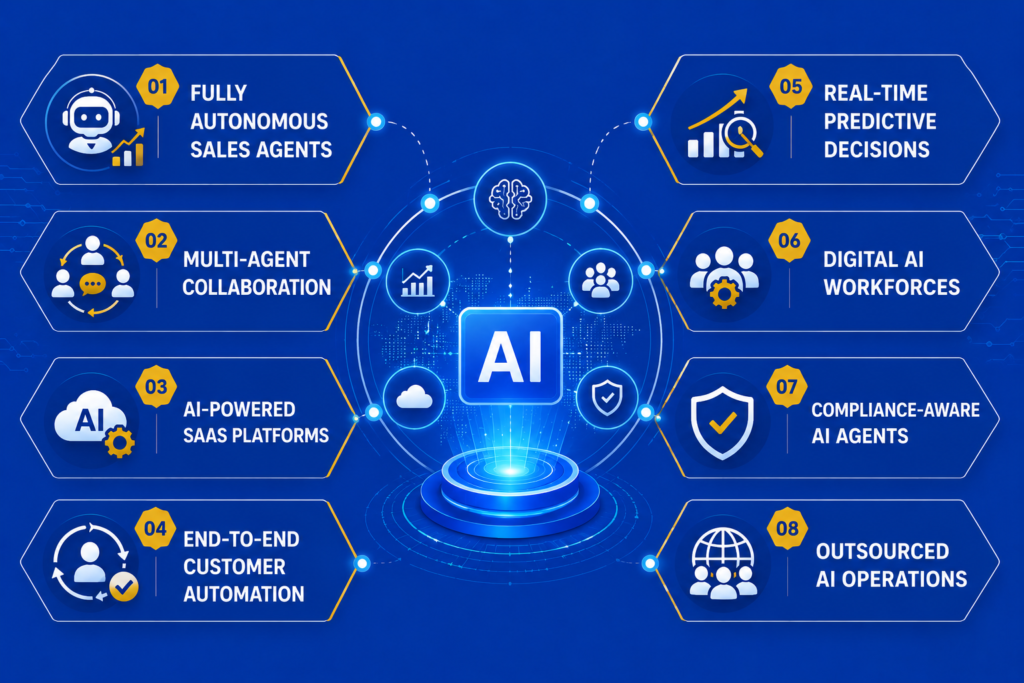
1. Fully Autonomous Sales Agents Become Mainstream
The future of AI in sales is far from what people have imagined. By 2026, AI will impact every facet of sales, and that will make sales more efficient and effective than it has ever been done before.
The AI agents will assist in that transformation in ways that aren’t just about sales automation, but about enhancing the sales experience every step of the way, from real-time coaching and predictive analytics to personalized content and advanced forecasting.
AI will play a role in seamlessly embedding itself into day-to-day tasks and turning habitual behaviours into qualitative opportunities. These agents will automatically:
- Conduct prospect research
- Personalise outreach
- Qualify leads
- Update CRM information
- Trigger follow-ups
- Book meetings
Rather than just being a tool, AI will function like a digital sales co-worker. Companies that adopt AI agents or AI-powered sales teams will see a dramatic drop in acquisition costs and a significant increase in pipeline creation. AI will change the face of sales, not just in the way sales are conducted, but what it means to be in sales by linking human intuition with machine intelligence to create a new synergy.
2. Multi-Agent Collaboration Across Departments
AI agents of the future are not just working independently. They are working together, a multi-agent system is a collection of intelligent agents that can perceive, reason, communicate, and act in a networked ecosystem. Assigning an agent to a specific task, they can talk to each other, relay information, and work together to more quickly and effectively handle issues.
This matters because people today do not want to be sold, they want to buy on their terms. Before they even engage with your rep, they have gone on Google and searched your product, read the reviews, and compared your competitors.
AI powered sales teams operate at that same pace by surfacing insights at the right moment, like which leads to actually follow up on, or which communications yield the most enticing messaging.
Moreover, on average, sellers only spend 28% of their weeks selling. The rest is spent on administrative work such as managing deals and data entry. Next-gen AI agents can take careof the administrative work, logging calls, summarizing meetings, writing follow up emails, and entering data into their sales CRM. Reps can concentrate on real conversations, not administer data for CRM updates.
3. SaaS Platforms Come Preloaded With AI Agents
By 2026, most leading SaaS tools, CRM, HRM, analytics, project management, CX platforms, will come with:
- Embedded workflow agents
- Autonomous reporting capabilities
- Predictive decision-making tools
- Task execution bots built in
Instead of logging into software to get work done, companies will simply assign jobs to AI agents inside these platforms. This shift reduces manual workload and removes the friction that slows down digital teams today.
4. End-to-End Customer Journey Automation
AI agents are becoming sophisticated enough to manage entire customer journeys. From first touch to contract renewal, AI will assist or fully automate:
- Lead nurturing
- Sales qualification
- Onboarding
- Support ticket resolution
- Upselling
- Churn prevention
This trend transforms customer experience from reactive to predictive and personalized. For outsourcing partners like IDEAIFY, this means helping businesses build AI-first customer operations that are proactive, consistent, and scalable.
5. Predictive Decision-Making Becomes Real-Time
2026 will also mark the rise of predictive agents that don’t just analyze data — they act on it. For example:
- A supply chain agent automatically reroutes shipments based on delays
- A sales agent boosts ad spend the moment funnel conversion dips
- A customer success agent detects risk early and triggers an intervention
These agents will continuously process analytics, identify opportunities or threats, and initiate actions. This is the next evolution of analytics: data that instantly drives decisions.
6. Digital AI Workforces Become a Competitive Advantage
Companies are beginning to hire “digital workers” alongside human employees. By 2026, digital teams made up of AI agents will handle:
- Lead generation
- Reporting
- Data cleansing
- Content production
- Task scheduling
- Ticket triage
- Compliance checks
Instead of replacing humans, these agents function as force multipliers, completing repetitive tasks so human teams can focus on strategy, creativity, and relationships.
Businesses that learn to integrate digital and human workers will unlock major competitive advantages in cost, speed, and scale.
7. Compliance-Aware Agents Take Center Stage
As regulations around AI tighten worldwide, companies must adopt AI tools that can:
- Self-audit
- Explain decisions
- Track data lineage
- Maintain compliance logs automatically
These compliance-aware agents will help businesses avoid the legal and operational risks associated with AI expansion.
For sectors like finance, healthcare, or enterprise SaaS, compliance-aware agents will be the bridge between innovation and governance in 2026.
8. Outsourced AI Agent Operations Become the New Normal
Not every business can build and manage AI agent systems internally. That’s why outsourcing partners with deep technical and operational experience will become essential.
At IDEAIFY, we see growing demand for:
- AI agent deployment
- Workflow automation
- Managed digital teams
- Custom AI integration
- Model fine-tuning
- AI-led marketing, CX, development, and analytics
Instead of hiring large in-house teams, companies partner with specialized agencies to build and maintain their AI ecosystems, reducing cost, speeding up adoption, and ensuring expert implementation.
This trend will define how mid-market and enterprise businesses scale AI without overwhelming internal teams.
How Companies Should Prepare Today
To take advantage of these trends, data-driven organizations must begin preparing now. Key steps include:
- Ensuring data cleanliness and accessibility
- Automating fragmented workflows
- Training teams to work with AI
- Upgrading security and compliance frameworks
- Partnering with expert agencies
The companies that take action early will be the ones leading their industries by 2026.
Conclusion
AI agents are reshaping how modern businesses operate. In 2026, they won’t be optional add-ons, they’ll be core operational engines driving sales, marketing, support, finance, and product development. For data-driven companies, embracing these trends early is the difference between leading the market and falling behind it.
With IDEAIFY’s 15+ years of outsourcing and IT expertise, and our team of 50+ certified specialists, we help companies adopt, integrate, and scale AI agent operations with confidence.
The future belongs to businesses ready to work side-by-side with intelligent digital teams.
2026 is closer than you think, now is the time to prepare.