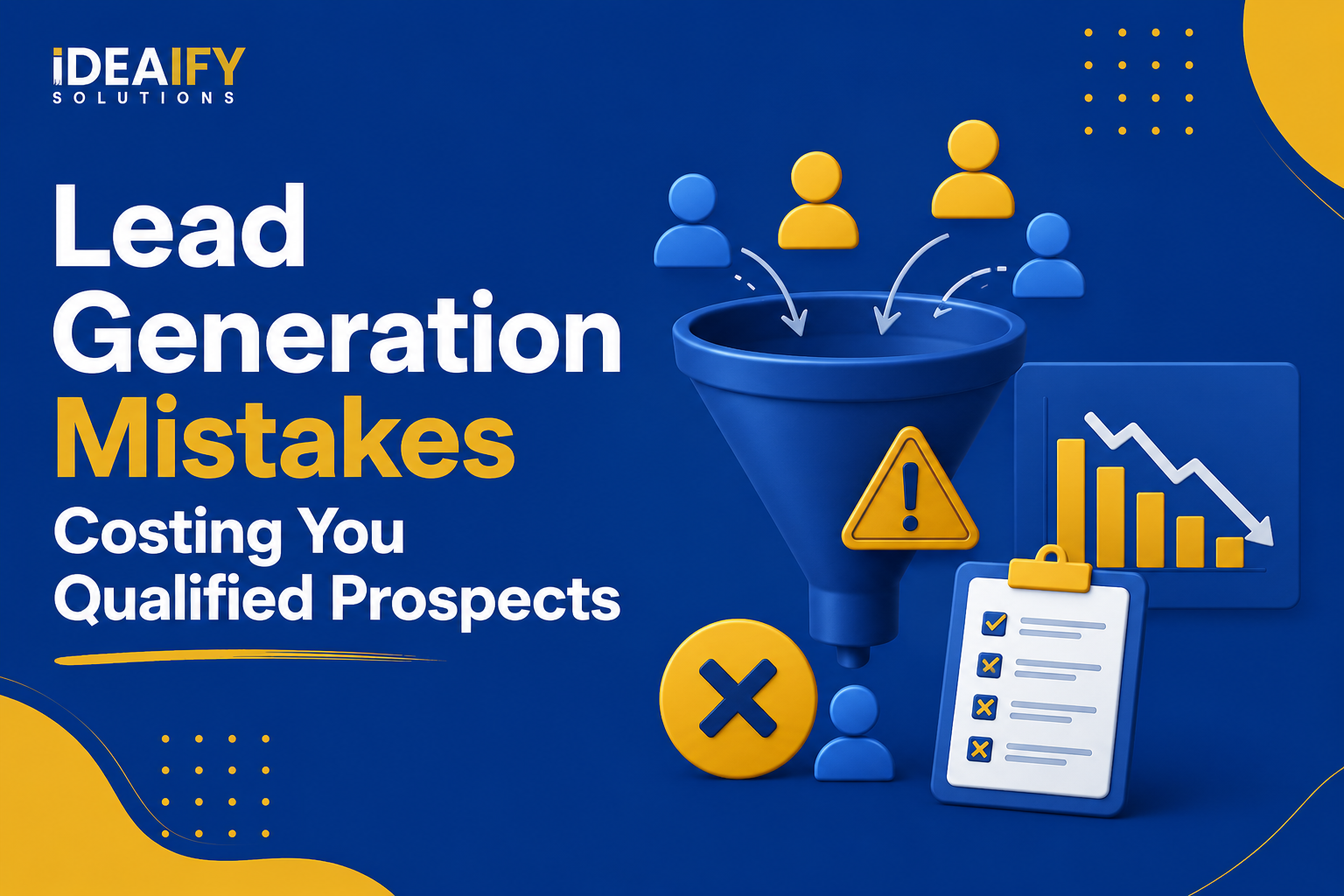
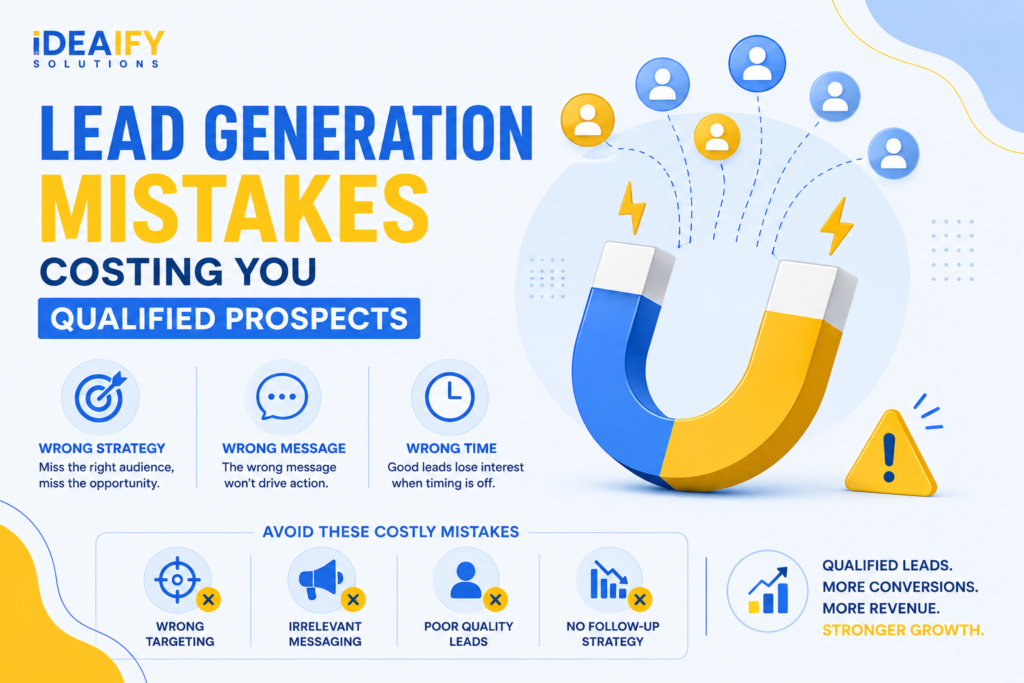
Lead generation strategy can make or break your business growth trajectory. In the competitive B2B space, generating high-quality leads is no longer just about filling your pipeline, it is about generating revenue growth and creating lasting customer relationships.
Acquiring contact information is merely one component of lead generation strategy. Ultimately, it’s about relaying the right message to the right people at the right time. The problem is that the consequences of an ineffective target strategy are more than just a few leads wasted. It thoughtfully erodes your time, money, and ultimately growth and potential success.
However, many times, organizations are unintentionally sabotaging their lead generation strategies by making fatal mistakes that cost them valuable resources and poor results. These mistakes can ultimately cost business its customers, and market share, especially in a highly competitive market.
In the competitive B2B marketing, capturing high-quality leads can make or break your business growth. Yet, many organizations do not realize that they have fallen into the common traps of lead generation mistakes that cost them conversions issues and wasted marketing budgets.
At IDEAIFY, we know the impact that small errors in your lead generation strategy can have on your campaign, even at its most favorable. In this blog article, we’ll be dissecting each of the mistakes, how the process harms your B2B sales funnel, and steps you can take in practice to fix them and start generating better ROI.
1. Targeting the Wrong Audience
An improper targeting tactic is a significant hurdle in your lead generation strategy. It’s similar to shooting arrows in the dark, you may hit something, but rarely is it what you intended.
Or think of selling a luxury watch at a flea market. Not the right crowd, right? This is what happens when businesses don’t define their target audience. If you don’t know who you’re selling to, you are going to waste your resources pursuing the wrong crowd. Adding to this, your messaging will feel generic and will resonate with no one.
When companies lack accurate targeting, their ads, content, and emails are viewed by people outside of their buying circle. This leads to poor engagement, conversion issues, and increased cost to market. Precision marketing allows B2B marketers to focus their efforts on the people that really want what the marketer offers. It makes your marketing feel more personal, increases customer satisfaction, and increases the number of customers that return.
When B2B marketers don’t utilize their customer data to better target their audience, they cannot expect to increase conversion rates, have increased traffic to their website, or build greater customer loyalty over time. The more precise the targeting, the more qualified prospects will be brought into their B2B sales funnel.
To create improved lead quality, develop buyer personas to emphasize the ideal customers. A more focused approach to targeting will help the B2B marketer attract more leads that are financially capable and will convert.
2. Ignoring the Middle of the B2B Sales Funnel
A lot of businesses concentrate on creating awareness (top of the funnel) and closing deals (bottom of the funnel) without even recognizing the middle part of the timeline. This is arguably the most important part of the sales timeline because this is where relationships are created, and leads become converts. Ignoring the middle of the B2B sales funnel only leads to poor engagement and higher drop-off rates.
Leads won’t just become converts overnight or even in a day or two. For instance, just because someone signed up for your lead magnet doesn’t mean they are ready to jump on a call.However, if you don’t have a nurturing system in place to guide your leads down your funnel strategically, you’ll just lose them to your competitors, probably.
To compete B2B Marketers will need to prepare some nurturing campaigns via email. Think of them as a bridge between the initial commitment (= signing up for your lead magnet) and making an offer when they are ready. These emails will help build trust, keep you top of mind with your leads, and show them how your products or services will help them. To maximize the effectiveness of these emails, personalize them for every segment in order to reflect that segment’s unique circumstances to avoid conversion issues.
3. Overreliance on Cold Outreach
Cold emails and calls have always been go-to tactics to initiate a conversation in any B2B lead generation strategy. But sticking exclusively to them could restrict your limit to results. Buyers today want to be engaged in a personalized way using insights to back it up. Unfortunately, automated outreach by B2B marketers is treating it like a megaphone blast instead of a means of personal communication.
The lack of personalization, which involves sending the same generic message to hundreds of prospects, will ruin process rates leading to conversion issues. Today’s buyers can tell immediately when an email is just a generic template that is blasted to every single prospect. It feels impersonal and often irrelevant. Therefore, it typically ends up being ignored or deleted.
B2B marketers would need to focus on personalization, contacting buyers that does take more effort up front, but it pays off. You will stop getting deleted and start to obtain replies. Plus, you protect your sender reputation across its sales funnel because people will be less likely to mark a thoughtful, relevant email as spam.
4. Poor Lead Qualification Process
Leads based on stale or missing data lead to poor targeting and wasted outreach. If you do not have the right company information, accurate contact information, or even visibility into how recently they interacted with your marketing, sales teams risk contacting the wrong person or missing all the early signals of a prospect being interested in buying. You need up-to-date data to accurately qualify leads with data in the B2B space.
This volume of wasted time and unknowns can be mitigated by integrating a CRM with automation features and lead qualification scoring in order to make this process efficient and across a lot of leads. Automation will help in a few ways with capturing, scoring and distributing leads, as well as capturing lead interactions, updating records/notes and scoring prospects in real time. Advanced CRMs allow for set scoring which automatically assigns the right lead score to each prospect based on calculations on the recipient’s engagement and the qualification based demographic data points. This allows a sales team to prioritize the lead most likely to close. Resulting in them wasting only a little time on pursuing leads that don’t convert to buying customers. Scoring leads consistently also improves efficiency and win rates overall.
5. Weak Follow-Up Strategy
Most leads do not turn into a sale without being nurtured. And nothing is more frustrating than losing a lead you have worked so hard to generate. In fact often, it isn’t a case of the lead being disinterested or unready to buy, but a lack of follow up or worse, no follow up at all leads to conversion issues.
For example, you are at a conference, and you meet a vendor you are excited about. You swap contact information and are so excited to talk to them, only to hear nothing a week later. By now you have likely already moved on to another choice or forgotten even why you were interested to begin with.
That’s why speed particularly matters in the prospect of lead generation strategy. In fact if you can’t follow up that quickly, make sure you at least do something within the first hour. The faster you follow up, the better impression you will make on the lead. And don’t forget, once again, that every lead is different, so make sure you at least reference their situation too. Reference their industry or reference whatever their pain points were, or the reason for their initial outreach.
It is essential that each follow-up contains some value. This could be either details on what is going to happen next, a solution to their problem, or an interesting case study. In any case, you can be certain that every follow-up is delivered with purpose.
Professionals who follow up in a timely manner can earn the trust of their prospect. Building trust can help close qualified prospects into patients during your lead generation efforts.
6. Focusing on Quantity Over Quality
One common lead generation mistake that B2B marketers tend to have is that they think more leads will invariably lead to more revenue. Without a clear approach, sales teams squander their time chasing difficult-to-convert prospects while flagging high value opportunities and allowing them to slip through the fingers leading to conversion issues.
A quality lead is relevant and motivated to buy. They are need-ready to buy, with the budget in place to meet that need, and they are actively seeking a product to fulfill that need.On the other hand, quantity leads mean generating many leads, but not all will be qualified and there is no guarantee they will convert, you’re wasting your time and money chasing leads such as these.
It is important for B2B marketers to understand the importance of utilizing both approaches at the different stages of their lead generation strategy. Early-funnel campaigns can generate awareness and uncover new opportunities, but quality will be the variable that determines whether a good lead will convert as prospects draw closer to purchase.
7. Neglecting Lead Nurturing
One of the top reasons for having trouble with conversion in B2B marketing is neglecting lead nurturing. Consider this analogy: it’s like preparing a gorgeously made ice cream sundae, with whipped cream, chocolate sauce, and sprinkles, only to leave it out in the sun to melt.
Lead nurturing is the fuel behind getting sales opportunities from your website. Email marketing campaigns, educational content, and retargeting campaigns can be effective tools to keep you at the forefront of a buyer’s mind. But it is important to have personalized touch points utilizing behavior-based automation, including offering relevant case studies, product demos, or insights to prospects based on where they are in the sales funnel.
Lead nurturing done right should be a fundamental part of every successful growth B2B marketing strategy, but it should not be complicated.
8. Weak Content Strategy
Establishing a strong content marketing tactic is essential to lead generating strategy, and can positively affect your business three times more than traditional marketing strategies, yet many businesses do not maximize the potential of the strategy.
B2B marketers often struggle to create superficial content that does not offer new insights or actionable value or sustain the audience’s engagement. Content is also considered bad content if it does not move readers toward the subsequent steps in the buyer process. Failing to address SEO optimization is to basic rules of content development, you will produce bad content.
A strategic content marketing approach is designed to convert casual visitors to your websites into qualified leads, using valuable, targeted content that addresses specific pain points you know are aligned with your B2B sales funnel stages.
Consequently, B2B marketers should engage in understanding the content and will need to address some specific questions.What problems is your audience experiencing? What solutions are you able to offer? How does your solution compare to other solutions?
As you address these questions systematically using a variety of content types, you create easier engagement with even more opportunities for lead generation.
9. Failing to Track and Optimize Conversion Metrics
Conversion rate optimization (CRO) revolves around providing your users the value they intended to get from your site, based on your knowledge of their goals, desires, and needs. If you do not measure your conversion issues, you will be unable to prevent them. Many B2B marketers do not even bother analyzing critical data like click-through rates, lead-to-sale rates, or cost per lead. Without this information, you cannot improve your lead generation strategy.
B2B marketers are able to fix this by tracking lead to customer conversion rates, pipeline velocity, and revenue attribution. You can make use of custom fields and reports to track your B2B-specific metrics. In addition, by centralizing your marketing efforts with complete tracking across email campaigns, landing pages, and lead scoring. Utilize the CRM integration for full-funnel visibility.
Focusing on the right metrics in B2B marketing fuels smarter campaigns for better ROI, aligning marketing and sales teams.
10. Lack of Sales and Marketing Alignment
The disconnect between B2B sales teams and marketing teams isn’t just a recipe for internal conflict; it can ultimately cost your business, in some capacity, revenue. It can completely disrupt your B2B sales funnel.
When your two departments operate in silos, your business is left with a lack of communication, conflicting agendas, and waste. Leads are slipping through the cracks, purchase opportunities have been missed, and marketing efforts are misaligned with the actual needs of customers.
To tackle this it is important to clearly establish shared goals and KPIs. Creating thorough buyer personas and promoting open communication and collaboration is also very necessary. B2B marketers should also need to take advantage of technology and automation, and ensure consistent messaging and branding.
Alignment improves the productivity of your lead generation strategy, and improves conversion rates.
Fixing Lead Generation Mistakes for Better ROI
Generating leads is not just about being seen, it is about delivering the right message to the right individual at the right time. As you’ve seen, even well-intended approaches can be misguided and can flop when they are based on faulty, ill informed, or poor assumptions. The first step to creating a successful and sustainable lead pipeline is to avoid these common mistakes.
Whether you are just getting started with digital marketing, or whether you are looking to scale your lead generation strategy, partnering with professionals who understand what works, and what does not, can save a considerable amount of time and budget. One of the most reliable and performance focused lead generation companies is IDEAIFY.
IDEAIFY is hyper-focused on conversion optimization, content strategy, SEO, and paid campaigns and serves to assist brands in avoiding these common pitfalls and in creating and building strong converting B2B sales funnels that actually provides results for the brands it partners with.
If you’d like to partner with a digital marketing company that thinks of your growth as their own, then it’s time to take the next step.