The B2B marketing teams are overwhelmed with more and more leads and are unable to identify which are the most valuable. With no direction, the sales teams treat each lead with the same amount of time, losing high potential prospects while wasting their own precious time with the prospects with least possible conversion.
The issue? There’s no effective process in existence to quickly identify which leads need maximum priority focus.
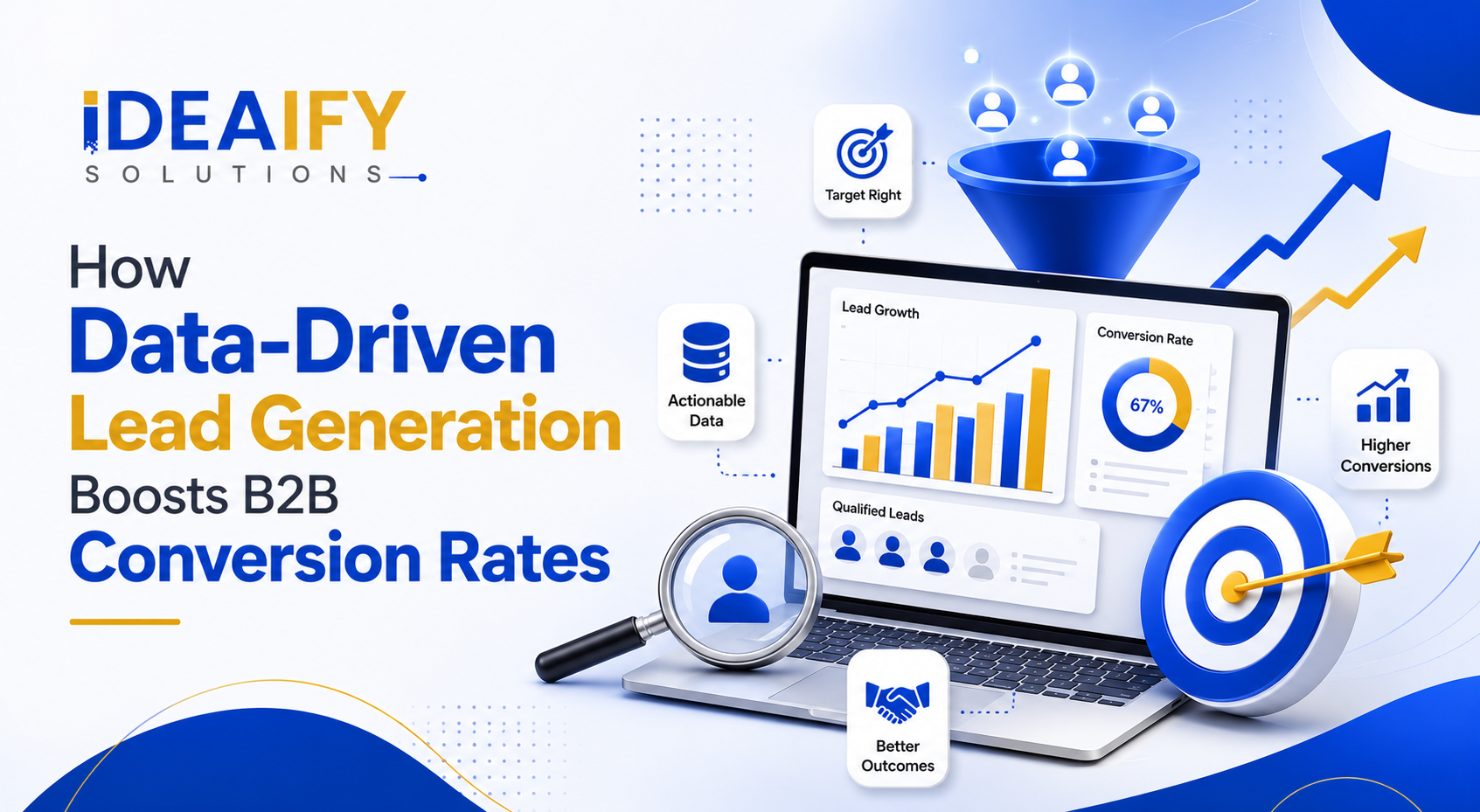
In the rapidly evolving B2B marketing world, gut instinct and guesswork are no longer acceptable. Those successful businesses are the ones that base their decisions on facts. Data-driven lead generation is no longer a catchword but it’s a strong method utilizing the application of data analytics in order to more persuasively attract, qualify, and convert leads.
In this article, we take a closer look at AI in lead scoring and we summarize the best practices for how to integrate AI in your B2B marketing plan which enhances conversion optimization.
Understanding the Power of Data in B2B Lead Generation
Lead gen information in B2B sales is the building block. It allows teams to shift from guessing and move towards targeting with precision. Instead of fishing with a large net, marketing and sales professionals can target high-fit prospects with exactitude, customize outreach, and maximize timing for the sake of engagement.
Highly efficient lead generation data sustains account-based models, facilitates quicker qualification processes, and enhances conversion optimization.
When paired with AI and automation programs, such information becomes even more powerful like running predictive models, scorecards, and highly personalized communication. Data-driven lead gen ends up enabling teams to scale without losing focus.
Lead generation in the B2B space relies heavily on data. It provides valuable insights into likely target audiences, and this allows companies to tailor strategies in response. With data analytics, companies have been able to establish key demographics, behaviors, and preferences and adopt a more refined process of lead generation.
In this respect, data can suggest which marketing channels have the greatest potential to reach potential leads, and this assists companies in leveraging their resources more affordably.
Key Benefits of Data-Driven Lead Generation
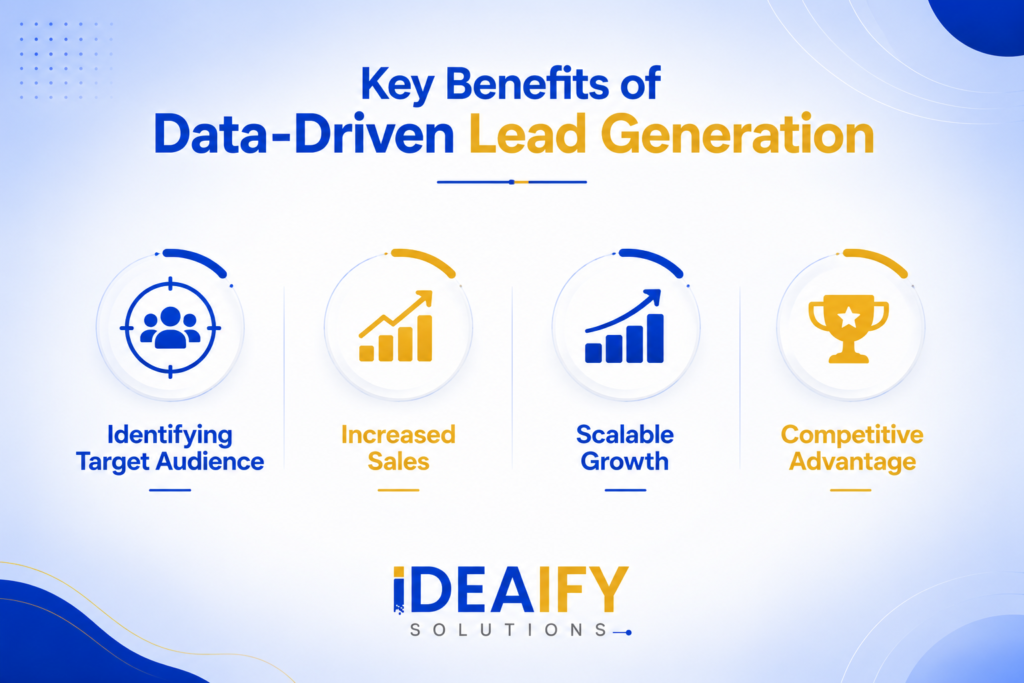
- Identifying Target Audience
Lead generation enables businesses to understand who precisely they wish to promote to and with customized messages since customization is one of the main ingredient for conversion optimization.
- Increased Sales
By creating high-quality leads, companies have more chances to transform potential customers into paying ones and thereby improve profitability and revenues.
- Scalable Growth
Lead flow on a regular basis guarantees a stable potential customer pipeline and hence stable long-term business development.
- Competitive Advantage
Efficient lead-generating strategies put companies ahead of competition since they get in touch with potential clients before others have had the chance to.
The Role of Data Analytics in Lead Generation
Just think about how it’d be to know which leads have the greatest chance of converting and becoming loyal customers? That’s the magic predictive analytics which elevates lead generation into high gear. It leads to lead scoring. A subset of data analytics, predictive analytics digs into past data to predict future outcomes. Implemented in the context of lead generation, it’s like a crystal ball that reveals which leads have the greatest chance of converting.
What’s magical about predictive analytics is that it applies sophisticated algorithms and machine learning to data. Based on patterns in historical behavior, it accurately predicts future behavior. Think of it like an ultimate weeder in distinguishing between the wheat and chaff, it separates the leads that have potential from those that have little chance of succeeding. With this kind of targeted approach, businesses end up becoming much more efficient in how they deploy their resources, devoting them to nurturing high potential leads.
Adding predictive analytics to your lead scoring process is a real game-changer. Not only will it work on conversion optimization, it will also make it possible for the business marketing and sales teams to develop more strategic and personalized strategies. In an age where businesses just want customer attention, predictive analytics becomes the edge you’ll have to get one step ahead of the competition.
Tools That Empower Data-Driven Lead Generation
HubSpot: The Automation Powerhouse
HubSpot is a top choice among B2B agencies due to how it streamlines the overall process of generating and nurturing leads. It’s an all-inclusive solution that enables marketing and sales teams to function more effectively, have teams in sync, and produce results that count. From workflow automation to actionable insights, HubSpot makes generating leads a simpler process while boosting communication between teams.
Power BI: Visualizing Performance
Power BI goes well with HubSpot. Whereas HubSpot stores and controls leads, Power BI provides advanced capabilities for deriving actionable meaning from raw data. The businesses can visualize trends, patterns, and anomalies via its user-intuitive interface. What’s more, its artificial-intelligence capabilities and sophisticated analytic tools allow predictive analytics to become more mainstream, informing future decisions.
Other Tools to Consider
- Google Analytics for website traffic tracking
- Hunter for Email Searches
- Intercom for AI powered chat bots
- Zapier for automation between apps
How to Build a Data-Driven Lead Generation Strategy
Step 1: Define Your Target Audience
Begin with clarity. Whom do you want to go to market with? Determine them with data analytics to whom you want to engage and convert.
Step 2: Collect and Clean Your Data
Data only comes in handy if it’s reliable data. Clean up duplicates and stale data to create actionable data.
Step 3: Choose the Right Tools
Choose tools that share your team’s objectives like automate with HubSpot, analyze with Power BI, and conduct data handling with CRM software.
Step 4: Map the Customer Journey
Get to know each touchpoint of the customer, even their awareness to buy from you and where you have opportunity to optimize conversion.
Step 5: Measure and Optimize
Establish KPIs such as cost per lead, conversion rate, and lead velocity to track the progress efficiently.
Conversion Rate Optimization Through Data
Conversion rate optimization (CRO) elevates a business website or digital experiences in a systematic process to optimize the percentage of visitors who take a desired action, such as buying, requesting a demo, or subscribing to a newsletter.
CRO brings together data analytics, user research, and deliberate experimentation to reduce friction, understand customer behavior, and move more users to high-value actions.
Using conversion rate optimization can also benefit you:
- Make more money from existing traffic by turning more visits into sales or qualified leads.
- Reduce customer acquisition costs by deriving maximum value from marketing dollars.
- Reveal actionable customer preference data so you can personalize and tailor the user experience.
Common Challenges and How to Overcome Them
Measuring Lead Generation ROI
Measuring the influence of the lead generation efforts can get tricky, with only 21% of B2B marketers actually able to track ROI. Without defined metrics and KPIs, it becomes difficult to know which strategies are good and which ones require fine-tuning. In order to track lead generation ROI, it’s imperative to put in place key performance indicators (KPIs) in line with the business objectives. It can be achieved by using software such as Google Analytics and HubSpot to monitor lead-to-customer conversion rate, cost per lead, and revenue that comes from leads.
Maintaining Data Quality
Incorrect or outdated data may result in a 27.3% inaccurate lead percentage. Low-quality data may result in lost money, lost time, and lost opportunities. Regular data cleaning and validation processes and choosing good sources to obtain data accurately ensure data quality.
Maintaining Consistency in Lead Quality and Messaging
Being consistent in lead quality and brand messaging is hard, though, especially when scaling up operations. It results in a 20% revenue loss due to messaging inconsistency. In an effort to stay consistent, developing clear brand guidelines and lead quality standards becomes imperative. By being consistent, a business gets to establish credibility with its audience and ensure that its leads qualify.
The Future of Data-Driven B2B Lead Generation
B2B lead generation space is itself undergoing radical changes, and 2026 will become a turning point year for those companies who wish to remain ahead in the years to come.
Successful B2B lead generation in 2026 happens only with tapping into early-stage engagement power, personalization through AI, and account-based marketing. With an understanding of such trends and the right kind of tools and platforms, organizations get to reap the full potential of lead generation and establish tangible results with conversion optimization.
Whether you are a seasoned marketing professional, this guide article by Ideaify Solutions may have provided you with the knowledge and comprehension you need to succeed in the B2B lead generation market.