The AI calling agents are emerging as the key to marketing teams of the modern era that aim to scale the communication, generate more leads and enhance customer experience without adding more staff. The more the inbound and outbound funnels evolve, the more businesses require automation that does not just take in and return calls, but also comprehends intent, conducts dialogue and guides the prospect to conversion.
This is of course where IDEAIFY Solutions comes in. We offer a state-of-the-art AI call automation service that is tailored to the high-performance inbound and outbound call operations. Whether it is by getting immediate responses to customer calls or conducting mass outbound campaigns of follow-up, we assist marketing managers to simplify operations, cut down the number of lost opportunities, and increase funnel efficiencies. At IDEAIFY, AI inbound calling makes sure that every inquiry is recorded 24/7 and AI outbound call automates lead outreach, nurturing, and re-engagement, so it is a potent tool that any team intending to gain the most ROI through automation can use.
However, what are the criteria when to use AI inbound calling, and when to use AI outbound calling? The following is a clear breakdown to enable the marketing managers to make the correct strategic decision.
Understanding AI Calling Agents
Advanced voice-AI technology is used by AI calling agents to receive, make, and continue phone calls without human intervention. Compared to the basic IVR menu, these systems are intent-aware, have natural conversations, deliver information, qualify leads, update CRM data, and can transfer calls where necessary.
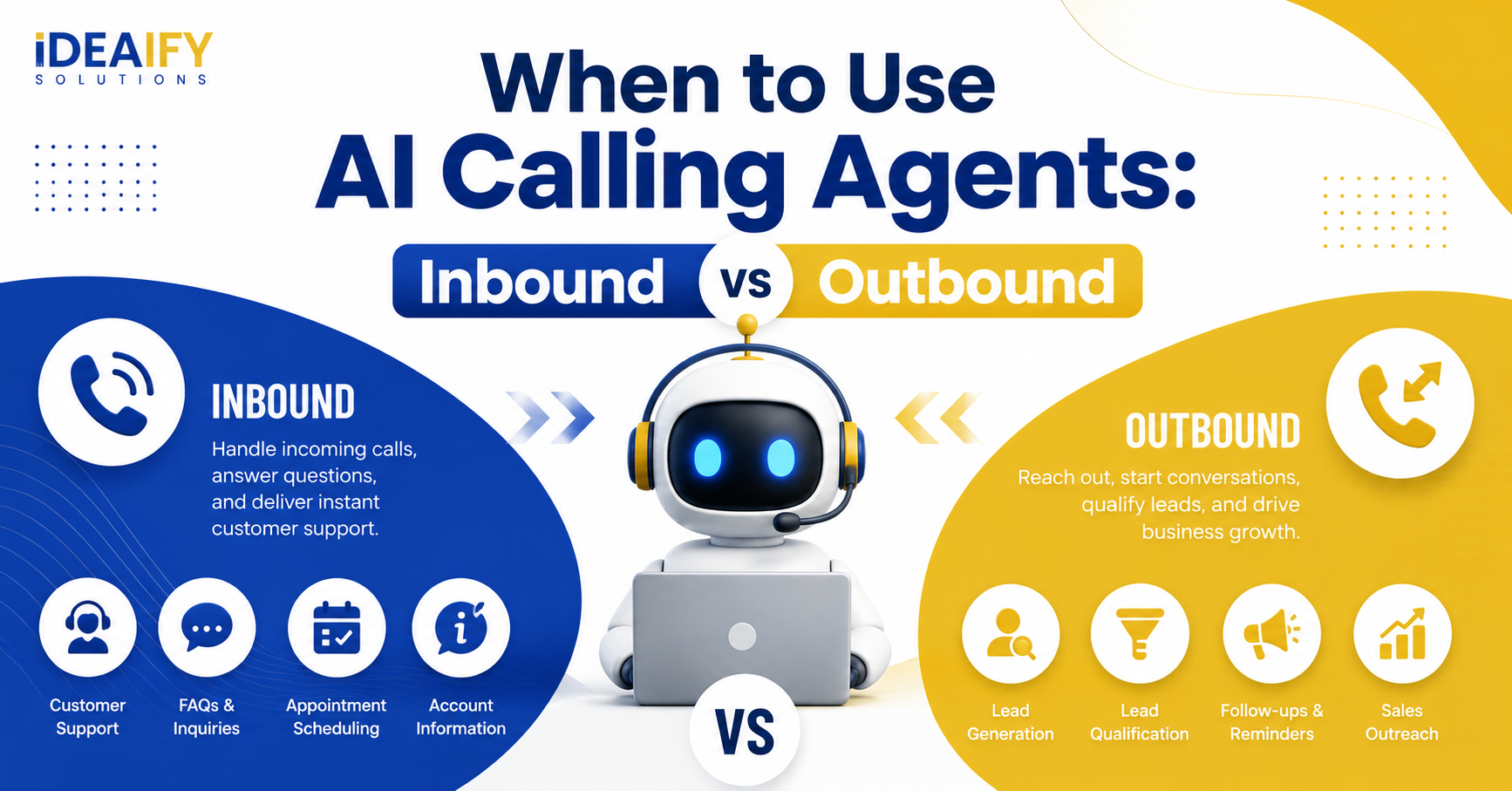
Both AI inbound calling and AI outbound calling can be found in this umbrella but applications are very different.
With such differences in mind, marketing managers are able to make the correct choice of where automation should be introduced into the customer journey and where people should take over.
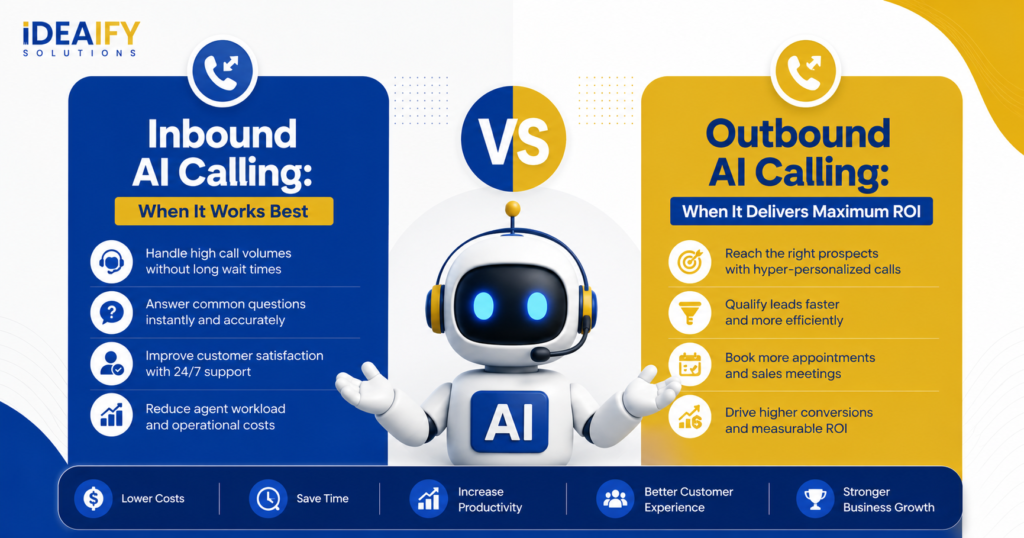
Inbound AI Calling: When It Works Best
AI inbound calling is used to process calls made by your audience. These are usually emergency calls, time-sensitive or decisions related to buying.
1. High-Volume Inquiry Management
Inbound calling will reduce lost opportunities in case your business is receiving more calls than your team can handle promptly.
AI calling agents can:
- answer calls 24/7
- provide instant responses
- direct calls to the departments.
- reduce wait times to zero
- copy lead even later in the day
To marketing teams, this means that all advertisements, landing pages and funnels will generate higher ROI since not a single lead will go to waste without being noticed.
2. Qualification Before Human Transfer
There are large volumes of inbound calls which require basic filtering prior to becoming sales-ready.
The AI inbound calling can automatically:
- ask qualifying questions
- verify contact information
- collect intent data
- update your CRM
- deliver only quality leads
This will not have your sales team wasting time since they might not be dealing with a qualified inquiry.
3. Follow-up on Missed Calls
The AI calling agents have the ability to call back missed inbound calls automatically which the human teams fail to do reliably. This in itself can increase conversions tremendously particularly in real estate and home services, as well as healthcare industries.
4. Customer Support and FAQ Handling
In case of repetitive questions, AI inbound calling would be more scalable and quick.
Example use cases:
- Appointment scheduling
- Policy clarifications
- Product information
- Order status
- Troubleshooting basics
With the automation of these activities, which is possible via AI call automation, marketing managers will be able to invest more funds in growth rather than personnel.
Outbound AI Calling: When It Delivers Maximum ROI
Whereas the inbound AI processes the incoming calls, the AI outbound calling is concerned with the system-initiated calls. It is in this that automation can hugely enhance pipeline movement particularly to marketing teams that have huge lead lists.
1. Nurturing and Qualification of Lead.
The outbound AI calling agents can make outbound calls automatically and leads do not freeze.
Examples:
- Reaching out to captured leads in seconds
- Checking interest levels
- Verifying readiness to buy
- Warming them up takes place prior to passing them to sales
It is among the most lucrative AI calling agent applications particularly those funnels that receive high volumes of paid campaign leads.
2. Reminder and Confirmation Calls
Outbound agents are good at outreach activities which need to be timely, including:
- Appointment reminders
- Payment reminders
- Event confirmations
- Product renewal prompts
Since they are repetitive tasks, AI call automation helps in providing consistency and ensuring there is no human error.
3. Re-Engagement Campaigns
AI outbound calling is very useful in making dead leads or deadbeat customers come to life.
Examples:
- Contact former customers to upgrade them
- Engaging dormant subscribers
- Communication of new offers to users
- Checking interest after great silence
Manual outreach is time-consuming, and this is why marketing teams do not take such leads into account. With AI, it becomes automatic.
4. Feedback and Post purchase calls
AI outbound calling is able to collect:
- Satisfaction scores among customers
- Testimonials
- Service feedback
- Product reviews
This provides the marketing teams with useful data and leaves the human resources with more strategic activities.
Inbound vs Outbound AI: How to Choose the Right Strategy
Choosing between inbound vs outbound AI depends on operational goals, audience behavior, funnel structure, and staffing constraints.
Below is a simple comparison for clarity.
| Decision Factor | Inbound AI Calling | Outbound AI Calling |
| Who initiates the call? | Customer calls you | AI calls the customer |
| Best for | Support, lead capture, qualification | Support, lead capture, qualificationNurturing, reminders, re-engagement |
| Impact on marketing | Reduces leakage and response time | Increases conversions and follow-ups |
| Budget efficiency | Cuts support cost | Boosts sales pipeline efficiency |
| Human involvement | Needed for complex queries | Needed for final closing |
The comparison of inbound and outbound AI reveals that marketing managers can gain the most from a combination as they can easily take the different parts of the funnel served by different approaches.
Practical Use Cases for Marketing Managers
In case maximizing ROI is on your agenda, below are the highest-impact AI calling agent use cases:
Inbound Use Cases
- Handling landing page call inquiries
- Answering ads with call-to-action prompts
- Capturing missed leads from campaigns
- Providing 24/7 support
Outbound Use Cases
- Auto-calling leads from Facebook/Google Ads
- Re-engaging cold leads from CRM
- Delivering instant follow-ups after form submissions
- Calling webinar registrations or event leads
The usage of both guarantees full funnel coverage, and this is one of the platforms like Ideaify that has a significant advantage in this regard.Why AI Call Automation Matters More Than Ever
Marketing managers have been dealing with the mansions where their response time is very crucial. The sooner you respond the sooner the sale is yours. AI call automation provides:
- Immediate response
- All the time coverage
- Uniform communication
- Better data gathering
- Wide outreach that can be increased
The main advantage is that it enables your human team to gear up for strategy rather than handling calls over and over again.
Conclusion
The moment of using AI inbound calling and AI outbound calling is a very critical one for marketing performance to get the best of it and to reduce the cost of operations. Inbound AI is the one that helps in response time , qualification and even calls the leads generated by your campaigns instantaneously. Outbound AI , on the other hand, increases the follow-ups, re-engagement, nurturing, and pipeline velocity, all without putting any extra pressure on your sales team.
By acquiring the knowledge of inbound vs outbound AI differences, marketing managers could deploy AI calling agents in a more strategic manner and reap significantly higher ROI from automation. Outreach experts like IDEAIFY make it a piece of cake to use both methods interchangeably, thus, providing your business with a competitive edge regarding speed, consistency, and conversion performance.
If your company is aiming for a future-ready communication strategy, then the combination of inbound and outbound AI is not an option anymore; it is the new baseline for marketing operations that are efficient and scalable.