Bootstrapped SaaS companies face a constant balancing act. You have to have steady development, but you cannot afford to squander money on ineffective advertising. Every dollar needs to show real results. Most founders get stuck here. They either use paid advertisements that rapidly deplete their budget or they invest heavily in SEO and wait months for results.
The most clever SaaS firms forgo between the two. They use both. With a well-organized SEO plus PPC strategy, paid campaigns speed conversions and organic traffic provides long-term growth by means of a full-funnel system. Together, they create a scalable SaaS acquisition plan that generates a steady pipeline free from overspending. Together SEO and paid efforts help founders and marketing teams construct a workable, budget-friendly B2B funnel.
Why SEO or Paid Alone Is Not Enough
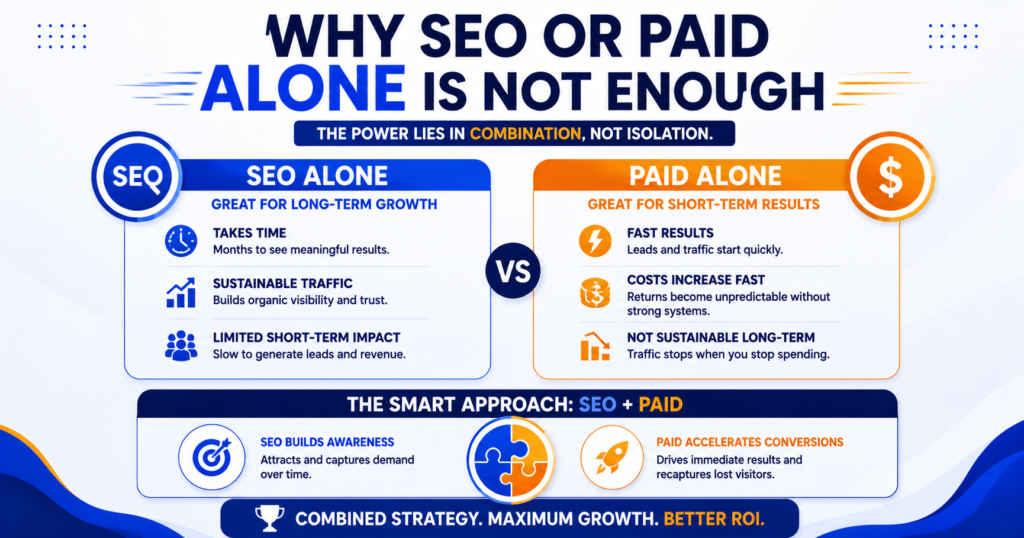
Most SaaS companies start with one of two approaches.
They either focus on SEO, publishing blogs and waiting for traffic to grow. Or they run paid ads to generate immediate leads.
Both approaches have value, but both have limitations when used alone.
SEO is powerful for long-term demand generation, but it takes time. It can take months before content ranks and starts driving meaningful traffic.
Paid campaigns, on the other hand, deliver faster results. But without a strong system behind them, costs increase quickly and returns become unpredictable.
The problem is not SEO or paid marketing.
The problem is using them in isolation.
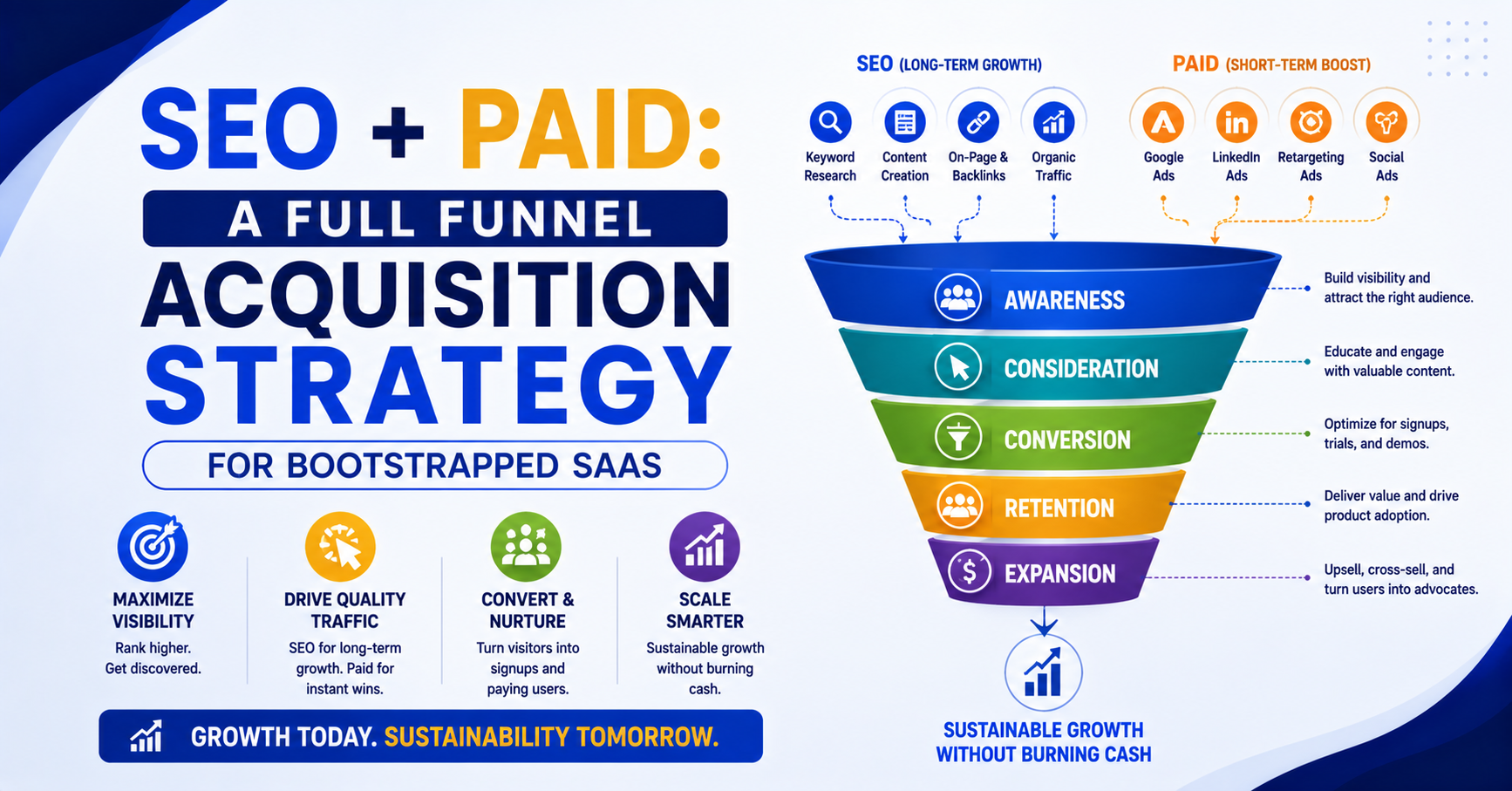
When combined strategically, SEO and paid campaigns complement each other. SEO builds awareness and captures intent, while paid campaigns accelerate conversions and bring back lost visitors.
Understanding the Full Funnel Approach
A successful SaaS acquisition strategy is not just about getting traffic. It is about guiding potential customers through a structured journey.
This journey typically has three stages:
Top of Funnel: Awareness
At this stage, your audience is discovering a problem or exploring solutions.
SEO plays a major role here. Blog content, guides, and educational resources attract users searching for information.
Examples include:
• “How to improve customer support for SaaS”
• “Best tools for B2B lead generation”
• “Scaling outbound sales teams”
This content builds visibility and positions your brand as a trusted resource.
Middle of Funnel: Consideration
At this stage, prospects are evaluating solutions.
They are comparing tools, reading case studies, and exploring options.
This is where both SEO and paid campaigns work together.
SEO content such as:
• comparison pages
• use-case pages
• product-focused blogs
helps capture intent.
At the same time, retargeting ads ensure that visitors who previously engaged with your content return and continue their journey.
Bottom of Funnel: Conversion
This is where decisions happen.
Prospects are ready to take action, but they may still need reassurance.
Paid campaigns play a critical role here, especially:
• retargeting ads
• branded search campaigns
• high-intent keyword ads
These campaigns bring back warm prospects and guide them toward conversion actions such as booking a demo or starting a trial.
How SEO Powers Demand Generation
For bootstrapped SaaS businesses, it offers an affordable means to produce regular traffic without continuous ad expenditure.
Good SEO, on the other hand, is not about posting anything. It calls for a systematic approach coordinated with your B2B funnel.
Concentrate on Intent- Driven Content.
Not every kind of traffic is worthwhile. The aim is to draw consumers who are seeking answers relevant to your product. High-performing SEO material usually divides under three types:
- Academic material
- Comparison content
- Problem-solution content
These formats align with different stages of the buyer journey and contribute directly to demand generation.
Build Topic Clusters
Develop clusters around main ideas rather than separate papers. For instance, a SaaS firm providing customer support services might create content around:
- Automation of customer assistance
- Live chat enhancement
- Tools for helping desks
Every piece helps the others, therefore raising general ratings and credibility.
Capture Leads from SEO Traffic
Traffic alone is not enough. Your website must convert visitors into leads. This can be achieved through:
- Lead magnets
- Demo CTAs
- Free tools
- Email capture forms
This ensures that your SEO efforts contribute directly to pipeline growth.
How Paid Campaigns Accelerate Conversions
While SEO builds awareness, paid campaigns help convert that attention into action.
For bootstrapped SaaS companies, the key is to use paid ads strategically, not aggressively.
Retargeting Is Your Highest ROI Channel
Most visitors do not convert on their first visit.
Retargeting allows you to re-engage users who have already interacted with your website.
These users are far more likely to convert than cold traffic.
Effective retargeting strategies include:
• showing ads to blog readers
• targeting users who visited product pages
• re-engaging trial users who did not convert
Retargeting keeps your brand top of mind and shortens the decision-making process.
Use Paid Search for High-Intent Keywords
Paid search works best when targeting keywords with strong buying intent.
Examples include:
• “best SaaS customer support software”
• “CRM for startups pricing”
• “B2B lead generation tools”
These searches indicate that the user is close to making a decision.
Bidding on these keywords ensures that your product appears at the right moment.
Support SEO with Paid Distribution
Paid campaigns can also amplify your SEO efforts.
Promoting high-value content through ads helps:
• increase traffic quickly
• test content performance
• generate early engagement signals
This approach allows you to validate content before relying solely on organic rankings.
Building a Unified SEO Plus PPC Strategy
To make SEO and paid campaigns work together, they must be aligned under a single strategy.
Align Messaging Across Channels
Your SEO content, landing pages, and ads should communicate a consistent message.
If your blog focuses on solving a specific problem, your ads should reinforce that same solution.
Consistency improves trust and increases conversion rates.
Use SEO Data to Inform Paid Campaigns
SEO provides valuable insights into what your audience is searching for.
Use this data to:
• identify high-performing keywords
• understand user intent
• refine ad targeting
This reduces guesswork and improves the efficiency of paid campaigns.
Create Dedicated Landing Pages
Sending paid traffic to generic pages often leads to poor results.
Instead, create landing pages tailored to specific campaigns.
These pages should include:
• clear value propositions
• relevant messaging
• strong CTAs
• trust signals
This improves both user experience and conversion rates.
Budget Allocation for Bootstrapped SaaS
One of the biggest challenges for bootstrapped companies is deciding how to allocate budget.
A practical approach is to balance long-term and short-term growth.
SEO should receive consistent investment because it builds long-term assets.
Paid campaigns should be focused and performance-driven.
A typical approach might look like:
• invest in content creation for SEO
• allocate a smaller budget for retargeting
• test high-intent paid search campaigns
The goal is not to spend more, but to spend smarter.
Common Mistakes to Avoid
Many SaaS businesses fail to see results because of a few crucial errors. High expenses and erratic growth result from depending only on sponsored ads without generating organic traffic.
Publishing SEO content without conversion optimization yields traffic devoid of leads. Ignoring retargeting means losing possible clients already interested. Treating SEO and paid advertising as distinct tactics leads to inefficiencies and lost possibilities. Avoiding these errors can greatly boost the results of your SaaS acquisition plan.
The Future of SaaS Demand Generation
As competition increases, customer acquisition will become more challenging.
Attention is limited, and users are exposed to countless options.
The companies that succeed will be those that build integrated acquisition systems, not isolated tactics.
A combined SEO plus PPC strategy allows SaaS companies to:
• generate consistent demand
• capture high-intent traffic
• convert leads efficiently
• scale without excessive spending
This approach is especially important for bootstrapped businesses that need predictable growth without large marketing budgets.
Conclusion
Growth for bootstrapped SaaS companies is not about choosing between SEO and paid marketing.
It is about combining both into a cohesive system.
SEO builds long-term visibility and trust. Paid campaigns accelerate conversions and maximize the value of existing traffic.
Together, they create a powerful B2B funnel that supports sustainable demand generation.
For founders and marketing leaders, the opportunity is clear.
Build a strategy where SEO attracts the right audience, and paid campaigns guide them toward action.
When executed correctly, this approach turns limited budgets into consistent pipeline and predictable growth.