The reality is that most startups aren’t struggling to build their product; they’re struggling to find the right people to sell it to. This is pretty much a given. Most startups will go ahead and invest marketing dollars, marketing tools, and even hire people to sell their products. And yet, even that seems to be somewhat of a hit-or-miss situation.
Honestly, the outreach strategy isn’t what’s holding them back. The real culprit? Bad prospecting data. When you rely on generic contact lists, you end up with outdated info, random contacts, and companies that just aren’t a fit. Sales teams waste their time chasing leads who were never going to buy in the first place.
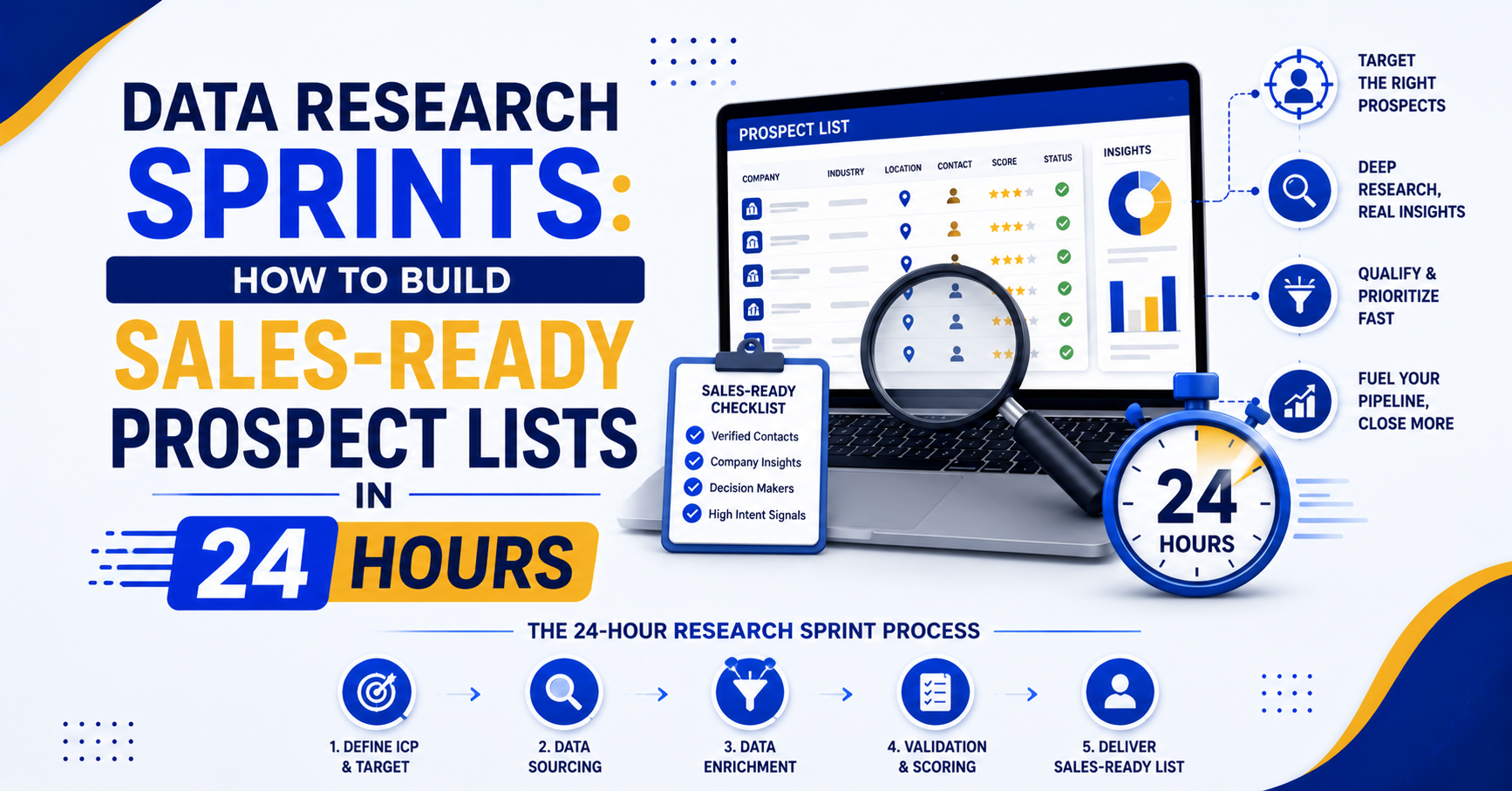
That’s why a lot of fast-growing companies turn to data research sprints. Instead of spending weeks slowly gathering leads, they dive into focused research sessions—pulling together segmented, accurate B2B prospect lists in less than a day. If you do it right, one research sprint can deliver hundreds of sales-ready leads that actually fit your ideal customer profile.
This guide walks through how founders and SaaS teams can use structured data research and B2B list building to quickly create top-notch prospect lists—without the headaches.
Why Prospecting Data Determines Sales Success
The success of your sales team largely depends on the quality of the leads that they are working with. This is because even the best team of salespeople will not be able to get far if they are working with substandard leads. This means that if your list of leads does not have the right people, you will end up with low response rates, little to no meetings scheduled, and a whole lot of time and energy put into nothing.
But when you have strong data and a list packed with the right prospects, suddenly things start to click. Your emails make sense to the person reading them. Cold calls actually lead somewhere. More people ask for demos, and the whole sales funnel just works better.
For startups and SaaS companies, this really matters. Limited resources mean you can’t afford to waste time, so a well-researched list can help a smaller team punch way above its weight.
That’s where a data research sprint comes in, you want to build a list where every single prospect fits your target market and actually has a reason to care about your offer.
What Is a Data Research Sprint?
A data research sprint is a focused, time-bound process used to collect and organize prospecting data quickly.
Instead of gathering contacts randomly over several days, teams dedicate a structured session to identifying, verifying, and segmenting prospects.
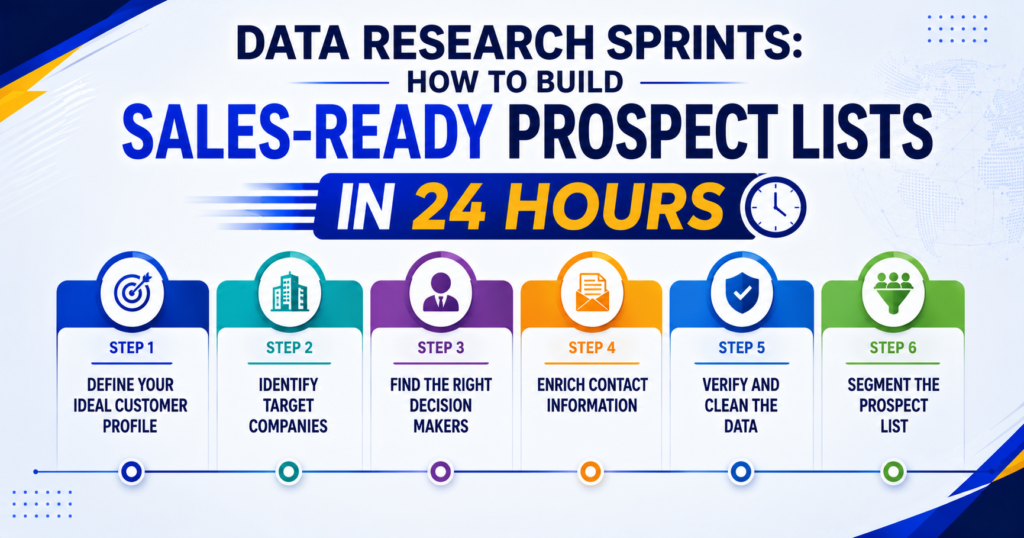
Most sprints follow a clear framework:
First, define the ideal customer profile.
Then identify relevant companies that match that profile.
Next, collect decision-maker contact details.
Finally, verify and segment the data so the list becomes immediately usable for outreach.
By working through these steps in a concentrated time block, teams can produce sales-ready leads within a single day.
This approach keeps research efficient and ensures that every lead collected has a clear purpose in the sales strategy.
Step 1: Define Your Ideal Customer Profile
The first step is easy, yet important. That is to define your ideal customer profile. Do not skip this step. Many entrepreneurs start pulling contacts without doing this step properly. As a result, they end up with a list of contacts that nobody cares about. Here, your ideal customer profile is your guide to defining the type of company that should be interested in what you are offering. For SaaS and tech-related startups, this would usually include defining the type of industry, company size, revenue range, technology stack, location, and growth stage.
For example, if your business is a SaaS company that offers a SaaS solution for business analytics, your ideal customer profile would be mid-size e-commerce companies that use Shopify as their technology stack and have revenues ranging from $5 million to $50 million. The more specific your ideal customer profile is, the better your chances of generating a quality list of contacts. Having a quality ideal customer profile will almost guarantee that the leads you generate will have a real chance of converting to customers.
Step 2: Identify Target Companies
Now that you’ve nailed down who your ideal customer is, it’s time to zero in on companies that actually fit those criteria. This part isn’t about hunting individual contacts just yet, it’s about pulling together a solid list of organizations first.
You’ve got plenty of tools to make this process easier. LinkedIn Sales Navigator, Crunchbase, Apollo, BuiltWith, and various industry directories can help you search fast. Just plug in filters like company size, location, and industry, and you’ll end up with a bunch of possible options in no time.
But here’s the thing: don’t get distracted by sheer numbers. You want quality over quantity. Take your time and go through each company, make sure it lines up with your ideal customer profile. If a business doesn’t really fit what your product offers, cut it from the list.
When you finish, you’ll have a shortlist of companies that actually make sense as strong potential customers.
Step 3: Find the Right Decision Makers
Once the company list is ready, the next task is identifying the individuals responsible for purchasing decisions.
Reaching the wrong person is one of the most common reasons cold outreach fails.
In B2B environments, the relevant decision maker depends on the product you are selling.
For example:
A marketing automation platform may target VPs of Marketing or Growth Leaders.
A sales enablement tool may focus on Sales Directors or Revenue Operations Managers.
A customer support solution may reach out to Heads of Customer Experience or Support Managers.
LinkedIn remains one of the most effective tools for identifying these roles.
Search within each company for relevant job titles and verify that the contact is active and currently employed there.
At this stage, the goal is to attach real decision makers to the companies identified earlier.
This is what transforms a simple company list into meaningful B2B prospecting data.
Step 4: Enrich Contact Information
After identifying decision makers, the next step is gathering their contact details.
This process is known as data enrichment.
The goal is to collect accurate information such as:
Business email addresses
LinkedIn profiles
Company websites
Location data
Several tools specialize in this type of enrichment, including:
Apollo
Hunter
Clearbit
ZoomInfo
Snov.io
These platforms use large databases and verification algorithms to match names with professional email addresses.
When used correctly, they dramatically accelerate B2B list building.
However, accuracy should always take priority over speed. If a contact email looks suspicious or incomplete, verify it before adding it to the final list.
Clean data is essential for successful outreach campaigns.
Step 5: Verify and Clean the Data
At times, even the most reliable sources of information can carry outdated or incorrect information. It is, therefore, important to take the time to verify the information in your list of prospects. There are many email verification tools that can help you verify if the email address you have is valid and deliverable. This will help you avoid any negative impacts on your sender reputation. At this stage, you can also clean up your list by checking for common problems, including:
- Duplicate entries
- Generic company emails
- Inactive LinkedIn profiles
- Irrelevant job titles
Cleaning the data ensures that your final output contains sales-ready leads, not just raw contacts.
This step often determines whether your outreach campaign succeeds or fails.
Step 6: Segment the Prospect List
A strong prospect list is not only correct but also properly organized.
Segmenting your prospect list enables your sales team to communicate with different prospects in different ways.
Some examples of segmentation criteria are:
- Industry
- Company size
- Geographic location
- Product usage scenario
- Technology stack
For instance, a SaaS firm can create different campaigns targeting:
- E-commerce businesses
- Fintech businesses
- B2B SaaS businesses
Each list can then be sent different messaging based on what they need.
This level of personalization can dramatically increase response rates and booking meetings.
Segmented prospect lists can transform raw prospecting data into a valuable strategic asset.
Tools That Make Data Research Sprints Faster
Modern tools have made data research and prospecting far more efficient than in the past.
Several platforms help automate parts of the research process.
LinkedIn Sales Navigator remains one of the most powerful tools for identifying target companies and decision makers.
Apollo and ZoomInfo provide large databases of professional contacts along with verified email addresses.
Hunter and Snov.io specialize in finding and verifying business email addresses.
Finally, spreadsheet tools such as Google Sheets or Airtable allow teams to organize and manage their B2B prospect lists effectively.
When used together, these tools enable startups to build sales-ready leads at scale.
Turning Prospect Lists Into Sales Opportunities
Building a high-quality prospect list is only the first step.
The next stage involves turning those contacts into conversations.
Effective outreach campaigns combine personalized messaging with strong timing.
Start by researching each prospect briefly before sending outreach messages. Referencing the company’s recent activity, product launches, or industry trends can make your communication feel far more relevant.
Sales teams should also test multiple outreach channels. Email remains powerful, but LinkedIn messages and targeted calls often increase response rates.
Most importantly, outreach should focus on solving problems rather than promoting features.
When prospects see that you understand their challenges, they are far more likely to respond.
Why Data Research Sprints Work for Startups
Startups generally have limited sales resources. Traditional prospecting methods can take weeks, which slows down growth. Data research sprints fix this by condensing the entire process into a workflow. In one day, founders and small sales teams can create a pipeline of qualified leads.
There are several advantages to this method:
- It saves time by eliminating scattered research efforts.
- It improves lead quality through structured targeting.
- It creates momentum for sales outreach campaigns.
For early-stage SaaS companies, this method often becomes a repeatable engine for pipeline generation.
Conclusion
Any successful outbound sales strategy starts with a strong foundation of data.
Without proper prospecting data, even the most well-thought-out sales strategy will not be able to achieve desired results.
With the help of data research sprints, startup founders and SaaS teams can generate their B2B prospect list within a matter of 24 hours.
The process is quite simple yet effective. It starts with defining your ideal customer profile, identifying the companies that are relevant to your business, identifying decision-makers within those companies, refining your list of contacts, verifying your data for accuracy, and finally segmenting your list.
When done right, the result is a list of sales-ready leads that are ready to be contacted right away.
For growth-focused startups, this method of B2B list building can be quite beneficial for generating leads.