Why AI is a Game-Changer for Marketing
Artificial Intelligence, or AI, has transitioned from a marketing buzzword to a primary component of today’s marketing. AI marketing tools will help teams improve efficiency and effectiveness and increase relevancy and personalization like never before. The challenge lies in organizations adopting AI without overwhelming their marketing tech stack. Integrating any AI is like adding a more powerful engine to your car: it can be fun and exciting, but if you don’t understand how to drive a car effectively, you may crash.
At Ideaify Solutions, we help businesses create better growth through brand presence, lead generation, and other digital marketing services. When AI is utilized smartly in a marketing stack, the business’s ability to increase sales and impact can be a seamless addition without the complications of excessive tech and systems.
In this blog article, we will show you precisely how to easily integrate AI into your MarTech 2025 stack while maintaining simplicity, scalability, and a human touch.
Understanding the Basics of AI in Marketing
What AI Marketing Tools Can Do
AI marketing refers to the implementation of AI capabilities, such as data collection, data-driven analysis, natural language processing (NLP) and machine learning (ML), to provide customer insights while automating important marketing decisions. Currently, marketing teams are utilizing AI marketing tools more extensively than ever to create content, facilitate team efficiency, enhance customer experiences, and provide more effective results. According to consulting group McKinsey, AI adoption in the global business landscape has risen to 72% in 2024.
AI marketing tools are not solely focused on flashy features, but are enabling content creation, audience segmentation, predictive analytics, chatbots, and even email personalization. The intention? To help remove complexities, and allow your team to prioritize strategy, creativity, and high-level decision-making, rather than automation.
Common Misconceptions About AI
Some marketers believe that AI will replace human jobs. However, the reality is AI marketing tools support and augment the human workforce. The tools help in performing repetitive tasks, while delivering data-driven insights that were previously hidden in untapped, bulky, data sets. AI agents are ready and willing to scrub away the painful, mindless tasks that drag us down, like juggling schedules, sorting through overloaded inboxes, and relentless data entry. However, it’s not just about optimizing input and output. A common misconception is that AI is about output alone, but the broader opportunity here is unleashing human potential.
Let’s assume that with AI performing the tasks people dislike or find mind-numbing in your organization, your team is freed up to continually explore creative paths to problem-solving and strategic innovation, as well as strengthening those uniquely human connections that AI can never replace. As such, AI will boost the productivity of lower-skilled workers possibly more than it does for higher-skilled workers. The secret to success becomes using AI as an enhancement instead of a replacement..
The Role of Automation in Modern Marketing
Streamlining Repetitive Tasks
Among one of the major benefits of AI, is automation, AI-driven marketing automation enhances marketing processes, executes recurring tasks, and eliminates manual labor, freeing up marketers to work more efficiently, and deploy their time and resources towards higher value opportunities such as strategy or the development of creative assets.
Enhancing Personalization Without Overload
AI can assess customer behavior, to tailor content for every customer segment. It allows marketers to deliver highly customized experiences to individuals at scale. Marketers can apply AI algorithms to assess customer behavior, apply data analysis, and determine digital marketing messages, product recommendations, and content specifically tailored to the unique preferences and interests of each customer, leading to more engagements and conversions.
Assessing Your Current Marketing Stack
Identifying Bottlenecks
Before incorporating AI, be sure to critically assess your marketing stack, where does your business get bogged down? Is your data siloed across disparate platforms? Are there tasks that take up a lot of time because they are needlessly repetitive? Identifying all these bottlenecks will help you figure out where the biggest impact with AI can take place.
Determining Which AI Tools Fit Best
AI tools can differ significantly from one another. The best way to evaluate tools is to identify tools that are aligned with your goals and that provide value to existing systems. Stay away from unnecessary bells and whistles that complicate your processes.
Choosing AI Marketing Tools Wisely
Criteria for Selection
In choosing the right AI marketing tools first consider ease of use, integration and scalability, and lastly potential for ROI. Additionally, check if the tool supports automation, analytics, and reporting while still being simple for your team to utilize.
Avoiding Feature Overload
In today’s technology-driven culture, there are a lot of AI and AI marketing tool optimizations from emerging startups. Marketing has a few thousand resources for new tools to try as they increasingly maintain modern and innovative, highly-marketable promises to “solve the marketing and business issue.” The temptation is to hop on every new option that comes your way.
However, most of the time is spent here just trying to sort through the ever-increasing universe of options to better evaluate and be tactical about the AI marketing tools you decide to use moving forward. This saves time, clutter, and increases productivity, You only need to stick to the essentials. Too many features causes confusion amongst your team and will limit and slow down your adoption of AI tools.
Integrating AI Without Disruption
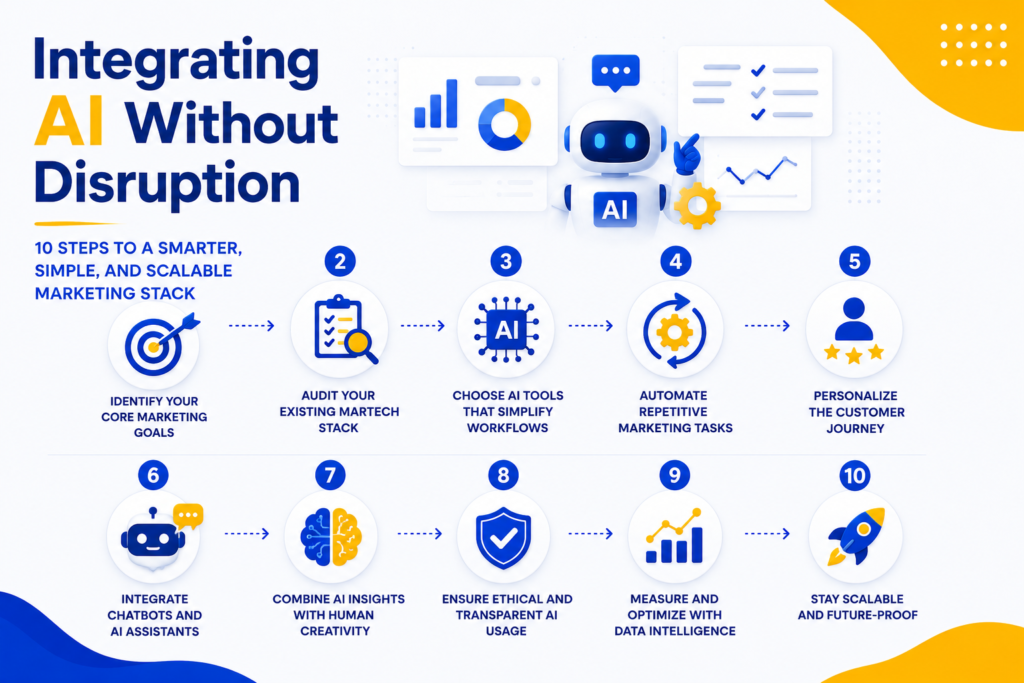
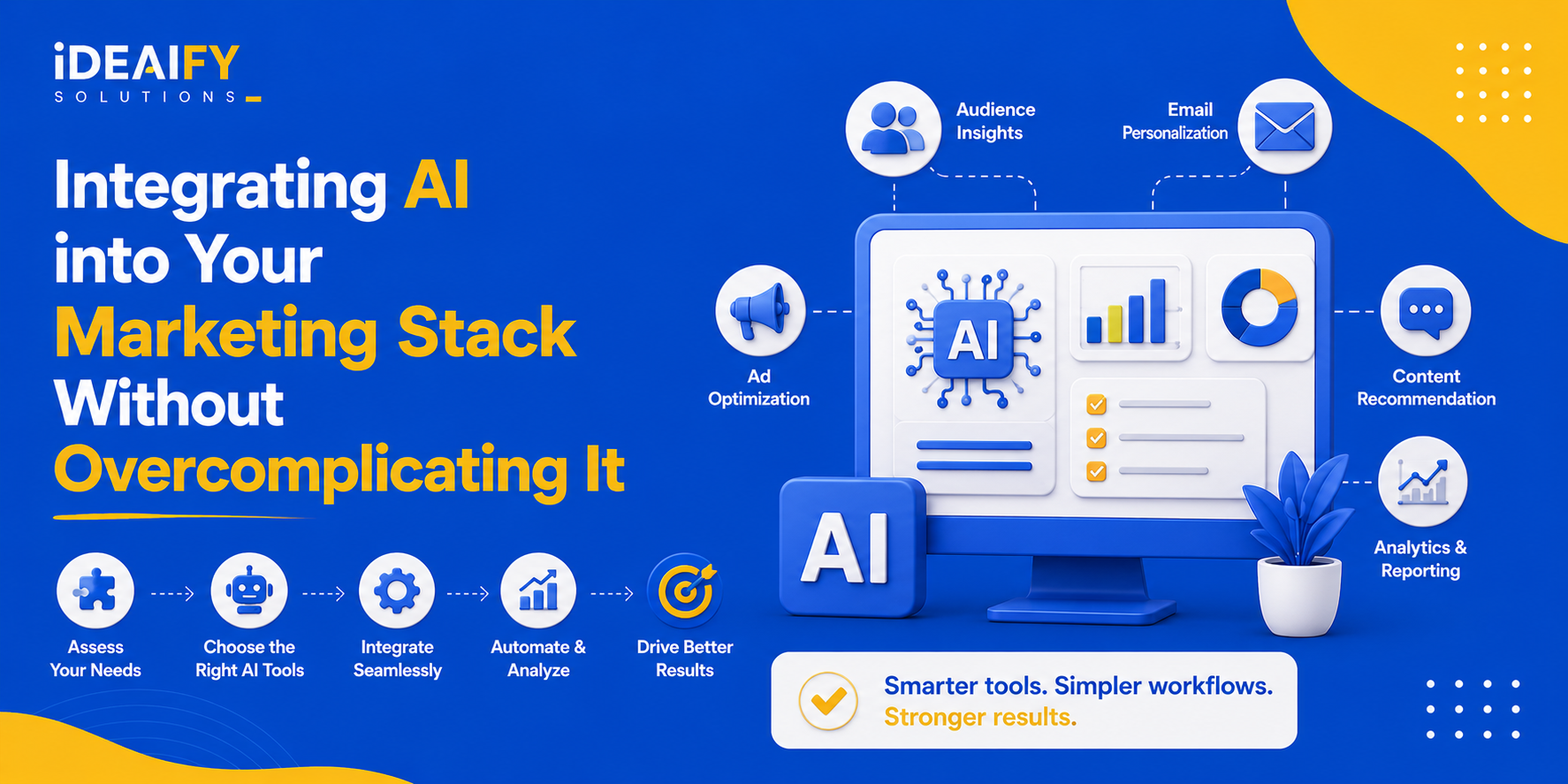
Step-by-Step Integration Process
Step 1: Identify Your Core Marketing Goals
Identify how you define success before jumping to AI marketing tools. Do you want to see growth in SEO, or lead generation, or retention? You want to make sure you are aligned in your automation layers with the strategic purpose of your goals and ensure the strategy can be measured quickly and easily in your MarTech 2025 strategy.
Step 2: Audit Your Existing MarTech Stack
Look at the tools that you already have and consider overlap, gaps, and efficiencies. Reduce redundancy, and transform your systems into a lean, high-performing ecosystem powered by smart automation and integration in MarTech 2025.
Step 3: Choose AI Tools That Simplify Workflows
Choose AI marketing products that make things easier for marketing teams, not harder. When picking your AI marketing tool sets that make your campaigns better every month without exception, enhance team collaboration, and supercharge your synergy with the MarTech 2025 stack for SEO growth that is future-proof, think about an integration-first platform.
Step 4: Automate Repetitive Marketing Tasks
Use automation where repetitive and manual tasks are completed, such as gathering reporting insight, arranging email sequential templates, and ad campaign optimization. Intelligent AI systems that automate tasks empower marketing teams to do what they do best, work together on managing strategy and innovation. All of this happens in the MarTech 2025 space.
Step 5: Personalize the Customer Journey
Utilize AI marketing solutions for predictive personalization. Provide audiences with personalized experiences, dynamic campaigns, and recommendations at the moment of engagement to drive conversions as part of your MarTech 2025 philosophy.
Step 6: Integrate Chatbots and AI Assistants
Incorporate AI chatbots to qualify leads, automate responses, and provide users assistance 24/7. These resources benefit the customer experience while harvesting further insights for action in your MarTech 2025 automation systems.
Step 7: Combine AI Insights with Human Creativity
Balance data-driven intelligence with creativity. Use AI marketing tools for insights and marketing automation for efficiency but let your team’s storytelling deliver emotion and depth to future MarTech 2025 campaigns.
Step 8: Ensure Ethical and Transparent AI Usage
Build trust through ethical use of AI marketing technology. You’re not responsible, but transparency and compliance with privacy laws and responsible use of automation all help create trust, credibility, and longevity in the marketing campaigns of MarTech 2025.
Step 9: Measure and Optimize with Data Intelligence
Utilize AI marketing tools to provide real-time analytics on SEO growth, campaign results, and customer data that will optimize automation and constantly improve your MarTech 2025 performance strategy.
Step 10: Stay Scalable and Future-Proof
Get adaptable AI marketing tools with open integrations and learning capabilities. Scalable automation allows your MarTech 2025 stack to grow with your business, while keeping marketing teams agile and competitive.
Training Your Team Effectively
A top-notch AI tool is of no use if your team is unsure of how to use it. Make sure to provide clear instructions, organize workshops, and encourage experimentation with the team. Your team will embrace the platform quickly if they feel confident using it.
Measuring Success and ROI
Key Metrics to Track
Monitor campaign performance, conversions, time saved, and customer engagement. AI marketing tools can generate a lot of data, but tracking the right metrics means you can see the value.
Adjusting Your Strategy Based on Data
Campaigns driven by data from AI make data-driven marketing. If an automation workflow isn’t working, change it. As long as your monitoring is consistent, integration of AI should improve outcomes, not complicate them.
Best Practices for a Balanced AI-Driven Stack
Combining Human Creativity with AI Insights
While AI has a high mastery of data analysis, it can’t get anywhere near your mastery of storytelling and creativity. Instead, combine the two: leverage AI insights to guide your campaigns and let your human team produce the message.
Regularly Reviewing Tool Efficiency
Technology is evolving daily. Review your AI tools and ask yourself about their effectiveness. Are they still serving the original needs? Is there an alternative tool that may perform better? This process of review helps to keep your stack lean and dependable.
Future Trends in MarTech 2025
By the year 2025, predictive analytics and frictionless automation using artificial intelligence (AI) will define MarTech. Marketing teams will implement AI marketing tools to predict consumer behaviors, personalizing campaigns and optimizing strategies before running them. Predictive intelligence will reduce guesswork and create a more accurate and positive impact on ROI. In addition, cross-platform automation will connect systems such as Customer Relationship Management systems (CRMs), social media systems and analytics dashboards while removing the burden of moving data manually between systems. The MarTech 2025 environment will integrate workflows and enhance automation while allowing teams to make more intelligent, timelier data-driven decisions leading to increased growth and increased efficiencies of modern digital marketing executions.
Challenges to Watch Out For
Data Privacy Concerns
A major ethical consideration regarding the adoption of AI in marketing is data privacy. Advanced AI systems need vast amounts of consumer data to tailor the user experience, which points to the potential misuse of data. Marketing teams should be transparent in their data practices and comply with regulations.
Avoiding Over-Automation
Automation is powerful, but too much of it can jeopardize a campaign’s success. If AI replaces your voice instead of amplifying it, your brand starts to take on a robotic feel. Marketers must understand that AI can be a useful tool as long as it helps your efforts, but does not compromise your authenticity.
Using AI Responsibly
Marketers will need to ensure AI systems are transparent and provide clear explanations to consumers about their data and how marketing decisions are made. Consumers who are informed will be more likely to build trust and comfort with the use of AI in marketing.
Final Thoughts
When marketers develop strategies to figure out what consumers want, they traditionally have examined demographic trends and surveys, plus intuition and assumptions based on past performance. AI has changed that approach dramatically.
Marketers don’t have to work hard to work with AI in their marketing stack. By selecting the appropriate AI marketing tools, automating repetitive tasks, and blending creativity with AI insights into their digital storytelling, marketing teams can boost efficiency, the customer experience, and return on investment.
For businesses working with Ideaify Solutions, AI has the potential to accelerate growth, raise brand awareness, and streamline lead generation while keeping the user experience simple.
Keep your marketing stack straightforward, measure performance consistently, and remain nimble in keeping up with the MarTech trends of 2025. AI is structured to simplify not complicate your marketing journey and provide businesses like your awesome results with minimal stress.