

The Startup Founder’s Reality Growth vs. Burnout
Every startup founder desires to grow quickly to create a business that grows beyond their involvement. Unfortunately, the reality is that if you are trying to do it all yourself, you are on the fast track to burnout. Founders tend to find themselves wearing all of the hats or juggling various roles, which could typecast them as a marketer, accountant, HR, designer, customer support, all at once. This is where startup outsourcing comes in.
Outsourcing should not be confused with cost-cutting or paying low wages, startup outsourcing is about leveraging the remote workforce strategically so founders can do what they should be doing like innovating, strategizing, and scaling. When done responsibly, the correct outsourcing of non-value add, routine tasks can yield an incredibly valuable resource – time, mental clarity, and energy. Smart outsourcing is simply the long and short of it, which facilitates scaling your business without you burning yourself out.
At Ideaify Solutions, we understand this struggle firsthand. We help startups and growing businesses unlock better growth by increasing sales, strengthening their brand presence through digital marketing, lead generation, and offering smart outsourcing support. Our goal is to help founders scale efficiently while staying focused on their true mission, building impact-driven businesses that thrive.
This blog will examine how startups can take advantage of the power shift through outsourcing. We will address various growth strategies for startups and the advantages of outsourcing, as well as challenges startups face when outsourcing and possible opportunities for startups such as future trends.
What Is Smart Outsourcing and Why It Matters for Startup Founders
The Difference Between Smart Outsourcing and Traditional Outsourcing
Smart outsourcing is a modern version of delegating. The focus is no longer saving costs but rather it is creating space for valued tasks. The point is not merely delegating things away from you-on to others, but to consider bringing in remote support as strategically linked to your growth objectives.
Traditional outsourcing was fundamentally a model based on cost savings. The tasks delegated are often repetitive, or low-level tasks assigned to external vendors or workforces which typically work in more affordable cost locations to save money. The primary aim is to mitigate costs by offshoring labor.
Why Startup Outsourcing Is the Future of Business Scaling
The worldwide startup ecosystem is built on speed and agility. Startup outsourcing helps allocate resources more effectively. Rather than getting bogged down with internal maintenance, startups are able to relocate resources to creating innovation, marketing, or other growth activities. In addition, outsourcing allows startups to provide a more reliable and seamless experience to their clients. When the systems run efficiently and consistently, businesses are better positioned to meet customers’ expectations and service them exceptionally well. A structured environment of virtual teams promotes growth without the founders extending themselves too far.
How Startup Outsourcing Enables Sustainable Business Scaling
The Role of Virtual Teams in Startup Growth
In today’s fast-paced work environment, virtual teams are a secret weapon for modern startups. First of all, virtual teams greatly expand the number of candidates you can hire. Rather than being limited to people within commuting distance, startups can hire the best candidates from all over the world. It provides the added benefit of having a team with specialized skills that sometimes can be difficult to find locally.
In addition, virtual teams can save startups money. It can save on overhead costs, since businesses won’t have to lease a large office, buy furniture, cover utilities, and buy office supplies.
Furthermore, it provides flexibility, because research shows that employees who have flexibility in their schedules are happier and more engaged.
The Hidden Benefits of Outsourcing for Founders’ Mental Health
One of the major advantages of virtual teams is when they create a greater work-life balance. Many startup founders can get burned out when all tasks are their responsibility and they are doing everything. But when work is delegated to others in a virtual team, they have free time again or can use that time in personal activities or even with family. It may make the work-place more flexible and can provide new ideas for business scalability as well. It can contribute to better health and less stress as well for the founder and their staff.
What Startup Founders Should Outsource First
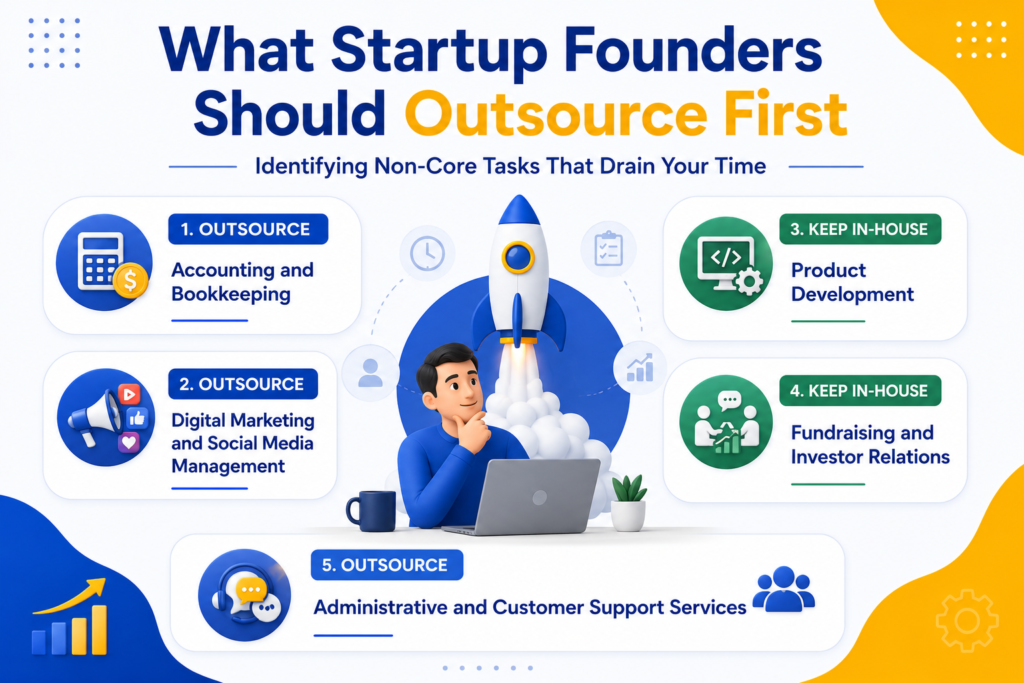
Identifying Non-Core Tasks That Drain Your Time
Starting a startup can be thrilling but typically involves numerous responsibilities. As founders, it’s important to group tasks in a strategic manner to improve thebusiness scalability and not to drain the time. Here are five key functions startups might want to consider outsourcing right away and which ones to retain in house:
1. Outsource: Accounting and Bookkeeping
Keeping financial records accurate is important but takes time. Outsourcing accounting will ensure compliance with local tax laws while freeing up founders to focus on the overall strategy of the business.
2. Outsource: Digital Marketing and Social Media Management
Skillful agencies not only have the expertise to develop targeted campaigns, deal with a content calendar, and track and analyze performance metrics, but these are also usually resource-heavy functions that may use up time if done in-house.
3. Keep In-House: Product Development
At the heart of a startup’s value proposition exists its product. Retaining control over the key aspects of product design, product innovation, and product development creates flexibility in your offering and preserves the startup’s intellectual property.
4. Keep In-House: Fundraising and Investor Relations
Founders prefer to stay directly involved with investors to build trust and convey vision and progress, which helps to raise capital more easily.
5. Outsource: Administrative and Customer Support Services
Routine tasks like scheduling meetings, responding to inquiries, and onboarding customers can be easily outsourced to third parties, while maintaining consistency in your service level without using internal resources.
Practical Examples of Outsourced Startup Roles
To maximize efficiency, successful startups often rely upon third-party specialists and professionals for work. For example, Software as a Service (SAAS) companies may outsource services such as software development, cybersecurity, IT support, cloud computing, etc.; therefore, they are utilizing advanced technologies, as well as highly knowledgeable professionals, without investing an entire in-house team to get knowledge in a range of specialties.
Other outsourcing startups can include customer service, where virtual teams may provide call center services, helpdesk services, and live chat. Providing outsourced customer services allows a startup to manage high volumes of callers and inquiries while providing quality customer service to increase business scalability.
Similarly, it is becoming increasingly common for startups to outsource on marketing functions, including hiring third-party specialists for digital marketing, content creation or even conducting marketing research. Outsourced marketing services, among many, may include hiring an agency for managing SEO, social media or email marketing campaigns.
How to Build Virtual Teams That Match Your Startup’s Culture
Recruiting Remote Talent That Fits Your Vision
The first step to creating a successful virtual team is to hire the right individuals. Founders should think beyond what is listed on the resume, as cultural fit, communication skills and reliability are more important than pure technical talent. Sites like Upwork, LinkedIn, Indeed, and remote job boards are great starting points. Moreover, sometimes the best talent can be sourced from your ethical networks or even via a referral from trusted contacts. That is the power of word-of-mouth.
If your outsourced team understands the mission of your startup, they will work for something deeper than just pay.
Maintaining Communication and Motivation in Virtual Teams
As the founder, startup outsourcing of a virtual team, you know firsthand just how difficult it is to keep them motivated and inspired. Apps like iDoneThis help with this because they celebrate your team’s accomplishments and keep everyone in the loop. As another example, the Basecamp app improves the transparency of virtual teams and helps you track your team’s progress against goals.
Dropbox can also help with that by allowing all your team members to share files in real-time so everyone can touch base at the same time (regardless of when they check in and from where). Other collaborative tools are Slack, Trello, and Notion and they are very simple to use.
Founders must learn that virtual teams thrive on trust and ethical collaborative work practices. A motivated virtual team can outperform an in-house team when communication flows freely and recognition is done on a continual basis.
The Financial Power of Startup Outsourcing
Scaling Smart with Flexible Costs
Building a full team from the beginning can be very expensive. With startup outsourcing, founders get access to experts whenever they need to work on a project without the additional cost of hiring someone full-time. For instance, you can hire a specific contractor to help out on a digital marketing project whenever you need it for your business scalability.
How Outsourcing Helps You Compete with Bigger Players
In today’s marketplace, competition doesn’t take a break. Your end users want answers immediately and 24/7 peace of mind. For startup founders, customer satisfaction is everything. Therefore, like medium and large organisations, they also leverage outsourcing to give them the support they need at scale and be competitive by providing 24/7 solutions easily, without straining or burdening their internal teams. Outsourcing also provides them with access to best-of-breed technology without the upfront cost.
Top Tools That Make Virtual Teams and Startup Outsourcing Work Smoothly
Startup outsourcing can work wonders in conjunction with the right tools. Here are a few that work well:
- Rippling
Best for centralized workforce management. This is more than a communication tool, Rippling is a single platform that can help businesses manage employees and operations by connecting all your employees on one unified platform across departments.
- Slack
Best for team messaging and integrations. Its structure is based on channels, but its user-friendly interface and 1000s of integrations allows it to act as a centralized hub for discussions within teams, sharing quick updates, and judging files.
- Microsoft Teams
Best for enterprise communications. A part of the Microsoft 365 family, Teams is ideal for use for companies that already employ Microsoft products. Teams helps to combine messaging and file sharing along with video calls while remaining accessible to tools that we all know and use such as Word, Excel and SharePoint.
- Zoom
Best for video conferencing and webinars. Zoom is a household name as much as remote work is. This is ubiquitous to remote work and offers reliable video conferencing with collaboration tool options.
- Asana
Best for project and tracking. Asana provides teams with a platform that allows for customizable views (lists, boards, and timelines), task dependencies, and task automation. Asana is built for teams that need structure and visibility.
These virtual collaboration tools do more than just connect virtual team members. They serve as digital ecosystems where work happens.
Avoiding Common Mistakes in Startup Outsourcing
The most significant outsourcing danger signals are the innocent yet dangerous bubbles of poor communication, vague expectations, and time zone mismanagement.
To engage in productive outsourcing, startup founders should devote time to establish clear expectations for deliverables, clarify reasons for delays, set measurable and explicit KPIs (Key Performance Indicators), and use structured routines for communicating with the virtual team(s). Successful outsourcing is ultimately predicated on clarity, accountability, and respect, and also time.
Best Practices for Managing Virtual Teams and Outsourced Projects
- Establish clear goals, and timelines.
- Use KPIs to determine success.
- Spend time doing regular updates and check-ins.
- Reward when performance is good and communicate when it isn’t. Collaborate regularly!
- Outsourcing a startup works well when you take the time to build trust.
Think of your virtual team as an extension of your startup, not just a vendor and engage them as such!
Scale Smartly, Build Stronger
Outsourcing is not just a trend in the startup space; for modern founders, outsourcing is a professional necessity now. Efficient virtual teams and outsourcing outlying non-core functionality allows startup founders to scale their business faster, smarter, and without burnout. Startup outsourcing works best when used purposefully, out of sheer necessity, not time and cost savings.
Start with functions that hinder you but don’t require a strategic compass to be effective. Keep product, hiring, and brand decisions within close reach while your systems mature. Use consistent processes, select the correct out-sourcing model, and use vendors like an extension of your organization.
Getting this right will leave your startup efficient, focused, and capable of business scalability.
If you’re ready to take that next step in your growth journey, outsourcing for startups is one approach to move faster without losing control.
At Ideaify Solutions, we help startups scale smarter. Whether you need support teams, recruitment support, or back-office services, we help ensure that you outsource the right tasks at the right time. Our customized outsourcing solutions can collaborate with your vision and can compete with the best right now.
Let’s build your competitive edge together.
Reach out to us to discuss how we can help your organization remain focused on growth and we can manage the rest.