Cold outreach has changed dramatically over the past few years.
Mass email blasts, generic LinkedIn messages, and copy-and-paste sales templates are no longer enough to capture attention. Today’s buyers receive dozens of outreach messages every week, making personalization a necessity rather than a competitive advantage.
At the same time, manually researching every prospect isn’t practical for growing sales teams. A sales development representative (SDR) responsible for contacting hundreds of prospects each month simply cannot spend 20 minutes researching every lead.
This is where artificial intelligence and smart data research come together.
The most successful sales organizations are using AI to automate repetitive work while relying on quality prospect data to create outreach that feels genuinely personal. The goal isn’t to fool prospects into thinking every email was written from scratch. It’s to deliver relevant messages that demonstrate an understanding of the recipient’s business, challenges, and goals.
In this guide, we’ll explore how to combine data research and AI to achieve cold outreach personalization at scale, helping B2B sales teams generate more conversations without sacrificing quality.
Why Personalization Still Wins in 2026
Decision-makers are overwhelmed with sales messages.
Whether you’re targeting SaaS founders, operations leaders, marketing executives, or procurement teams, your outreach competes with dozens of other emails and LinkedIn messages every day.
Personalized outreach works because it answers one simple question:
“Why are you contacting me specifically?”
When prospects immediately recognize that your message is relevant to their business, they’re far more likely to engage.
Research across B2B sales consistently shows that personalized outreach improves:
- Email open rates
- Reply rates
- Meeting bookings
- Sales conversations
- Overall campaign ROI
However, effective personalization isn’t about mentioning someone’s first name. It’s about demonstrating relevance.
What Personalization Actually Means
Many sales teams confuse personalization with token customization.
Simply inserting variables like:
- First name
- Company name
- Job title
is no longer enough.
Modern personalization uses meaningful business context.
Examples include:
- Recent company announcements
- Hiring trends
- Technology stack
- Industry challenges
- Funding rounds
- Geographic expansion
- Customer reviews
- Website observations
- Product launches
- Content published by leadership
These insights create conversations that feel thoughtful rather than automated.
The Four Levels of Outreach Personalization
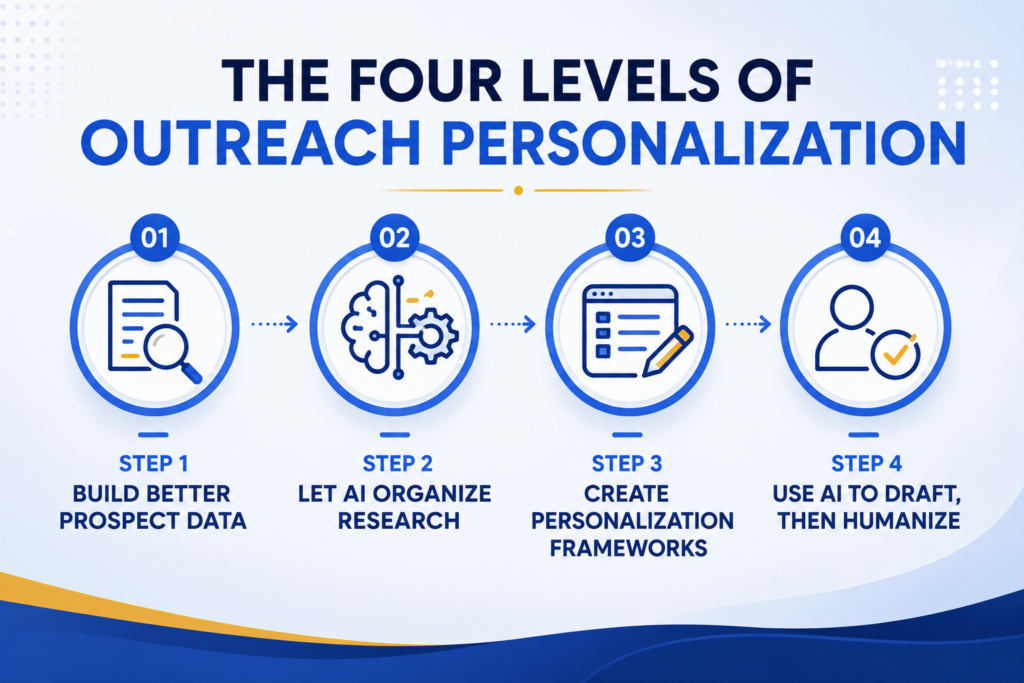
Not every campaign requires deep research.
Instead, segment prospects based on deal size and sales complexity.
| Personalization Level | Best For | Research Time |
| Basic | Large outbound campaigns | Under 2 minutes |
| Contextual | Mid-market outreach | 3–5 minutes |
| Strategic | Enterprise accounts | 10–15 minutes |
| Account-Based | High-value target accounts | 20+ minutes |
This tiered approach allows teams to allocate research time where it has the greatest impact.
Step 1: Build Better Prospect Data
AI can only produce quality outreach if it has quality information.
Before generating any message, gather meaningful prospect data.
Useful data points include:
Company Information
- Industry
- Employee count
- Revenue range
- Growth stage
- Headquarters
Decision-Maker Information
- Job title
- Responsibilities
- Team size
- Professional background
- Recent LinkedIn activity
Business Signals
- Recent funding
- Hiring activity
- New office locations
- Product releases
- Website updates
- Awards
- Strategic partnerships
Technology Signals
Understanding which tools a company already uses helps tailor your messaging.
Examples include CRM platforms, marketing automation software, customer support tools, analytics solutions, or cloud infrastructure.
The more relevant the context, the more natural your outreach becomes.
Step 2: Let AI Organize Research
Instead of asking AI to “write a sales email,” use it to analyze research first.
For example, AI can:
- Summarize company information
- Identify likely business priorities
- Highlight possible operational challenges
- Suggest relevant conversation starters
- Group similar prospects into segments
This saves time while preserving message quality.
Think of AI as a research assistant before it becomes a copywriter.
Step 3: Create Personalization Frameworks
Rather than writing every email individually, develop reusable frameworks.
For example:
Opening
Mention a relevant observation.
Example:
“I noticed your customer success team has expanded significantly over the past six months.”
Business Challenge
Connect that observation to a likely problem.
Example:
“Rapid growth often creates pressure on onboarding and customer support operations.”
Value Proposition
Explain how your solution helps.
Focus on outcomes rather than features.
Call to Action
Invite a conversation without pressure.
Simple CTAs generally outperform aggressive sales language.
Step 4: Use AI to Draft, Then Humanize
AI dramatically accelerates first drafts.
However, every outbound campaign benefits from human review.
Before sending, verify:
- Accuracy
- Tone
- Personalization quality
- Relevance
- Grammar
- Natural language
The best outreach combines AI efficiency with human judgment.
Personalization Channels Beyond Email
Cold outreach is no longer limited to email campaigns.
Successful sales teams personalize across multiple channels.
Reference:
- Recent posts
- Career milestones
- Company updates
- Industry insights
Meaningful engagement before sending a connection request often improves response rates.
Cold Calling
Research can improve opening conversations.
Instead of generic introductions:
“I wanted to learn more about your business.”
Try:
“I noticed your company recently expanded into two new markets, and I thought it might be worth discussing how growing teams are managing customer support.”
Relevant context immediately builds credibility.
Video Outreach
Short personalized videos stand out in crowded inboxes.
Mention:
- Company website
- Product
- Industry news
- Public achievements
Video demonstrates additional effort while maintaining scalability.
AI Tools That Support Personalization
AI now supports nearly every stage of the outbound process.
Common use cases include:
- Prospect research summaries
- Email drafting
- LinkedIn message generation
- Subject line creation
- Call preparation
- Follow-up sequences
- Objection prediction
- CRM note generation
Rather than replacing SDRs, these tools allow them to spend more time building relationships and less time performing repetitive administrative tasks.
Measuring Outreach Success
Personalization should produce measurable improvements.
Track metrics including:
| KPI | Why It Matters |
| Open Rate | Measures subject line effectiveness |
| Reply Rate | Indicates message relevance |
| Positive Reply Rate | Shows prospect interest |
| Meeting Booking Rate | Measures campaign success |
| Opportunity Creation | Tracks qualified pipeline |
| Conversion Rate | Evaluates overall outreach quality |
Weekly reporting helps identify which personalization strategies generate the strongest results.
Common Mistakes to Avoid
Many organizations adopt AI without improving outreach quality.
Avoid these common errors.
Over-Personalizing
Mentioning too many details can feel intrusive.
Use publicly available business information naturally rather than listing every fact you’ve uncovered.
Relying Entirely on AI
AI-generated messages often sound polished but generic.
Always review content before sending.
Using Weak Research
Outdated company information damages credibility.
Regularly refresh prospect data and verify key details.
Ignoring Segmentation
Different industries respond to different messaging.
Tailor value propositions based on industry, company size, and business priorities.
Prioritizing Volume Over Relevance
Sending 1,000 generic emails rarely outperforms sending 200 highly relevant ones.
Quality remains the biggest driver of reply rates.
Building a Scalable Outreach Workflow
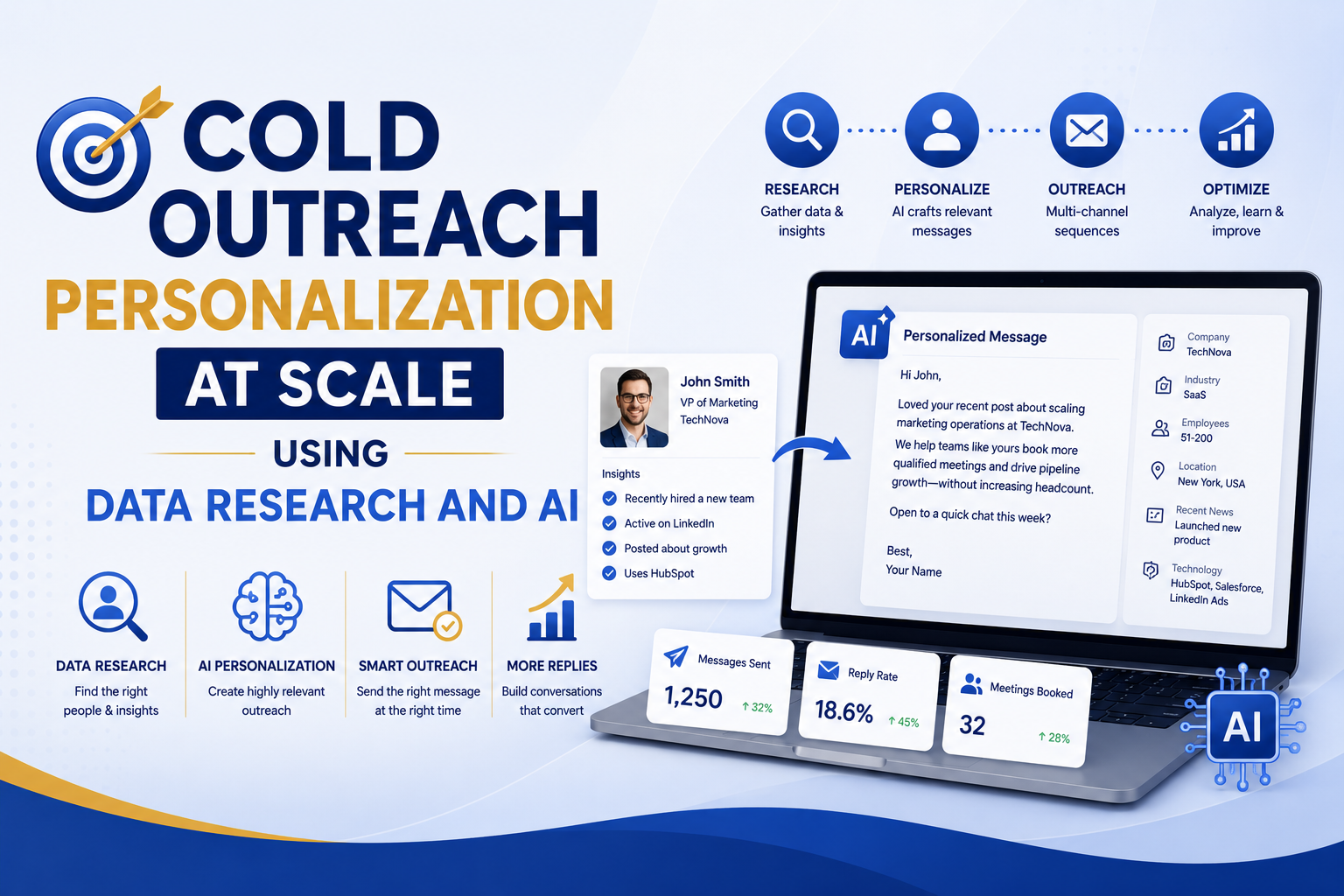
An effective personalization process often follows this sequence:
- Identify target accounts.
- Gather prospect data.
- Segment by industry or buyer persona.
- Analyze research with AI.
- Generate personalized message drafts.
- Review and refine content.
- Launch multichannel outreach.
- Monitor campaign performance.
- Optimize messaging based on results.
This workflow balances efficiency with personalization while supporting long-term scalability.
How IDEAIFY Solutions Helps Businesses Personalize Outreach
At IDEAIFY Solutions, we believe successful outbound sales combine technology with genuine human insight. AI can accelerate research, organize prospect information, and streamline content creation, but meaningful personalization still depends on understanding each prospect’s business goals and challenges.
Our sales and lead generation strategies focus on building targeted prospect lists, conducting high-quality research, developing personalized outreach campaigns, and continuously optimizing messaging based on performance data. By combining data-driven processes with AI-assisted workflows, businesses can scale outbound efforts without sacrificing authenticity or relevance.
Frequently Asked Questions
1. What is cold outreach personalization?
Cold outreach personalization is the practice of tailoring sales emails, LinkedIn messages, or calls using relevant information about a prospect’s business, role, or recent activities to make communication more meaningful.
2. Can AI fully automate personalized outreach?
AI can automate research summaries, draft messages, and suggest personalization, but human review remains essential for accuracy, tone, and relationship building.
3. What types of data improve outreach?
Useful data includes company size, industry, funding, hiring activity, technology stack, leadership content, business goals, and recent company news.
4. Is personalized outreach better than mass email campaigns?
Yes. Well-researched personalized outreach generally delivers higher reply rates, better engagement, and more qualified meetings than generic mass campaigns.
5. How much personalization is enough?
The right level depends on deal size and campaign goals. High-value accounts deserve deeper research, while broader campaigns benefit from scalable contextual personalization.
6. Which outreach channels benefit from personalization?
Email, LinkedIn, cold calling, video messaging, and follow-up sequences all become more effective when supported by relevant prospect insights.
7. How can sales teams measure personalization success?
Track metrics such as open rates, reply rates, positive responses, meeting bookings, opportunity creation, and conversion rates to evaluate the effectiveness of personalized outreach campaigns.
Conclusion
Modern outbound success is no longer driven by volume alone. Buyers expect relevant, thoughtful communication that reflects an understanding of their business, and sales teams that embrace cold outreach personalization at scale using data research and AI are better positioned to meet those expectations.
By combining reliable prospect research with AI-powered workflows, businesses can create outreach that feels personal without sacrificing efficiency. The result is stronger engagement, higher reply rates, and more qualified sales conversations.
As AI continues to evolve, the organizations that succeed will be those that use it to enhance human connection rather than replace it. For B2B sales teams and marketers, the winning strategy is clear: leverage technology to streamline the process, but let relevance, credibility, and genuine value lead every conversation.