The Evolution of Web Development in 2026
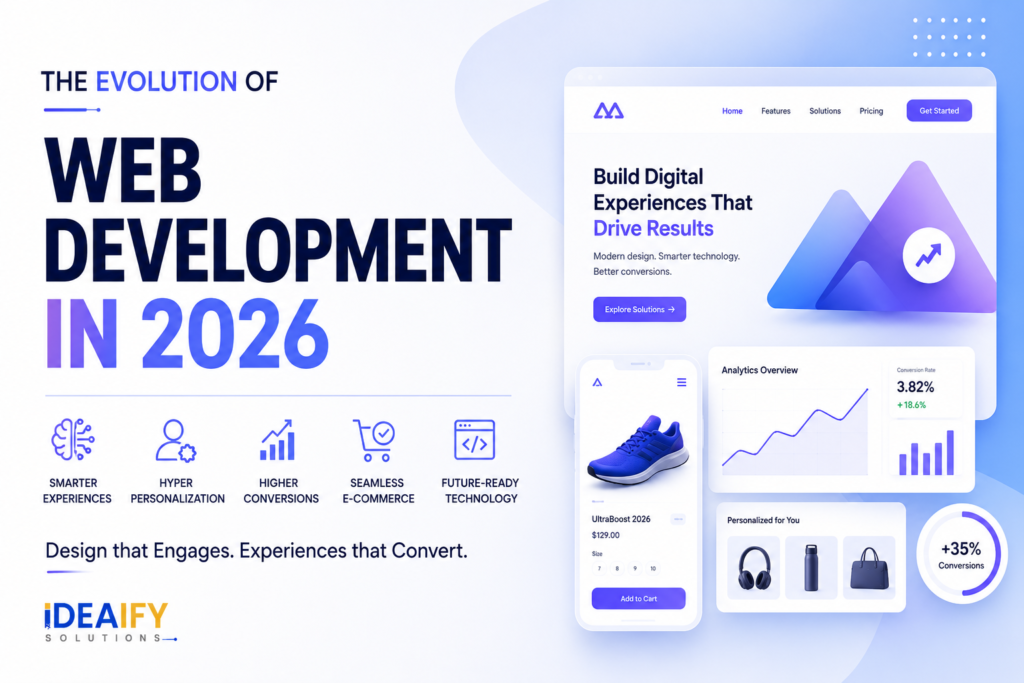
The digital world has undergone a complete metamorphosis within just a few years, and 2026 is the year when innovation and purpose have come together. Businesses across the board, but particularly e-commerce and SaaS, are concluding that they cannot just rely on their presence on the internet. A website designed for the modern era has to be able to sell. User engagement and conversion rates are mainly influenced by the choice of design in the case of checkout flows and first impressions.
The current web design trends are not limited to the boundaries of beauty, but they are a mix of psychology, technology, and user behavior that together create a web experience that is not just aesthetically pleasing but also brilliantly performing. The trend followed by websites is to become smart, interactive, and hyper-personalized. Now, for brands, the challenge is not only to keep pace with the change but also to be the ones who can be spotted in the loud digital world.
So, through this article by Ideaify Solutions, we are going to discuss the hottest web design trends, conversion optimization strategies, and UI/UX innovations of 2026 that are responsible for e-commerce and SaaS companies’ growth. If your goal is to have a more engaged audience, have a lower bounce rate, and more conversions, then this guide is definitely for you.
Why Conversion Optimization Matters More Than Ever
Let’s be honest: traffic that doesn’t convert is like a shop with people walking in but not buying anything.
In 2026, conversion optimization is not merely an as-is in the list of e-business essentials; it is the backbone of successful online businesses. Due to increasing advertising costs and competition, brands cannot allow the loss of potential customers at the last step. The optimization of conversion is now an integral part of web design. The modern-day customer is expecting the best from a website and is not ready to go through any slow loading time, so every pixel is optimized to drive action from faster loading speed to more persuasive microcopy.
For e-commerce and SaaS companies, this translates to harnessing data-driven design, AI suggestions, and user behavior tracking to his/her conversion funnels. Conversion optimization in 2026 will consist of enhancing CTA placements and restructuring the layout of pages. It will be using a combination of behavioral science and performance analytics to convert casual visitors into repeat customers.
The Core Connection Between Web Design Trends and Conversions
The connection between web design and conversions cannot be severed from each other. Your website’s look, usability, and responsiveness to devices not only affect user input but output; basically, whether or not users trust your brand or business to buy from. Studies show that users are able to judge a website’s quality in only 50 milliseconds, which is roughly the time it takes to blink an eye.
In 2026, expect web design trends to focus on clarity, emotion, and interaction. The usage of clean layouts, user-friendly navigation, and visually appealing elements keeps the users’ attention for a longer period of time and at the same time leads them to the desired action. The trend is changing from one of complex effects to one where simplicity serves a purpose.
The designers are mainly choosing to apply emotional design principles like color psychology, recognizable iconography, and storytellers’ visuals that affect the process of making decisions. For example, using a serene blue for trust or a daring red for urgency can quietly nudge users toward conversions.
Minimalist and Fast-Loading Websites: Speed as a Conversion Driver
It does not matter how beautiful looking a site may be, it is still a failure if it is slow. 2026 has set the two main stones of minimalistic design and page speed for conversion-oriented web development. Users are accustomed to getting instant feedback, and sites that load quickly will be rewarded by search engines with better rankings.
Minimalism has been a dominating trend in the web design arena, and in recent years has become the foremost strategy for solving the web performance issue. Clean, fast websites are achieved by eliminating superfluous scripts, pictures, and animations whose loading time is less than two seconds, a very important limit for preventing users getting bored and leaving the site.
Websites for e-commerce and SaaS Interfacing are the biggest gainers from a minimalistic UI. Cognitive load is reduced, hence it becomes easier to make decisions due to simple product grids, efficient checkout processes, and lean interfaces. Modern web development stacks now include tools like Next.js, Vite, and even lazy loading techniques as a requirement.
AI-Powered Personalization: Tailoring Experiences in Real Time
Artificial intelligence is transforming the way people use websites. By 2026, personalization will be hyper-intelligent. Through a combination of user history, preferences, and location, websites will analyze user behavior in real time to personalize the user experience. For example, think of a recommendation engine driven by AI that will suggest products based on the visitor’s previous viewing history, or how SaaS dashboards adapt to a user’s role and behavior to serve the best content. These kinds of personalized experiences will not only better engage their users, but they will also significantly drive conversions.
Moreover, machine learning algorithms will evaluate and then predict what the visitor might want next, ultimately automating the experience in everything ranging from pop-ups to content display. When done properly, artificial intelligence personalization will feel as natural as it will not feel intrusive. This fluid motion from users will result in a level of belonging never experienced before, and certainly lead to a higher likelihood of users completing purchases or signing up for a service.
Immersive User Interfaces: The Rise of Microinteractions and Animations
Microinteractions are those small, engaging animations that respond to your actions such as a button that jiggles when you click it, or a heart that fills up when you like something. These microinteractions add to the user experience (UX) and also prompt behavior, without actually needing to use copy.
By 2026, microinteractions will be commonplace in conversion-based design, as they give users immediate feedback, boost usability, and make the entire site feel alive or active. Motion-based UI elements like loading animations, hover effects, and progress bars will help reduce bounce rates and user drop off by keeping users entertained or engaged.
That said, there is a balance. Too many animations can distract the users, and too few can make the site feel stale. The most effective conversion-driven sites will use motion to draw attention to the CTAs, completion of forms, and product features, which in turn will effectively drive conversions.
Voice and Chat-Based Interfaces: Conversational UX in 2026
As AI assistants, such as ChatGPT and Alexa, gain popularity, voice interfaces and conversational UX are changing the way we interact on the web. In 2026, users will expect to have websites “talk back” to them. E-commerce websites have already introduced a voice search feature that enables people to find items on the website hands-free.
Similarly, SaaS products are adding AI chatbots that are capable of comprehending complicated queries, responding instantly, and even walking users through the onboarding process. This form of interface is able to reduce friction with communication by imitating real human conversations.
Additionally, it supports accessibility to make the web more inclusive for individuals with visual or physical limitations. A well-designed chatbot can perform like a sales person that works 24 hours a day to increase conversions and simultaneously enhance customer satisfaction.
Mobile-First to Mobile-Exclusive Design
With the emergence of chat-AI assistants such asChatGPT andAlexa, the world has progressed far beyond a “mobile-first” mentality. By the year 2026, mobile-only designs would have become standard, especially for e-commerce and SaaS companies. Why? The reasoning behind it is simple: more than 80% of users now browse, compare options, and even purchase products exclusively from their mobile devices. Your website is forfeiting sales every second that you’re not offering a mobile design.
This trend goes far beyond “responsive design”. Modern-day developers are thinking of things such as thumb-friendly navigation, gesture-based interactions, and adaptive layouts based on how the device is being held. One example would be specifically placing the checkout buttons in a thumb-friendly location, or refactoring menu buttons to allow for single-thumbed access.
Another significant development is mobile-first performance optimization. Developers are utilizing tools like AMP (Accelerated Mobile Pages) or progressive caching to optimize speed and performance on mobile networks. Just a one second decrease in load time on an e-commerce site can lead to an increase in conversions by up to 20 percent.
In SaaS, designing dashboards and onboarding flows to work on mobile is paramount. Actionable insight, performance, and clarity are the “holy trinity” of mobile-first exclusive design by 2026.
Dark Mode and Visual Accessibility: Designing for Every User
In 2026, dark mode has gone from being purely a visual trend to a significant part of UI/UX design and a condition of the overall user experience for the year 2026. It offers comfort, cuts down on eye fatigue, and makes it easier for users to read texts when they are online for long periods.
Today’s developers use WCAG-compliant contrast ratios and accessible typography as their standards to make it possible for people with vision impairments to use their products. For e-commerce and SaaS sites, accessibility has become a major factor in conversion optimization; an inclusive site attracts a greater audience and earns the trust of the brand. The use of flexible color schemes and contrast tools makes the website user-friendlier for everyone, thus turning accessibility into not only an ethical but also a strategic advantage for SEO growth and higher conversions.
Data-Driven UI/UX Design: Using Analytics for Smarter Decisions
When it comes toUI/UX in 2026, data will reign supreme. Designers can’t simply design based on gut anymore; web designers today rely upon heat tracking and analytics tools likeHotjar, Mixpanel, andGoogle Analytics 4 to enrich their process. In eCommerce and SaaS brands, this data-driven design process allows us to see real user behavior, including where users drop off and what keeps them on the page.
This information very much allows for constant iterations to layout, CTAs, and checkout flows specifically for increased conversions. As digital attention spans shrink, this data will also ensure that every facet of your design is intentional, measurable, and performance focused. It yields smarter decisions geared to better SEO visibility and long-term sustainability.
Progressive Web Apps (PWAs) and Headless CMS: Future-Ready Tech
Progressive Web Apps (PWAs) and headless CMS systems are some of the most game-changing web design trends of 2026. PWAs provide the speed, offline access and push notifications of mobile apps, but with no need to download anything. They can significantly increase conversion rates. Headless CMS solutions like Strapi and Contentful decouple front-end experience from content management, providing faster updates, omnichannel experiences, and a seamless connection into AI personalized experiences. The combination of these two solutions offers a scalable, flexible solution for e-commerce and SaaS businesses, improving SEO performance, engagement, and digital longevity.
The Impact of 3D and AR Elements on E-Commerce Conversions
Experiences with immersive technology typify UI/UX in 2026, with 3D graphics and augmented reality (AR) leading the way. These website design trends will change product discovery from passive browsing to active engagement, allowing users to see the products they are browsing for themselves, in their own environments, before they buy, and ecommerce platforms that offer augmented reality have been shown to achieve lower return rates and higher purchasing intent.
Software-as-a-service (SaaS) businesses also use AR, specifically 3D models in AR formats, to provide interactive demos for potential buyers and onboarding for new users. Brands can use open source libraries such as WebGL and AR.js to develop fun, engaging, and lightweight experiences in the browser, keeping customers engaged longer. Blending realism with innovation will help brands optimize conversion while also improving engagement metrics and SEO ranks.
Ethical Design and Transparency: Building User Trust
The year 2026 has already seen ethical and transparent web designing as the main factor of conversion optimization. People are now more conscious of their privacy and, therefore, demand to know how their data will be used and specifically refuse to be subjected to the “dark patterns,” which are manipulative design tactics. E-commerce and SaaS companies that are willing to use interfaces that are driven by empathy and practice clear consent can only count on trust and loyalty from customers to be deeper.
The idea behind letting the customers know the truth goes raising trustworthiness which is one of the primary factors stimulating involvement and the raising of the conversion rate. The justification for ethical design is not only in its usage but also in the metrics taken for it. The more users feel safe and honored the more they will connect, the higher the ratio of conversion, and the more they will be brand advocates. The big thing in UI/UX 2026 is that trust is the most significant currency for conversion.
Building a Conversion-Driven Digital Experience in 2026
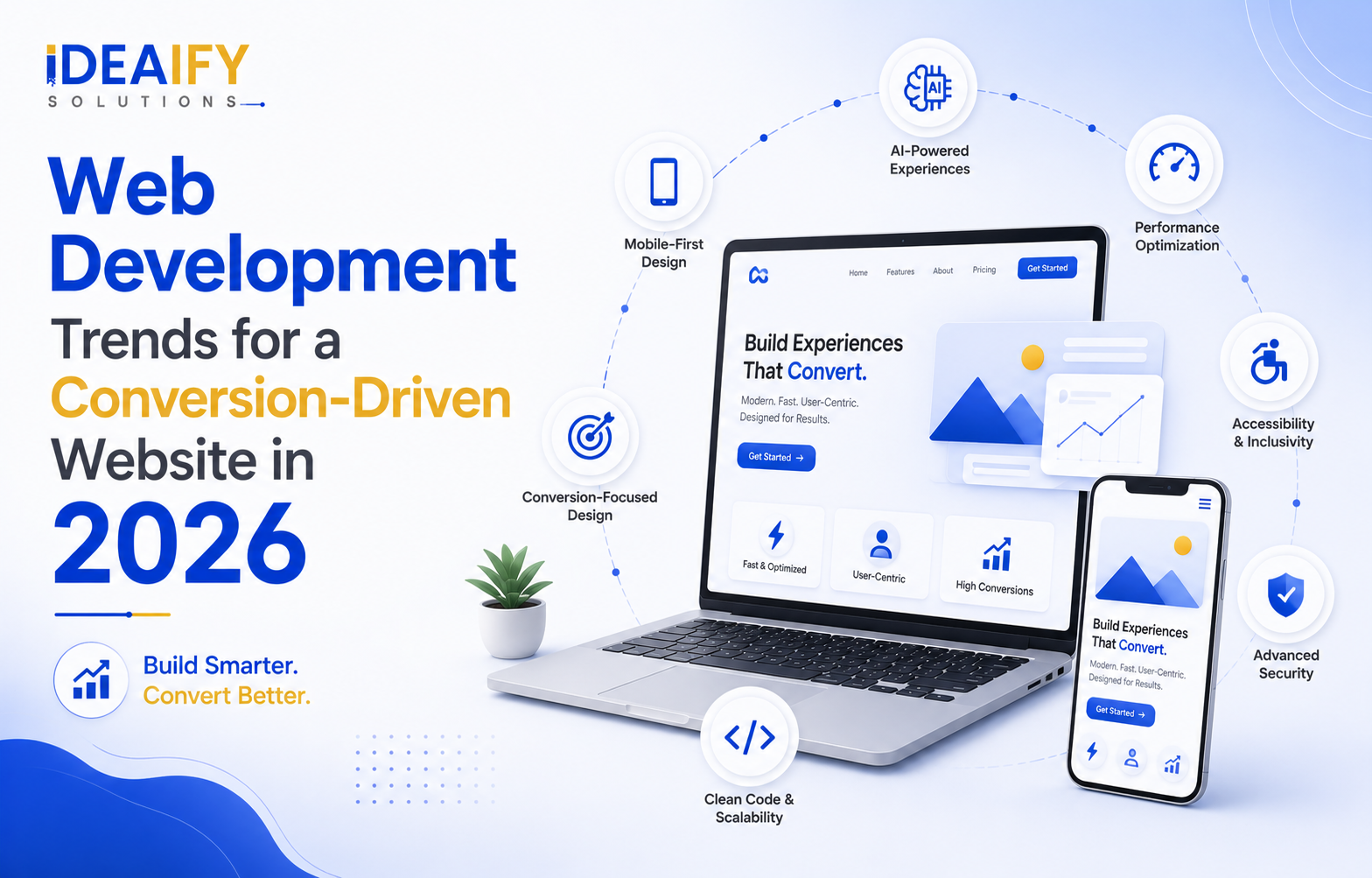
As web development progresses into 2026, real success is now defined by whether or not the experiences created convert, not necessarily whether they look nice. Success of conversion in e-commerce and SaaS businesses is now attained from the combination of UI/UX 2026, AI personalization, and ethical design. All design decisions made will have ramifications for user trust and engagement; an issue tuned into everything from speed optimization to accessibility. Pioneering brands treat their website presence as living breathing systems; ones that will be reviewed and updated to constantly improve the user experience and user trust based on data and ongoing user feedback. Following the evergreen web design trends in this article, can enhance your engagement, improve SEO ranking and finally turn each of those visits into a loyal customer. Digital Growth Pathway to 2026 is clear: Design with purpose, empathy, and performance at the forefront.