In 2026, getting visitors to your website is only half the battle. The real challenge is turning those visitors into qualified leads, booked discovery calls, and paying clients.
For B2B service businesses, every landing page should function as a dedicated salesperson. It should clearly communicate value, answer common objections, establish trust, and guide prospects toward taking action.
Unfortunately, many companies still rely on generic service pages that list features without explaining outcomes. Others overload their pages with excessive text, weak calls to action, or confusing navigation that causes visitors to leave before converting.
Modern B2B landing pages require a strategic balance of persuasive messaging, user experience, trust-building, and conversion optimization. Whether you’re offering outsourced customer support, digital marketing, software development, AI consulting, or business services, your landing page plays a critical role in your sales funnel.
This guide provides a practical blueprint for building service offer pages that generate more qualified leads and help businesses maximize every marketing dollar.
Why Landing Pages Matter More Than Ever
B2B buyers are conducting more independent research before speaking with a sales representative.
By the time someone reaches your landing page, they have likely:
- Compared multiple providers
- Read reviews
- Evaluated competitors
- Identified their business challenge
- Established a shortlist
Your landing page must quickly answer one important question:
Why should they choose you?
Unlike a homepage, which serves multiple audiences, a landing page focuses on one specific offer and one conversion goal.
That focus dramatically improves conversion rates when executed properly.
What Makes a High-Converting B2B Landing Page?
High-performing landing pages share several common characteristics.
They are:
- Focused on one offer
- Written for one audience
- Built around one conversion goal
- Optimized for speed and mobile devices
- Designed to reduce friction
- Structured to answer buyer questions logically
Rather than overwhelming visitors, they guide them through a clear decision-making process.
The Anatomy of a High-Converting Service Offer Page
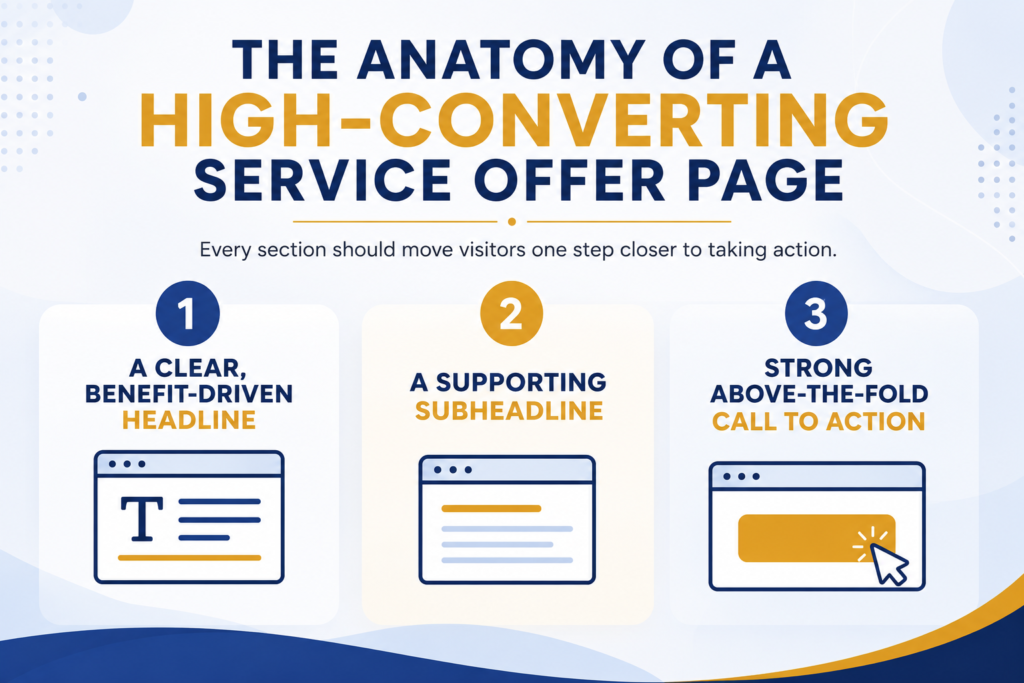
Every section should move visitors one step closer to taking action.
1. A Clear, Benefit-Driven Headline
Your headline should immediately communicate the primary outcome.
Avoid vague statements like:
We Deliver Innovative Business Solutions
Instead, focus on measurable value.
Examples:
- Scale Customer Support Without Hiring In-House
- Book More Qualified Sales Meetings Every Month
- Build Your Offshore Team in Less Than 30 Days
Visitors should understand your offer within five seconds.
2. A Supporting Subheadline
The subheadline expands on your value proposition.
It should explain:
- Who you help
- What problem you solve
- Why your solution is different
Example:
“Dedicated customer support specialists, sales teams, and virtual assistants that integrate seamlessly into your business while reducing operational costs.”
3. Strong Above-the-Fold Call to Action
The primary CTA should appear immediately.
Examples include:
- Book a Free Consultation
- Schedule a Strategy Call
- Get a Custom Quote
- Request Pricing
- Start Your Free Assessment
Avoid competing CTAs that create decision fatigue.
One page.
One offer.
One primary action.
Build Around Customer Problems, Not Your Services
Many businesses describe everything they do.
Successful landing pages describe what customers achieve.
Instead of writing:
“We provide outsourced customer support.”
Focus on outcomes:
“Reduce customer response times, improve satisfaction scores, and scale support without increasing overhead.”
People buy results, not services.
Explain Your Offer in Simple Language
Complex wording reduces conversions.
Avoid technical jargon whenever possible.
Instead of:
“Our omnichannel communication framework leverages scalable customer engagement infrastructure.”
Write:
“We manage customer conversations across email, live chat, phone, and social media from one dedicated support team.”
Simple language increases trust and understanding.
Show Your Process
B2B buyers want to know what happens after they contact you.
A simple process reduces uncertainty.
Example:
| Step | What Happens |
| Discovery Call | Understand your business goals |
| Solution Planning | Build a customized service strategy |
| Team Setup | Assign specialists and tools |
| Launch | Begin delivering services |
| Optimization | Measure performance and improve results |
Transparency builds confidence.
Build Trust Throughout the Page
Trust is one of the biggest conversion factors in B2B marketing.
Include multiple trust signals such as:
Client Testimonials
Real client experiences help reduce perceived risk.
Focus on measurable results whenever possible.
Example:
“Our response time improved by 60% within the first month.”
Case Studies
Brief success stories demonstrate expertise.
Include:
- Client challenge
- Solution
- Results
Numbers make case studies significantly more persuasive.
Industry Experience
Highlight:
- Years in business
- Industries served
- Team expertise
- Certifications
- Technology partnerships
Experience reassures decision-makers.
Social Proof
Examples include:
- Companies served
- Projects completed
- Customer satisfaction ratings
- Team size
- Countries supported
These signals reinforce credibility without being overly promotional.
Handle Objections Before Prospects Ask
Most visitors have concerns before submitting a form.
Address them directly.
Common objections include:
Is this too expensive?
Explain long-term ROI rather than focusing solely on price.
Will your team understand our business?
Highlight onboarding processes and industry experience.
How quickly can we start?
Outline realistic implementation timelines.
What if it doesn’t work?
Reduce perceived risk through flexible engagement models or transparent communication.
When objections are answered proactively, conversions often improve.
Design for Conversion, Not Decoration
Effective web design for leads focuses on usability rather than visual complexity.
Prioritize:
- Clean layouts
- Strong visual hierarchy
- White space
- Readable typography
- Mobile responsiveness
- Fast loading speeds
- Accessible forms
Every design element should support the conversion goal.
Avoid unnecessary animations that distract visitors.
Optimize Your Forms
Long forms create friction.
Only ask for information necessary for the next step.
A typical B2B form includes:
- Name
- Company
- Business email
- Phone number (optional)
- Company size
- Message
Reducing unnecessary fields often increases submissions.
Improve Conversion Optimization with Better CTAs
Calls to action should communicate value.
Weak CTA:
- Submit
Better CTAs:
- Book My Strategy Call
- Get My Free Consultation
- Request My Proposal
- Talk to an Expert
Action-oriented language consistently performs better.
Use Visual Content Strategically
Visuals should support your message.
Effective elements include:
- Team photos
- Product screenshots
- Service workflow diagrams
- Client logos
- Dashboard examples
- Process illustrations
Avoid generic stock photography that adds little value.
Authentic visuals increase credibility.
SEO Best Practices for B2B Landing Pages in 2026
Modern landing pages must perform well in both traditional search engines and AI-powered search experiences.
Key optimization practices include:
Optimize for Search Intent
Target keywords naturally throughout the page, including:
- B2B landing pages
- Conversion optimization
- Service offer pages
- Web design for leads
- Lead generation
- Sales funnel optimization
Focus on answering user questions instead of repeating keywords.
Use Structured Headings
Clear H2 and H3 headings improve:
- Readability
- Search indexing
- AI summarization
Well-organized content is easier for both users and search engines to understand.
Add FAQ Sections
Frequently asked questions increase topical coverage while improving opportunities for featured snippets and AI-generated summaries.
Improve Page Speed
Fast-loading pages reduce bounce rates.
Compress images, minimize scripts, and optimize hosting performance.
Every second matters.
Common Mistakes That Hurt Landing Page Performance
Many businesses unknowingly reduce conversions through avoidable mistakes.
Common issues include:
Too Many Navigation Links
Landing pages should minimize distractions.
Remove unnecessary menu options whenever possible.
Generic Messaging
Avoid broad statements that could apply to any company.
Instead, communicate specific value.
Weak Headlines
Visitors should instantly understand what you offer.
Confusing headlines increase bounce rates.
No Proof
Claims without evidence reduce credibility.
Support your messaging with testimonials, statistics, or case studies.
Poor Mobile Experience
A growing percentage of B2B buyers research vendors using mobile devices.
Your landing page must function perfectly across all screen sizes.
Example Landing Page Structure
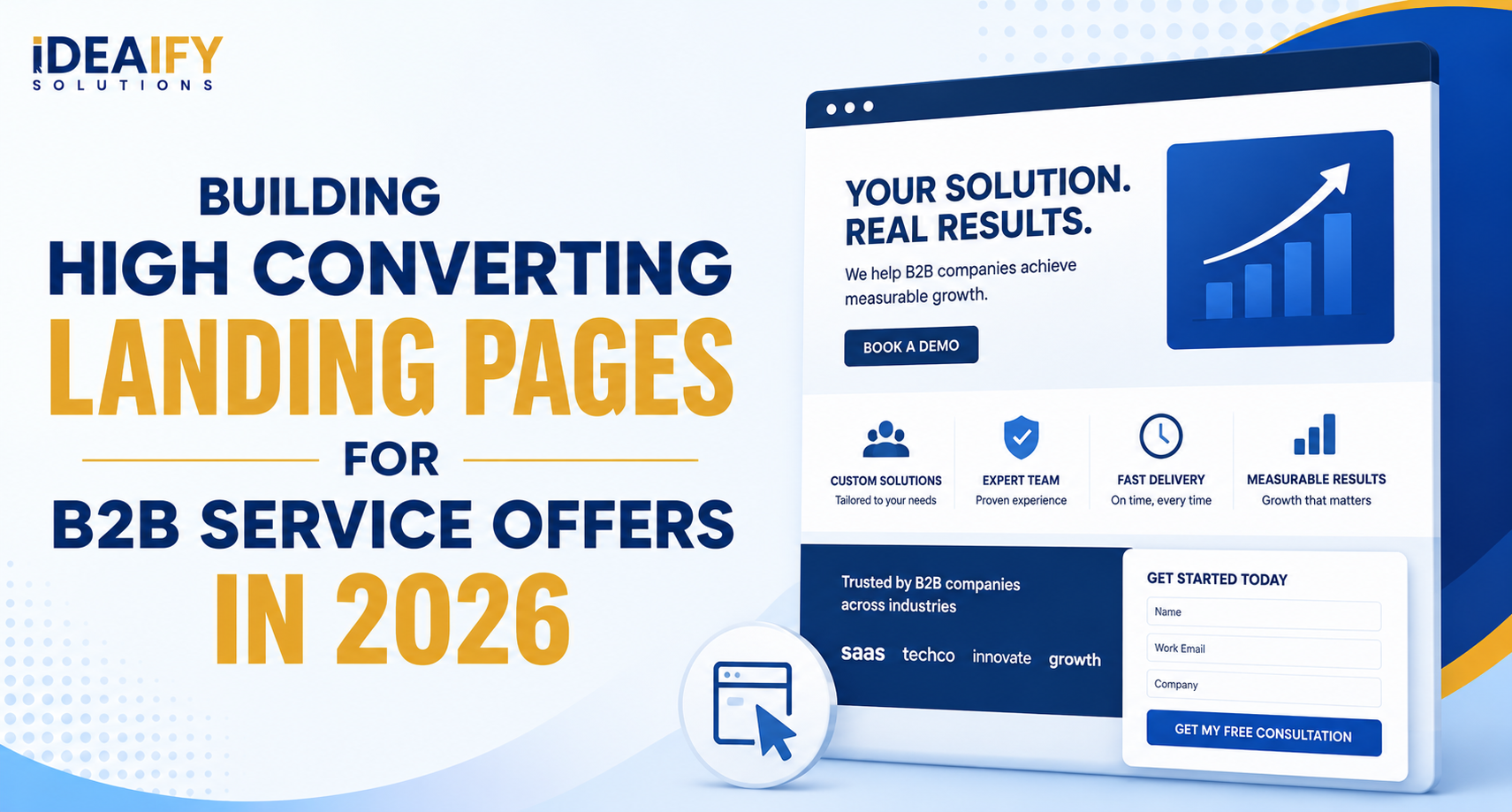
A high-converting service offer page often follows this structure:
- Headline
- Supporting subheadline
- Primary CTA
- Client logos
- Benefits
- Service overview
- Process
- Case study
- Testimonials
- FAQs
- Final CTA
This sequence answers questions in the order buyers naturally think.
How IDEAIFY Solutions Creates Landing Pages That Convert
At IDEAIFY Solutions, we understand that successful landing pages combine persuasive messaging, strategic design, and data-driven conversion optimization. Every service page should educate prospects, demonstrate expertise, and guide visitors toward a meaningful next step.
Our approach focuses on understanding buyer intent, simplifying complex service offerings, improving user experience, and creating content that performs well across both traditional search engines and AI-powered discovery platforms. The result is landing pages that not only attract visitors but also generate qualified conversations and measurable business growth.
Frequently Asked Questions
1. What is a B2B landing page?
A B2B landing page is a dedicated webpage designed to convert business visitors into qualified leads by focusing on a single offer and a specific call to action.
2. How is a landing page different from a homepage?
A homepage serves multiple purposes and audiences, while a landing page focuses on one service, campaign, or conversion objective.
3. What makes a landing page convert better?
Strong headlines, clear messaging, trust signals, simple forms, compelling calls to action, and an optimized user experience all contribute to higher conversion rates.
4. Should B2B landing pages include pricing?
It depends on your sales strategy. Transparent pricing can qualify leads more effectively, while custom pricing may be appropriate for complex or enterprise services.
5. How many calls to action should a landing page have?
Most high-performing landing pages focus on one primary conversion goal while repeating the same CTA throughout the page.
6. Why are testimonials important?
Testimonials provide social proof, reduce perceived risk, and demonstrate real-world success, making prospects more confident in their buying decision.
7. How often should landing pages be updated?
Landing pages should be reviewed regularly to refresh messaging, improve SEO, incorporate customer feedback, test new conversion elements, and reflect evolving market conditions.
Conclusion
High-converting B2B landing pages are built with purpose. They speak directly to a specific audience, present a clear value proposition, address common objections, and make it easy for prospects to take the next step.
As buyer expectations continue to evolve in 2026, businesses that invest in thoughtful conversion optimization, compelling service offer pages, and effective web design for leads will generate stronger engagement, higher-quality inquiries, and better returns from their marketing efforts.
Rather than treating your landing page as a digital brochure, view it as a strategic sales asset. With the right combination of persuasive content, user-focused design, and continuous optimization, your landing pages can become one of your most effective tools for driving sustainable B2B growth.