For most growing businesses, the busiest time of the year is also the most dangerous. Holiday seasons and early Q1 bring a sharp increase in customer activity. Orders go up. Product usage increases. Support tickets flood in. What looks like growth on the surface can quickly turn into chaos behind the scenes. Support teams get overwhelmed. Response times slow down. Customers grow frustrated. Negative reviews start appearing. And in SaaS, delayed support often leads directly to churn.
This is where many companies lose the momentum they worked all year to build. The problem is not the surge itself. It is the lack of preparation. Smart companies do not try to handle seasonal spikes with fixed internal teams. They build flexible systems that scale with demand. Using outsourced CX teams is one of the most efficient approaches to accomplish this.
A well-organized strategy to seasonal support guarantees your company can manage expansion without lowering customer experience. This guide describes how SaaS firms and e-commerce brands can handle holiday customer service demand, avoid backlog, and keep up excellent support during high seasons.
Why Holiday and Q1 Surges Break Support Systems
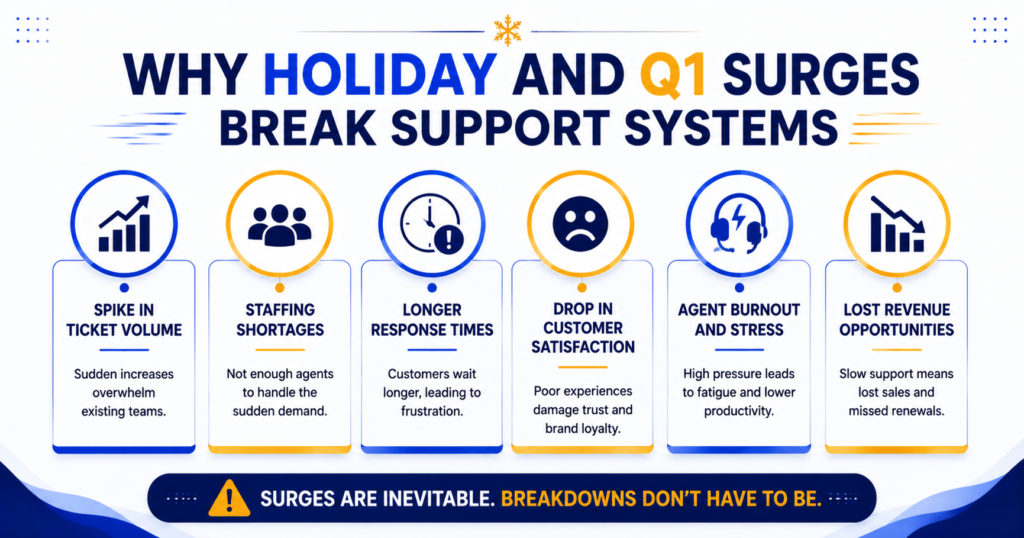
Most support teams are built for average demand, not peak demand. During normal operations, internal teams can manage tickets efficiently. But during seasonal spikes, ticket volume can increase by two to five times within days. This creates immediate pressure on support operations.
Some of the most common challenges include:
- Sudden increase in customer inquiries
- Delayed response times
- Overworked support agents
- Inconsistent service quality
- Rising customer frustration
For e-commerce brands, this often happens during holiday sales, Black Friday campaigns, and post-purchase inquiries.
For SaaS companies, Q1 is usually a high-growth period. New users onboard, existing customers upgrade plans, and support requests increase significantly.
Without proper ticket surge management, even strong teams begin to struggle.
The Hidden Cost of Poor Seasonal Support
Many companies underestimate the impact of poor support during high-volume periods. They focus on handling tickets but overlook the long-term consequences.
Delayed or poor holiday customer service can lead to:
- Lost customers who never return
- Negative reviews that damage brand reputation
- Increased refund requests
- Lower customer lifetime value
- Higher churn rates in SaaS products
Customer experience is not just a support function. It directly affects revenue.
When customers feel ignored or frustrated, they look for alternatives. In competitive markets, switching to another provider takes only minutes.
This is why seasonal support strategy should be treated as a core growth priority, not an afterthought.
What Is Ticket Surge Management?
Ticket surge management is the process of preparing for and managing unexpected increases in customer support. This includes planning and optimizing the process to ensure consistency in response and service quality.
Effective ticket surge management includes three key elements:
- Capacity
- Efficiency
- Consistency
Capacity ensures that there are enough agents to respond to incoming tickets.
Efficiency ensures that each ticket or request is handled quickly and effectively.
Consistency ensures that the experience remains seamless for the customer.
One way many businesses are trying to tackle the ticket surge management process is by asking internal teams to work longer hours. This is not a sustainable solution. Flexible support options are now being considered by many businesses.
Why Outsourced CX Teams Are the Smart Solution
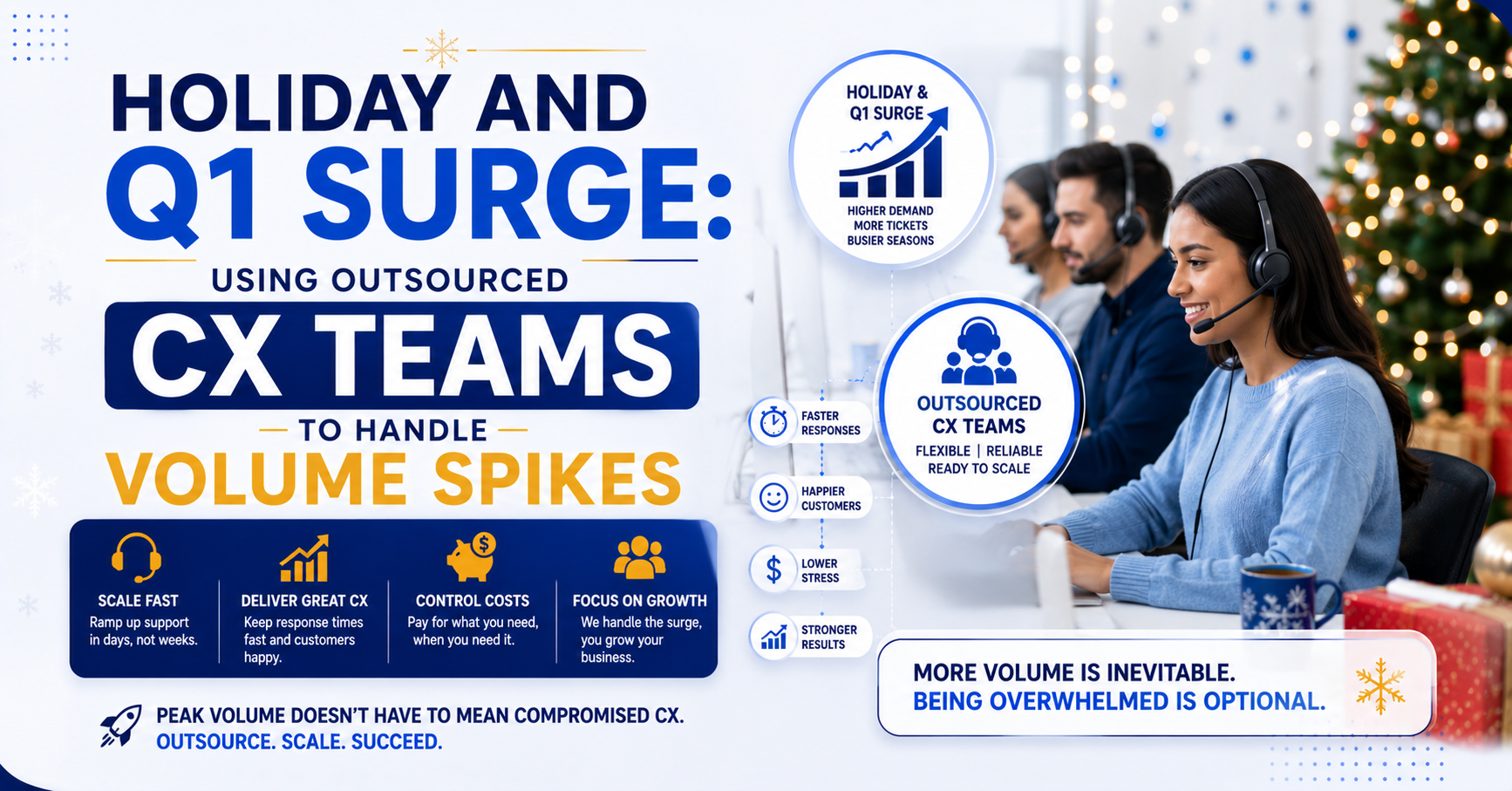
Working with outsourced CX companies is among the most efficient means to handle seasonal demand. Trained support professionals, these teams can fit into your current activities and manage peak-season client interactions. Outsourcing lets companies grow support capacity swiftly and effectively unlike employing full-time workers. Here is why this model works so well.
Immediate Scalability
- Outsourced teams can be deployed quickly when ticket volume increases.
- Instead of spending weeks recruiting and training new staff, you gain access to ready-to-perform agents.
- This is critical during fast-moving periods like holiday sales or product launches.
Cost Efficiency
- Hiring full-time staff for temporary demand is expensive.
- Outsourcing allows you to scale support only when needed. This keeps costs aligned with actual demand.
- For e-commerce and SaaS companies, this flexibility helps maintain profitability during high-growth periods.
Specialized and Trained Agents
- Experienced outsourced CX teams have already had customer interaction management training.
- They are conversant in performance measures, communication standards, and support procedures.
- This guarantees that customer experience does not suffer during peak times and cuts down onboarding time.
24/7 Support Cover
- Seasonal demand often goes beyond regular business hours.
- Round-the-clock assistance from outsourced teams guarantees that clients get prompt answers regardless of their location.
- This is especially crucial for companies operating internationally.
- This is especially important for global businesses.
How to Get Ready for Seasonal Support Surges
- Smooth operations and support turmoil are distinguished by preparation.
- Organizations managing seasonal spikes effectively typically employ a methodical strategy.
Analyze Historical Data
Start by reviewing past performance. Look at previous holiday seasons or high-growth periods and identify patterns.
Focus on:
- Peak ticket volume days
- Common customer issues
- Response time trends
- Resolution times
This data helps you forecast future demand and plan resources accordingly.
Identify High-Impact Support Areas
Not all tickets are equal.
Some issues require immediate attention, while others can wait.
Prioritize categories such as:
- Payment issues
- Order problems
- Account access issues
- Product failures
These are critical for customer satisfaction and should be handled quickly.
Build a Flexible Support Plan
Your support strategy should include both internal and external resources. Internal teams can focus on complex issues and high-value customers. Outsourced CX teams can handle repetitive queries, first-level support, and overflow tickets. This balance ensures efficiency without sacrificing quality.
How Outsourced CX Teams Improve Customer Experience
Many founders worry that outsourcing may reduce service quality. In reality, when implemented correctly, outsourcing often improves customer experience.
Faster Response Times
With additional support capacity, tickets are answered quickly.
Customers no longer wait hours or days for a response.
Speed alone can significantly improve satisfaction levels.
Reduced Backlogs
During peak periods, backlogs can grow quickly.
Outsourced teams help clear incoming tickets in real time, preventing accumulation.
This keeps operations under control.
Consistent Service Quality
Professional support teams follow structured processes and quality standards.
This ensures that customers receive consistent responses, even during high-volume periods.
Better Focus for Internal Teams
When routine queries are handled externally, internal teams can focus on:
- Complex problem solving
- Product improvements
- High-value customer interactions
This leads to better overall performance.
Seasonal Support Strategies for E-Commerce
E-commerce businesses face intense pressure during holiday seasons.
Order volumes increase, and customer expectations rise.
To manage this effectively:
Focus on post-purchase support. Customers often need help with order tracking, returns, and delivery issues.
Prepare for common questions. Build response templates for frequent queries.
Use outsourced CX teams to handle first-level inquiries and peak demand.
Ensure fast response times. In e-commerce, delays often lead directly to negative reviews.
A strong holiday customer service strategy can turn seasonal buyers into long-term customers.
Seasonal Support Strategies for SaaS Companies
For SaaS companies, Q1 is often a period of rapid growth.
New users onboard, and product usage increases.
To manage this:
Prioritize onboarding support. Early user experience is critical for retention.
Monitor technical issues closely. Bugs or downtime during growth phases can damage trust.
Use outsourced CX teams to handle onboarding queries and general support tickets.
Focus internal teams on product improvements and high-value accounts.
Strong ticket surge management during Q1 helps reduce churn and improve customer lifetime value.
Common Errors to Avoid
Even with the right strategy, some mistakes can reduce effectiveness like:
- When you rely only on internal teams, it often leads to burnout and declining service quality.
- Scaling too late can result in backlogs that are difficult to recover from.
- Poor communication between internal and outsourced teams can create inconsistencies.
- Lack of training or documentation can slow down onboarding for external agents.
- Avoiding these mistakes ensures that your seasonal support strategy delivers the expected results.
Building a Long-Term Support System
Seasonal support should not be treated as a one-time fix. Instead, it should be part of a long-term strategy. Companies that consistently grow build systems that can scale at any time.
This includes:
- Clear support processes
- Strong documentation
- Flexible resource allocation
- Reliable outsourcing partners
By combining internal expertise with outsourced CX teams, businesses create a support system that adapts to demand without breaking.
Conclusion
Holiday seasons and Q1 growth periods bring opportunity, but they also bring pressure. Unplanned, rising demand could result in bad customer experiences, unfavorable reviews, and lost income. Investing in ticket surge control and using outside CX teams helps companies to confidently negotiate high-volume times. This method helps SaaS businesses and e-commerce companies to grow support teams, preserve service quality, and guard customer connections. Growth should not come at the expense of customer experience. It does not have to be with the right seasonal support plan.
seasonal support, holiday customer service, outsourced CX teams, ticket surge management