Customer behaviours are changing rapidly and customers expect immediate responses, precise solutions and personal interactions. At the same time, companies must handle increasing volumes of support requests, more complex products and tighter budgets. Therefore, SaaS businesses, eCommerce companies and tech-enabled SMEs have a challenge to deliver fast, scalable support while maintaining the human experience their customers expect.
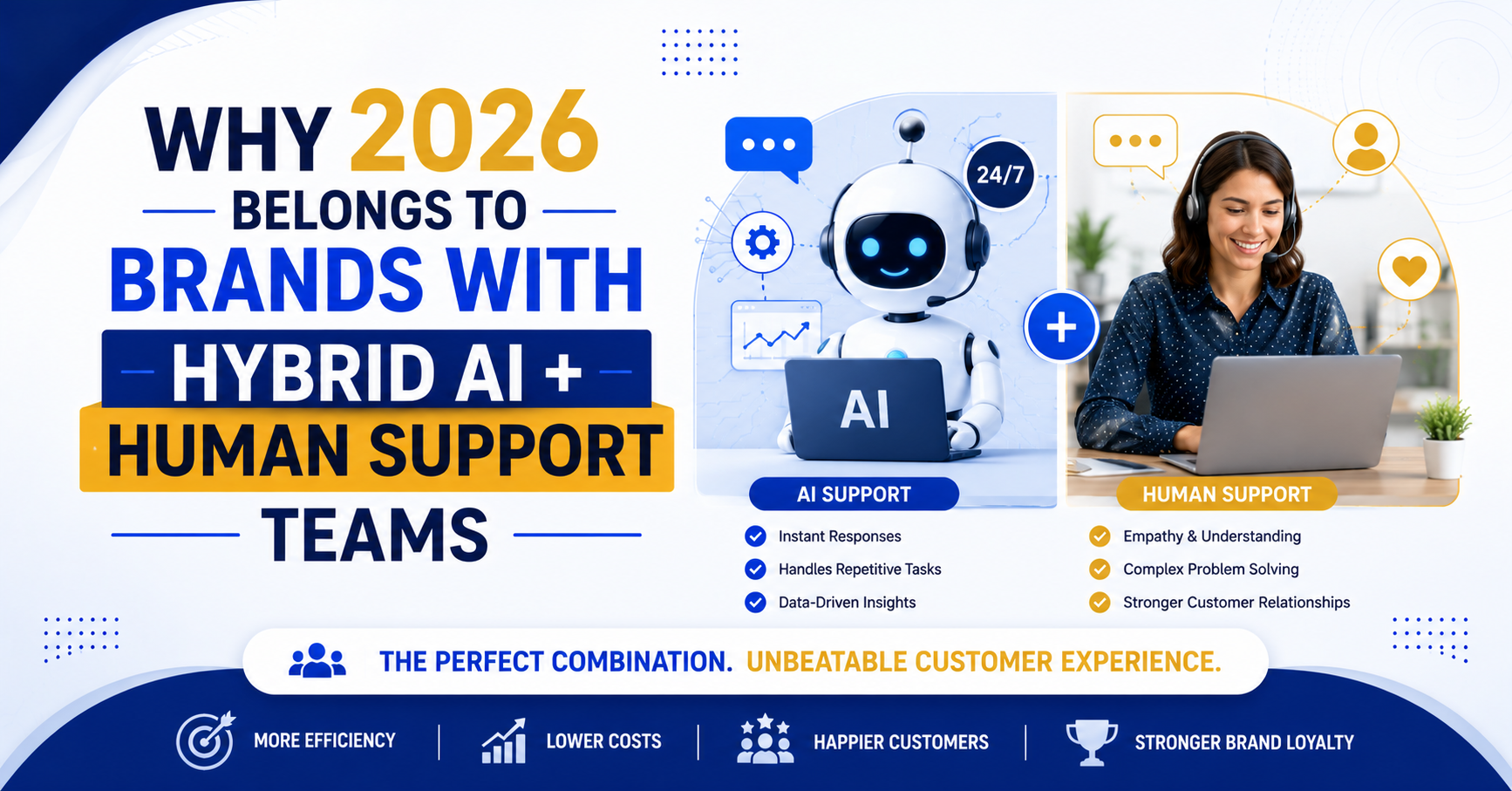
The solution is not choosing between automated or human support; the future belongs to those companies who can successfully integrate both types of support. The hybrid AI + human support model will enable companies to have the benefit of automating the repetitive tasks that occur, while also providing human customer service representatives with the ability to solve difficult problems and develop long-lasting relationships with their customers. This hybrid approach is rapidly becoming one of the top trends in Customer Experience for 2026. Therefore, companies that adopt this model early on are likely to experience rapid scalability, reduced operational expenses and provide their customers with an exceptional overall experience.
The Development of Customer Service
Customer service over the past ten years has developed through multiple steps. At first, businesses depended solely on human agents processing every single contact. Even though this offered a personal touch to customer service, it created some difficulties due to growing customer volumes. Support teams were overwhelmed by the growth of customers. The next step was to utilize automation. Automated systems, such as chatbots, promised to be efficient but many companies relied too heavily on chatbots. Customers frequently found themselves being processed through robotic flow charts that did not address their specific needs. Today, a hybrid model of Customer Experience is in the process of developing.
The hybrid model consists of utilizing artificial intelligence (AI) to complete basic, simple customer service tasks and utilizing human agents when empathy, judgement and problem-solving are required. AI, rather than replacing customer support agents, will improve the productivity of the support teams. The outcome will be faster response times to customers, more positive customer experience and improved efficiency within businesses.
What Is Hybrid AI Customer Support?
Hybrid AI customer support combines automation tools with skilled human agents to deliver a balanced support experience.
In this model:
AI systems manage repetitive, high-volume tasks.
Human agents focus on complex, high-value conversations.
The goal is simple: let technology handle what it does best while allowing humans to deliver empathy, creativity, and critical thinking.
A typical hybrid support system works like this:
AI handles initial interactions such as answering common questions, routing tickets, or retrieving account information. When a problem becomes more complex, the system seamlessly transfers the conversation to a human agent who can resolve it quickly.
This structure dramatically improves efficiency while maintaining the personal touch customers expect.
AI Can’t Be The Only Solution
Automation has certainly come a long way over the past several years; however, there are still some serious drawbacks to AI.
Many times when customers contact support, they are upset, confused and/or have a need that requires detailed personal interaction with the support person; therefore, AI does not yet possess the level of emotional intelligence that allows it to respond appropriately to variously complex support situations.
The following are a few examples of situations where a customer will seek assistance:
- A SaaS customer’s ability to access a mission-critical capability to run their business, at the time of their product launch.
- E-commerce customers receiving the wrong item prior to an important “event.”
- Business-to-business (B2B) customers having questions about pricing, onboarding or integrating with existing systems.
Scripted chatbot responses will not work for these types of support interactions because they lack the empathy, flexibility and critical thinking that live staff members possess. For this reason, organisations that use 100% automation for providing customer service generally experience declining satisfaction ratings from their customers. A better support strategy leverages AI, in conjunction with a live support agent, to enhance overall service delivery, rather than replacing the need for a live-support agent.
How the Hybrid Support Model Works
A well-designed hybrid system clearly divides responsibilities between AI tools and human agents.
AI Handles Speed and Scale
Artificial intelligence excels at processing large volumes of simple requests. These tasks often include:
Answering frequently asked questions
Providing order status updates
Resetting passwords
Collecting customer information
Routing tickets to the correct department
These repetitive tasks make up a large portion of support requests. When AI manages them, support teams free up significant time and resources.
Customers also benefit from faster response times because AI systems operate instantly and around the clock.
Humans Handle Complexity and Relationships
Human agents step in when interactions require deeper understanding.
These situations often include:
Technical troubleshooting
Customer complaints
Account management discussions
Upselling or cross-selling opportunities
B2B onboarding conversations
In these cases, human expertise and emotional intelligence make a huge difference.
For SaaS and B2B sales environments, support teams often play a direct role in customer retention and expansion. Skilled agents can identify opportunities to upgrade plans, recommend features, or solve problems before they lead to churn.
Why Hybrid Support Is a Major CX Trend for 2026
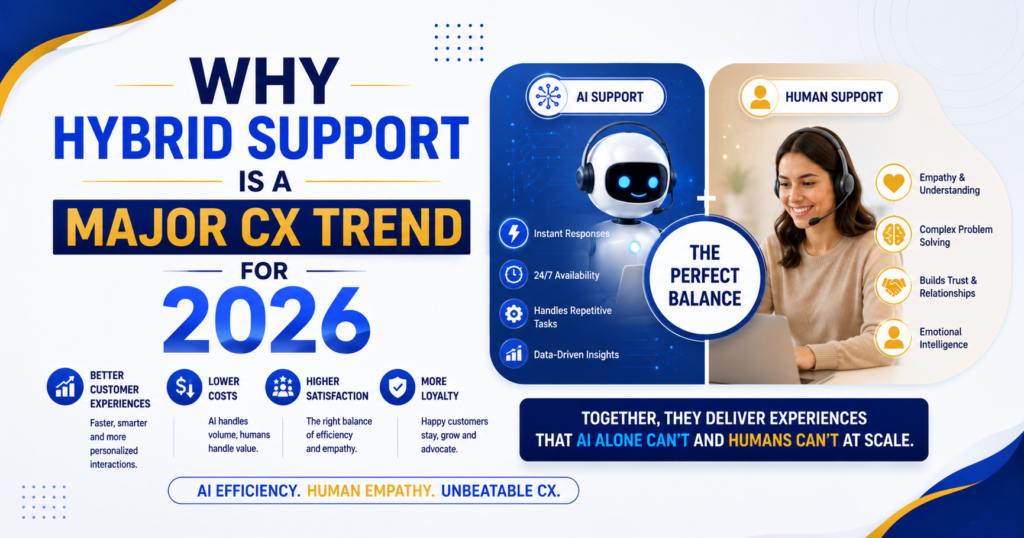
Hybrid support models are on track to emerge as a top customer experience (CX) trend in 2026 due to the following factors:
1) Rising customer expectations: Customers now demand instant responses. Long periods of time between the submission of their support requests and receiving a response are no longer acceptable, and thus customers are expecting a response immediately. Artificial intelligence (AI) systems provide instant responses to common requests but it’s human agents that can help with more complex issues. This balance of speed and quality is what the modern customer has come to expect.
2) Growing volume of support requests: As Software-as-a-Service (SaaS) products by online businesses grow, the number of support requests grows dramatically. Building large, in-house support teams can become cost-prohibitive. Hybrid support models can allow companies to scale their support operations, allowing their businesses the ability to deliver on the quality of service while creating efficiencies.
3) Cost-efficiency: AI systems can automate many of the processes associated with responding to time-consuming routine requests, thus enabling companies to save money and time on their support operations. At the same time, companies keep a smaller, well-trained human team who handle high-volume, low-complexity interactions. Many companies would also typically use outsourcers to provide their support needs in order to have the agents available without the associated overhead.
4) Improved customer insight: AI systems can analyze large amounts of customer data and identify patterns in their behaviour when interacting with the company. Companies are able to utilise this information to determine:
a) Common product issues
b) Customer pain points
c) Feature requests
d) Opportunities for improvement
Human agents will be able to use this type of information when interacting with customers to deliver a more effective level of service and to build stronger relationships with their customers.
The Role of Outsourced Support in Hybrid Models
Many companies that are developing quickly use a hybrid model of supporting their customer base by using AI-types of products along with outsourcing support functions.
Using these types of resources creates a lot of advantage to companies.
The first advantage is scalability. Using outsourced resources allows a company to quickly scale up and down to meet the needs of its customer base.
The second advantage is the reduced operational overhead of attempting to build and manage a large in-house team. Using outside organizations removes the burden of having to perform recruiting, training and support scheduling as part of the operation.
Another advantage is that outsourced teams often have additional domain-specific expertise in providing customer service especially as it relates to SaaS and/or B2B companies.
Using these types of resources in conjunction with AI technology allows outsourced agents to operate more efficiently and can handle higher volumes of interactions with customers.
This creates an overall support model that remains both scalable and cost-effective.
Benefits of the Hybrid AI Plus Human Support Model
Businesses adopting hybrid support models are seeing measurable improvements in several areas.
Faster Response Times
AI tools respond instantly to common requests, reducing wait times and improving the overall customer experience.
Higher Customer Satisfaction
Customers appreciate fast answers, but they also value human interaction when problems become complex. Hybrid systems deliver both.
Improved Agent Productivity
Human agents spend less time answering repetitive questions and more time solving meaningful problems.
This increases job satisfaction and reduces burnout within support teams.
Better Sales and Retention Opportunities
Support interactions often reveal important signals about customer needs.
In SaaS and B2B sales environments, agents can identify opportunities to upgrade subscriptions, introduce new features, or strengthen long-term relationships.
Scalable Operations
Hybrid systems allow companies to handle growing support demand without dramatically increasing costs.
This scalability becomes especially valuable for fast-growing startups and e-commerce brands.
Building a Hybrid Support Strategy
Companies that want to adopt a hybrid support model should focus on a few key steps.
Start by analyzing your current support data. Identify the most common types of support requests and determine which ones can be automated safely.
Next, implement AI tools that handle repetitive interactions while ensuring smooth escalation paths to human agents.
Finally, train support teams to focus on complex issues, customer relationships, and problem resolution.
Successful hybrid models rely on collaboration between technology and people. The goal is not to automate everything, but to create a balanced system that maximizes efficiency and customer satisfaction.
The Future of Customer Experience
Customer experience will become a major competitive advantage in the coming years.
Companies that respond quickly, solve problems effectively, and build genuine relationships with customers will stand out in crowded markets.
The human plus AI CX model enables businesses to achieve this balance.
AI provides the speed and efficiency customers expect. Human agents deliver the empathy, creativity, and trust that build lasting relationships.
Together, they create a powerful support system designed for the demands of modern digital businesses.
Conclusion
As we have stepped in 2026, customer support will evolve into an integrated technology/human-service delivery model that leverages both technological innovation and human expertise. Business models that are based solely on automated solutions only deliver a cold, impersonal customer experience. Businesses that rely solely on human employee engagement will likely experience difficulties in scaling their customer support operations efficiently. The companies that will be successful will be those who have embraced the use of both customer support teams consisting of AI technology, as well as the use of skilled employees and outsource resources to meet their customer service delivery goals. The result will be quicker response times, better assistance to customers, and stronger bonds between businesses and customers.
This is particularly true for SaaS-type companies, e-commerce brands, and technology-enabled SMEs. Therefore, it is clear that the future of customer experiences will be provided via hybrid-support teams.
In addition, the companies implementing the hybrid-support team model will be leading their respective industries by the year 2026.