The cost of customer acquisition has never been more, especially SaaS and e-commerce businesses fighting escalating the cost of advertising, over-saturating the market, and inefficiencies in funnel optimization. One trend is now crystal clear: businesses that just use human-based sales teams are losing to those businesses that embrace AI sales agents in their inbound and outbound funnels.
Artificial intelligence selling is not experimental anymore, it is the future growth driver. And outsourcing experts such as IDEAIFY Solutions is assisting companies in putting entire AI sales teams to work to qualify leads, schedule appointments, individualize their outreach, and convert more effectively. To brands looking to expand without doubling sales staff or advertising budgets, AI has proven to be the quickest path of reducing CAC and converting.
The article examines the role of AI sales agents, AI conversion rate optimization, and AI in sales funnels as transforming the growth strategies in 2026 and the way firms such as Ideaify are facilitating inbound and outbound automation that creates quantifiable revenue benefits.
Understanding the CAC Crisis in 2026
The customer acquisition cost (CAC) has shot up by several folds in the last five years. Advertisements have been unpredictable, there is high competition among the key words and customers need more touch points before making a purchase. The result? The cost of acquisitions usually increases more than the revenues and this squeezes the margins of the SaaS and e-commerce brands.
Leaks in the funnel like slow response times, poor lead qualification, etc., also multiply the costs. A sales rep who responds in 15 minutes is already too slow because AI sales agents can communicate in milliseconds. Companies that do not have automation are really paying top prices to get leads that they end up not converting.
That is why AI sales agents have become a necessity: they focus on CAC on the level of targeting, less human delays, and more funnels of scale.
What Are AI Sales Agents?
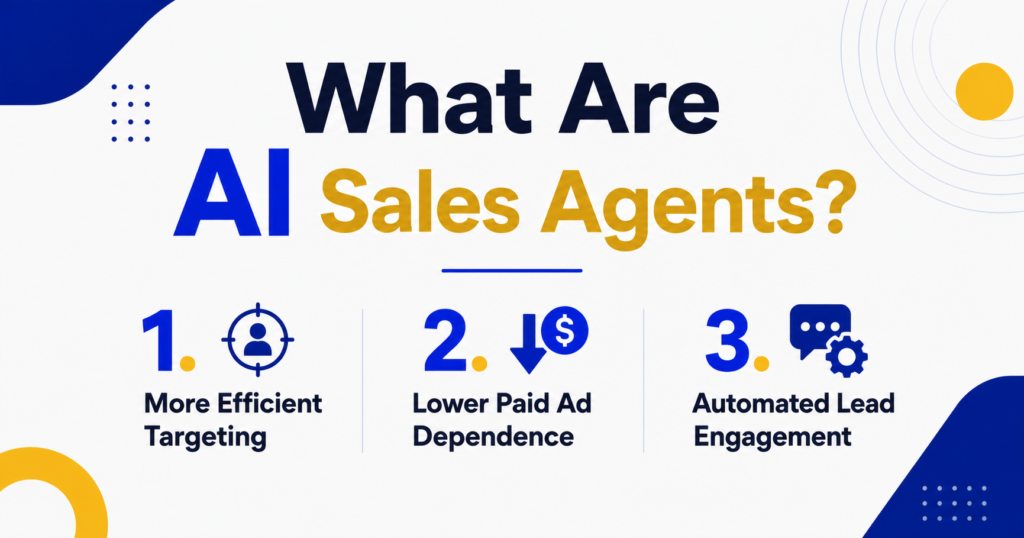
AI sales agents are smart and autonomous machines that have been made to carry out actual selling activities, something that traditional chatbots could never achieve. Giving answers to frequently asked questions is one thing, but on the other hand, chatbots answer questions, qualify leads, personalize outreach, make calls, and follow up 24/7.
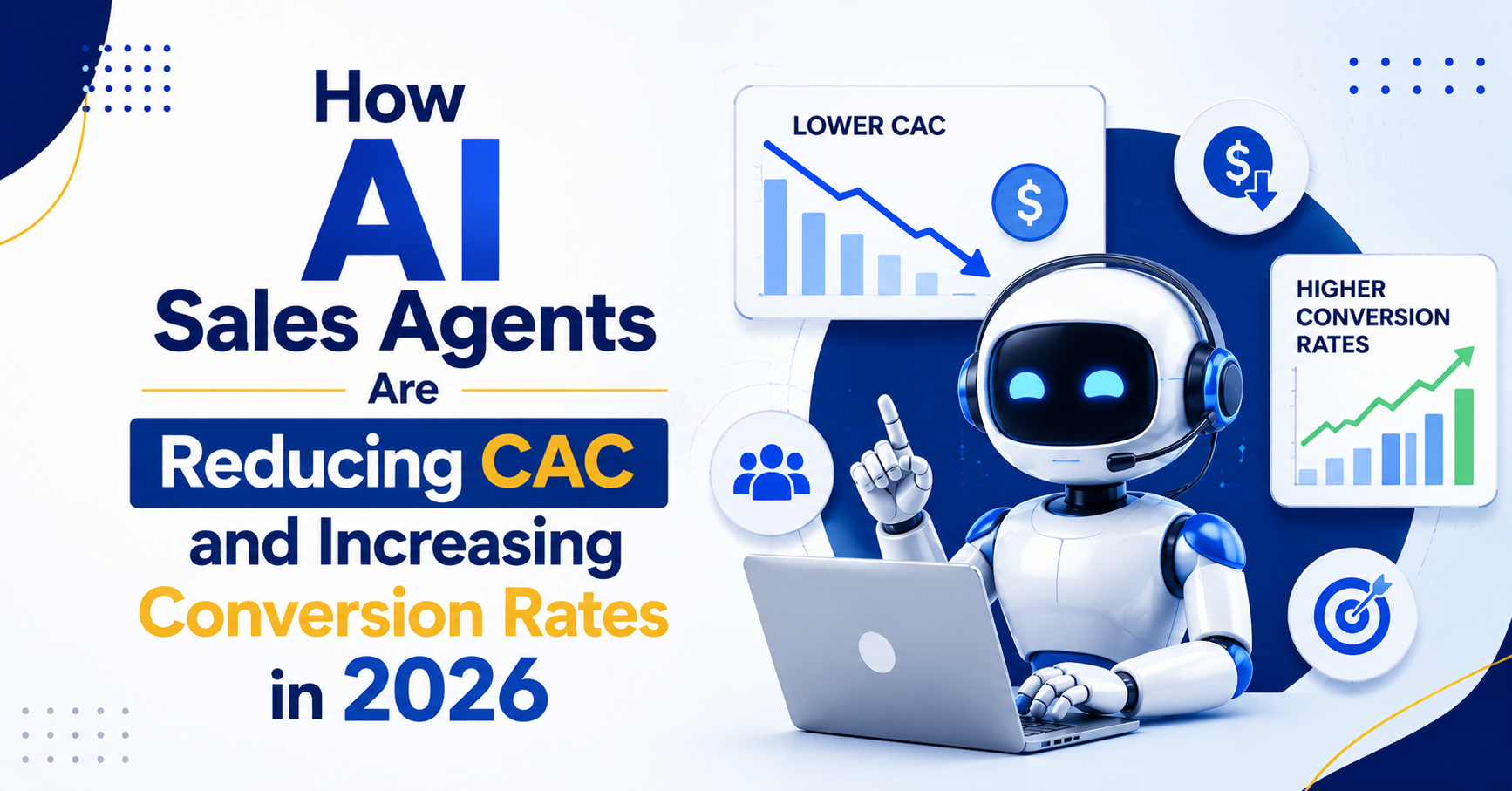
They interpret data, study customer behavior and dynamically change the messaging. This makes them both inbound and outbound environments and assists companies to lower customer acquisition cost with AI and achieve predictable sales results. One of the largest changes in the sales environment in 2026 is their development. The cost of acquiring customers is minimized by AI Sales Agents.
This is how the companies are reducing CAC with the help of AI:
1. More Efficient Targeting
AI will be able to analyze large amounts of data, including user behavior, purchase history, demographics, to determine which segments have the highest intent. Businesses only target individuals who are most likely to convert, instead of sending blasts campaigns to those people who do not show interest.
2. Lower Paid Ad Dependence
Less dependence on paid channels is due to better targeting and enhanced organic conversion.
3. Automated Lead Engagement
AI immediately reacts to incoming leads and reduces drop-off rates and expands the quantity of leads flowing into the pipeline.
Companies that use AI sales agents have a higher likelihood of cutting costs by 20-40 percent of CAC by eliminating inefficiencies.
AI-Powered Conversion Rate Optimization (CRO)
AI conversion rate optimization enables shopping organizations to study thousands of micro-behaviors, such as scroll depth, clicking behavior, the time of purchase, and more, and customize funnels accordingly.
AI CRO tools:
- Dynamic website message personalization.
- Suggest products on the basis of previous encounters.
- Initiate personalized email/SMS sequences.
- Determine when buyers will be converted most.
Such optimization cannot be carried out manually. Conversions increase when each user receives personalized experiences, which is commonly 50 percent or more in e-commerce. Increased demo bookings, trial conversions and retention help SaaS companies.
That is why one of the most popular and implemented strategies is AI conversion rate optimization in 2026.
Inbound AI That Never Sleeps: Transforming Every Lead Into a Real Sales Opportunity
Inbound leads can be wasted in less than two seconds, and that is why AI sales agents are currently the main component of contemporary inbound operations. They react immediately, they make requests specific, they make bookings independently and they make objections like a human rep only with more speed. They do away with delays that kill conversions with highly personalized industry, persona, and on-site behavior. The efficiency of AI in sales increases by an enormous margin the amount of inbound leads that transform into an actual pipeline. The outcome? Greater engagement, quicker responsiveness and quantifiable improvement of conversions through actual AI conversion rate optimization.
Outbound on Autopilot: The AI Engine Replacing Entire SDR Teams
The AI sales agents are completely redefining outbound, and through their capabilities to scrape prospects, analyze intent, customize messages, and conduct multi-channel outreach automatically, they have transformed it completely. These robots cultivate cold listings, deal with objections, and reserve demos without human intervention, which gives them massive operational lift. The solution lowers the cost of acquiring the customer to the company by a significant margin since AI can do the job of many SDRs; it also enhances the quality of outreach to the customer. The consequence is a highly predictable, scalable outbound platform in which prospecting at high volume occurs automatically and rates of conversion increase due to sustained AI-based sales efficiency and smart optimization at each touchpoint.
Predictive AI Lead Scoring: Always Know Who’s Ready to Buy Next
Predictive lead scoring has emerged as a hidden tool that teams would prefer to use to increase conversions and lower customer acquisition cost by using AI. The analysis of behavioral signals, past data, purchase triggers, and product usage trends places AI as a leader in terms of accuracy of almost one hundred percent. Immediately high-intent prospects are surfaced and lower-intent users are automatically sent into automated nurture flows that have been trained using AI conversion rate optimization. The AI-powered sales capabilities boost sales efficiency in the whole funnel because sales reps are only concerned with qualified and closable opportunities. This anticipatory intelligence is such that no hot lead is missed and no sales effort is thrown away.
24/7 AI Follow-Up Engines: Never Lose a Lead to Silence Again
The reason why most deals are lost is because humans forget to follow up or do not follow up adequately. At this point, everything is transformed by AI sales agents. These systems are 24/7 and send the most timely reminders, hyper-personalized follow-ups and intelligent objection-handling responses that feel as a real conversation. They examine the behavior, stage, and degree of engagement of individual leads to provide them with specific content that makes them come closer to a decision. Follow-up is consistent, intelligent and automated with AI and response rates are enhanced with increased conversions significantly higher. This form of AI-driven sales efficiency will see to it that even the potential buyers receive the correct message at the appropriate time without the delays that tend to stall opportunities. The result? Greater show-up rates, reduced sales cycle and closed deals, all with the aid of assisting firms in reducing the customer acquisition cost with AI by maximizing the value of each lead.
AI in Sales Funnels: Automation and Intelligence at Every Touchpoint
The artificial intelligence of sales funnels nowadays provides a smooth, smart automation of the whole buyer experience. AI can know immediately when the visitor is hesitating and provide real-time help to avoid drop-offs. It interprets the browsing behavior to make ultra-relevant product suggestions, email perfectly timed nurture, dynamically adjust the price higher or lower, and even accelerate the checkout process by eliminating friction. In such systems, AI conversion rate optimization is highly precise and potent compared to pre-existing manual techniques since they will constantly test, learn, and optimize each micro-interaction. Personalizing each step can be used to not only increase conversions but also enable businesses to spend less on customer acquisition when using AI by ensuring efficiency in all funnels. All touchpoints are re-engagement opportunities, influencing, and converting opportunities. As machine learning continuously optimizes everything, your funnel is an engine that lives and develops, turning more customers with less effort and more accuracy.
The Era of Autonomous Sales Is Here
2026 is when fully autonomous sales ecosystems emerge based on AI sales agents, predictive analytics, and advanced AI conversion rate optimization. The companies that adopt AI are not merely enhancing their workflow, but they are reinventing the very nature of the way leads are obtained, nurtured, and turned into sales. These systems will save CAC by a significant margin, boost the conversion rates, and simplify inbound and outbound operations. SaaS and e-commerce brands are leading the change and platforms such as Ideaify are enabling the deployment of AI-based sales engines that are far more reliable and precise.
IDEAIFY enables businesses to have inbound automation, outbound AI prospecting, and smart funnel optimization that helps to transform every touchpoint into income. AI is not competitive, it is the basis of the acquisition in the modern world. In the new era, AI-driven organizations would expand quicker, have fewer expenses, and be more successful than those based on manual procedures. The sales future is not an opposition between humans and AI, but rather humans with AI, performing smarter and expanding uphill.