The demand of customers is changing at a rate never before encountered in 2026. SaaS and e-commerce organizations are being compelled to provide inbound and outbound in-the-field, seamless, instant, and artificial intelligence-driven customer support experiences. Knowing the distinction between the inbound and outbound customer service is now paramount to the long-term customer satisfaction and retention.
Why the Inbound vs Outbound Distinction Matters More in 2026
The current customers who are more digital-oriented require speed, convenience and personalization. The two forms of service support various stages of a customer journey whether your business is getting queries left by customers, or customers are actively sought out by the service. It is likely that with new trends in AI customer service in 2026, companies are starting to combine automation and human touch in improving performance, reducing operational costs, and developing proactive customer success systems. Outsourcing by the business to reduce costs, increase its efficiency, and improve customer experience is being achieved through smarter AI-driven support systems deployed by the brand with the help of outsourcing partners such as IDEAIFY Solutions, a trusted customer support outsourcing specialist.
This blog article dissects the major distinctions between inbound and outbound customer service, the future of customer service as AI support automation changes both, and what the future of customer service is within E-commerce and SaaS brands.
What Is Inbound Customer Service in 2026?
Inbound customer service is the customer-initiated support. These include:
- Live chat messages
- Support tickets
- Phone calls
- Email requests
- In-app help requests
- Social media advocacy referrals.
1. Customer Intent
Inbound interactions tend to be situations where customers request assistance because of:
- Payment or billing issues
- Technical concerns
- Tracking of orders or delivery enquiries.
- Product-related questions
- Troubleshooting
It emphasizes resolution, reassurance and customer satisfaction.
2. Inbound Support Technology Developments by 2026
Inbound service has AI embedded in it. The trends of the top AI customers service in 2026 are:
- Chatbots with AI that can solve 80% of frequent questions
- Anticipatory routing that directs the customers to the appropriate agent
- Sentimental analysis to determine frustrated customers
- Voice AI assistance working on tier-1 calls
- Live AI recommendations on human agents
These solutions make work more efficient, quicker, and enable support departments to work at scale, which is particularly important when an E-commerce or SaaS organization needs to handle high traffic volume.
3. Inbound Customer Service objectives
- Enhance customer satisfaction.
- Reduce churn
- Enhance response and response times.
- Build loyalty and trust
- Easy customer integration in SaaS.
Inbound is reactive yet very crucial in the customer experience development.
What Is Outbound Customer Service in 2026?
The outbound customer service is where the company takes the initiative. This used to be largely concerned with follow ups and sales calls. In 2026, however, outbound support has developed into the active customer success system.
- Types of Outbound Support
By 2026, outbound customer service has evolved to be an active and highly tactical customer lifecycle component. Rather than making a sales call or checking in only once or twice, an outbound support is now implemented to help customers through all their important steps following a purchase or subscription. This involves automated follow-ups after purchase to keep them satisfied, organized feedback collection to enhance product experience and reminders to renew subscriptions to keep them off accidental churn. The businesses also go ahead to alert customers in advance of payment failures before service interruption is experienced. The outbound support teams, in the case of SaaS, provide both guided product learning and onboarding to enable users to learn the important features in less time. Besides, outbound contact allows the brands to re-engage inactive customers or those who expressed churn indicators early so that potential losses can be converted into reestablished relationships. In general, outbound support has become a process which is ongoing and relationship; it retains customers even after onboarding.
- 2026 improvements in technology of outbound support.
In 2026, technology has radically transformed outbound customer service, shifting it to a manpower-intensive outreach service to the automated and AI-centered communication systems. The role of automation now takes center stage in AI support where businesses can offer the customer a follow-up by using intelligent AI calling agents that provide a personalized check-in without human involvement. Businesses are using AI-based drip communication to send messages to their customers through WhatsApp, SMS, and email and make sure that the message arrives at the right time and is relevant to the customer. Machine learning algorithms go further to predict customer churn even before it occurs giving teams an opportunity to be proactive and not reactive. Automated onboarding processes in the SaaS world enable users to discover product features without having to be guided (manually) and reduces the friction and accelerates adoption. Also, AI alerts in real-time remind the teams when a user is facing troubles and allow them to engage in outbound communication and solve problems right away. Combined, these technologies make outbound support intelligent, quicker, and highly foretelling.
- Outbound Customer Service Objectives
Outbound customer service of 2026 is fundamentally aimed at developing a seamless, active, and value-oriented customer experience. The outbound teams want to prevent churn through early monitoring of user behavior and fixing the issues before they arise instead of having their customers raise concerns. They also pay a lot of attention to the increased adoption of the product, its customers should realize the whole functionality, and it is particularly important with SaaS products. Outbound service has a direct effect on the customer lifetime value by growing customer loyalty as involved customers feel satisfied and engaged, which means that business can retain customers longer and earn more revenue. The other important goal is to increase the rates of renewal and upgrading by sending timely reminders, personalized offers and constant guidance. On the whole, outbound service enhances the customer relationship due to the emphasis on prevention, ongoing communication, and meaningful communication, which eventually changes the support as a reactive process to a retention engine.
Inbound vs Outbound Customer Service in 2026: Key Differences
The most critical of the differences between inbound vs outbound customer service, as they will have changed in the realities of the AI-driven environment of 2026, include:
1. Reactive vs Proactive
In discussing inbound vs outbound customer service the first significant difference in 2026 is the reactive versus proactive nature of both strategies. Inbound customer care is active in the sense that customers contact the company whenever they expect problems, difficulties or doubts on products, money, or other capabilities of the platform. Outbound customer service, in turn, is active, and the company calls out the customer prior to any issues appearing, providing updates, reminders, and support messages. With the trends of AI customer service shaping the world in 2026, customer interaction through AI is becoming increasingly vital to businesses, as they respond in real-time using inbound means, and anticipate and mitigate problems using proactive outbound interactions. This balance increases satisfaction and retention.
2. Customer Intent
Another difference that defines inbound vs outbound customer service in 2026 is customer intent. The inbound support is aimed at the troubleshooting, support and the process of assisting customers who require assistance in resolving problems or in learning about the product features. Such interactions are normally urgent and solution-focused. Outbound customer service makes the intent shift to education, reminders, renewals, onboarding support, and message of retention. Outbound teams apply AI-based engagement to assist customers by engaging with them in advance instead of having to struggle. The increased sophistication of AI-powered interactions with customers allows organizations in E-commerce and SaaS to customize every touchpoint depending on intent, proactive help when it is useful, and reactive help when it is required to build a more whole and foreseeable customer experience.
3. Integration Levels
The role of AI in the distinction between the inbound and outbound support is transformative, as 2026 may become the next time when the customer experiences may be entirely automated and smart. Chatbots, voice AI, automated knowledge bases, and immediate-resolution systems all are critical components of inbound service, as they react instantly when a customer gets in touch with them. Outbound service applies technology in a different manner based on predictive analytics, automated follow-up infrastructure, churn forecasting models, and AI-driven engagement processes that proactively take actions ahead of problems. They indicate the largest AI-based customer service trends of 2026 and demonstrate that the automation of AI support has become the driving force behind the entire lifecycle, including both reactive support and proactive success to address a gap between support, onboarding, and retention.
4. Measures and KPIs
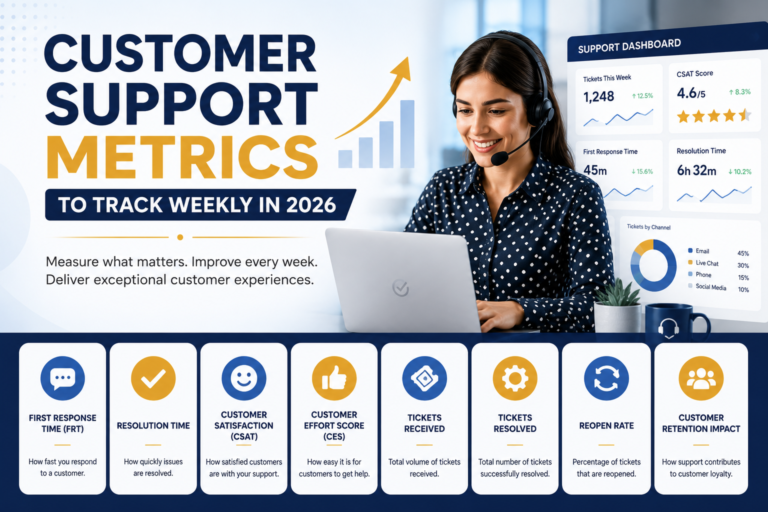
The discrepancy in metrics also throws the inbound vs outbound customer service in 2026 to light. First response time, customer satisfaction (C-SAT), resolution time, ticket volume, and agent productivity are some of the metrics that have been used to measure inbound success, with their values derived by determining how effectively and correctly issues are resolved. The outbound customer care is based on the measurement of performance which includes retention rate of customers, renewal rate, feedback score, engagement rate, and upsell or cross-sell success. These KPIs are directed at the optimization of the relationship and revenue in the long term. The emergence of AI support automation can give more information about both these types of measures, allowing E-commerce and SaaS enterprises to evaluate customer behavior, anticipate the results, and enhance the overall quality of services.
5. Value to E-Commerce and SaaS Businesses
The inbound and outbound customer service will each provide distinct value to the E-commerce and SaaS firms in 2026. Inbound support takes users through areas of frustration, fixes technical or billing complaints and enhances satisfaction and brand perception by providing fast and efficient support. The outbound service is also significant in keeping customers updated, motivation to adopt, renewal and avoid churn by actively communicating and educating. As the customer interactions continue to expand on the basis of AI, the two channels collaborate with each other to establish the complete ecosystem of customer experience wherein the problems are addressed promptly and avoided at an early stage. In high-moving internet businesses, this composite strategy has a direct positive influence on retention, lifetime value, and long-term increases in revenues.
The Future of Customer Service: What 2026 and Beyond Will Look Like
As AI technologies continue to evolve rapidly, customer service will shift more towards further automation, hyper-personalization, and predictive support.
1. Self-directed AI-based Customer Interactions
By 2026, AI systems will not only be able to respond but also will be able to predict the needs of the user.
- Making estimates about when a user can be faced with an issue
- Sending outbound messages earlier than raising tickets.
- Automatic navigation of customers through the working process
- Mastering supports journeys through learning
2. Unified Support Platforms
The contemporary platforms combine inbound ticketing, outbound messaging, CRM information as well as AI automation into a single platform.
3. Human + AI Hybrid Support
In place of substituting agents, AI gives them power:
- Suggestions of real-time responses.
- Automated summaries
- Faster issue diagnosis
- Reduced workload
This ensures that the support is more scalable, precise and consistent.
4. Hyper-Personalized Customer Services
Companies can use machine learning models to:
- Personalize responses
- Tailor outbound reminders
- Present specific entry-level programs
- Provide dynamic self-service assistance
The future lies in the emotionally intelligent and customer service which is highly adaptive.
Why Businesses Need Smarter Support Systems in 2026
With the digital environment evolving, it is no longer a mere operational issue between inbound and outbound customer service, but a strategic one. Customers will demand immediate services, active interaction, and smooth AI-driven experiences with each touch in 2026. This is why the recent trends in AI customer service are repositioning support as a cost center to a main driver of growth in 2026. Companies exploiting automation, predictive analytics, and human-AI workflows are not only solving problems more quickly, but preventing them, enhancing retention, and building long-term loyalty.
In case of businesses that are willing to take their customer experience to the next level, IDEAIFY Solutions has the knowledge to do so. Through artificial intelligence-driven automation solutions to expert inbound and outbound customer care teams, they enable E-commerce and SaaS firms to grow smarter, more effective, and provide the type of customer service that actually differentiates them in 2026 and further.