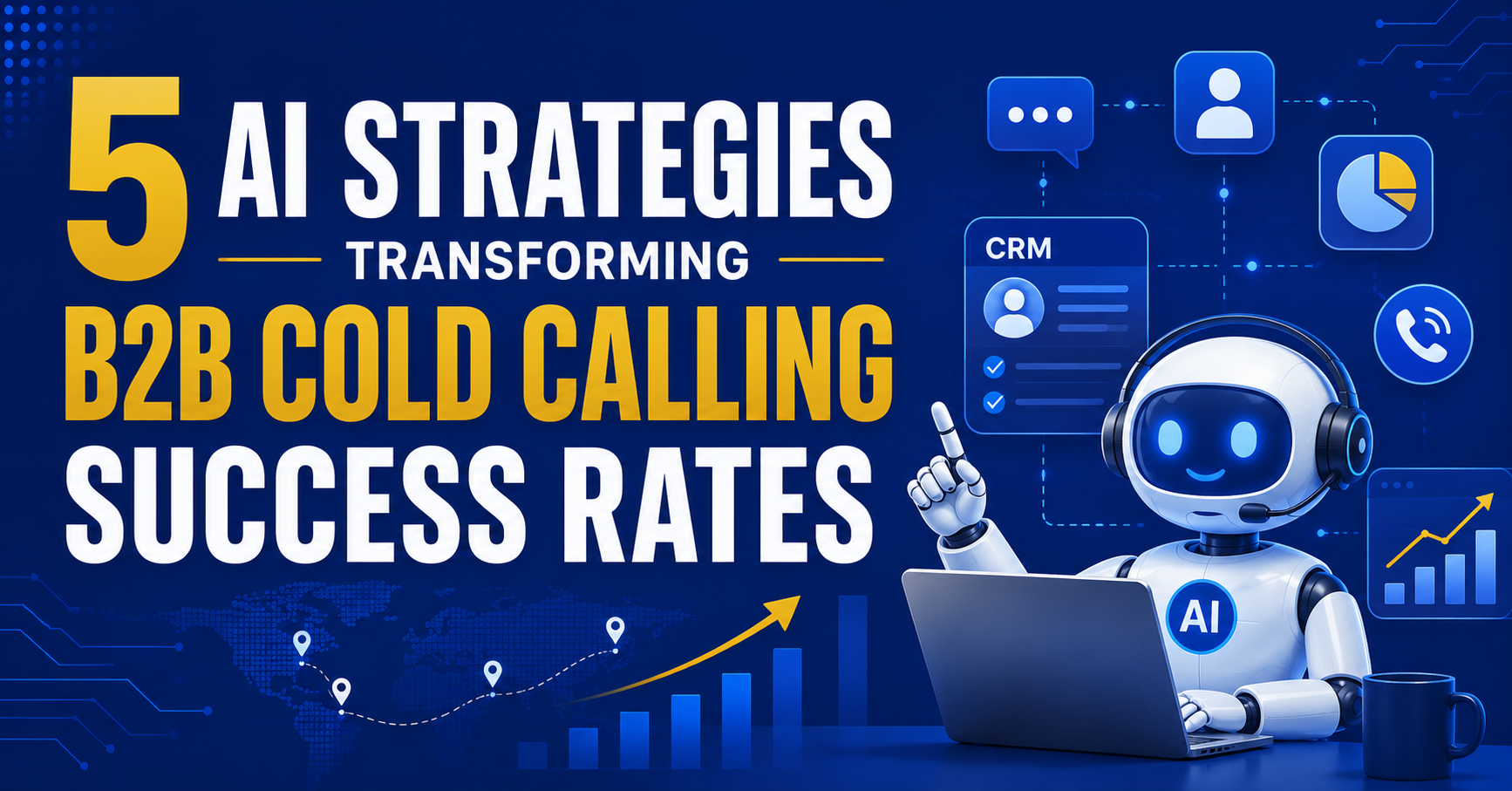
The B2B cold calling landscape has undergone a radical change, driven by AI. There was a time that teams relied on a manual dialing system, simple scripts, and instincts to find the right targets. But today’s market requires even more precision, personalization, and speed than ever before. AI is changing how marketing and sales teams think about outreach; this has turned what were often inconsistent cold calls into data-backed, insightful, and more productive approaches. And for multi-channel teams that do a combination of calls, emails, LinkedIn, and outbound sequences, incorporating AI should no longer even be an experiment, but an absolute competitive advantage.
The main takeaway is to leverage. AI B2B cold calling isn’t meant to replace representatives; it’s meant to provide them with better information, better messaging, better signals, and a better sense of the buyer’s state of mind, long before they dialed a number. Companies that have adopted AI technology in their sales processes have seen more successful rates of contact, better personalization, and improved call outcomes overall. Predictive analytics for cold calling, AI-driven personalization engines, and intelligent conversation analytics are starting to unlock performance levels the outreach of old could never touch.
This article by IDEAIFY, breaks down the five most impactful AI strategies for sales for transforming B2B cold calling success rates today. Each method is rooted in real-world application, backed by sales optimization data, and designed for marketing teams running multi-channel outreach who want faster conversions and smarter pipelines.
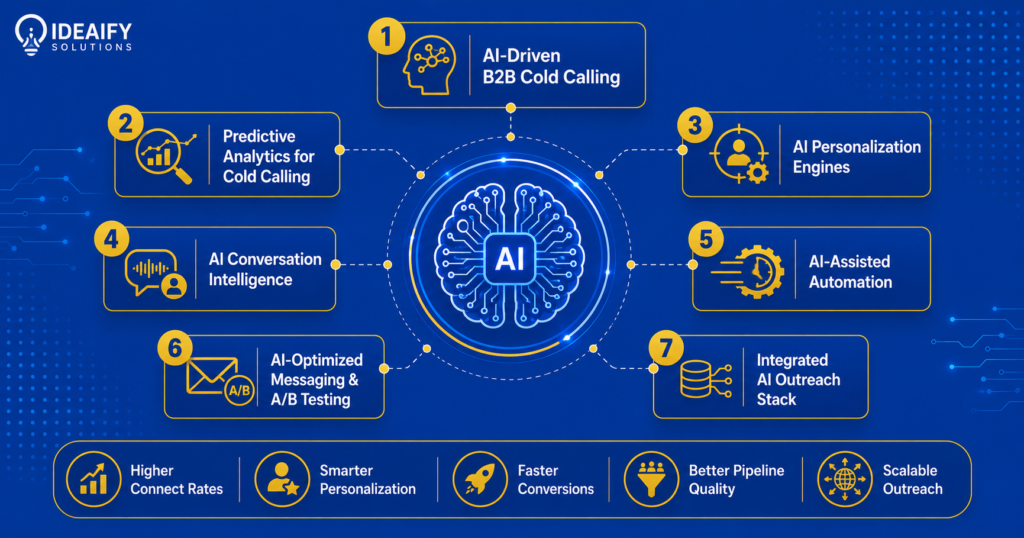
1. Understanding the New Era of AI-Driven B2B Cold Calling
B2B selling is becoming more dynamic than ever and cold calling, which used to be considered as being out of fashion, is gaining a strong resurgence with the help of AI. Conventional outreach was majorly depended on manual list building, generic scripts, and rep intuition. Neatly, however, to-day AI B2B cold calling is empowering teams as they can gain deeper insights, real-time personalization, and predictive models to assist sales reps in knowing who to call and when to call along with what to say that will be used to the most advantage.
Cold calling is not a completely irrelevant concept in B2B due to the fact that decision-makers still react to face-to-face communication. It was not the channel but rather the stupidity of it. AI resolves this by powering up sales teams with data accurate accuracy. The reps have become more of a strategist, rather than a random cold call, supported by analytics that indicate lead intent, buying signals, prior engagement patterns, and a prospect is statistically likely to become a conversion, all of which are now supported by analytics. This development is what makes teams that apply AI strategies to sales always win over stores that remain true to their manual process of selling goods.
This is also beneficial to marketing teams operating with multi-channel outreach since AI will unify all the points of contact affecting email, LinkedIn, SMS, and calls into a single smart system. This kind of cross-channel behavior is analyzed by AI to identify which leads are heating up and where cold calling would be the most suitable step in the chain. Predictive analytics in cold calling if applied properly mean the reps will have less time guessing and more time talking to the right people with the right message at the right time.
According to recent research, firms applying AI sales optimization tools have a 30-50 percent higher connect rate, personalization score, and a substantially reduced sales cycle. It is not simply automation, it is augmentation. AI is not usurping the human voice, it is improving it. The cold calling of the new era is not about volume but relevance, and AI makes every dial count.
2. Predictive Analytics for Cold Calling
Cold calling predictive analytics is now among the strongest AI strategies used by sales teams that aim to enhance efficiency and accuracy. Predictive AI models do not depend upon intuition or old lead lists, but instead consider vast volumes of data: intent signals, past interactions, demographic information, firmographics, purchasing behavior, engagements with CRM, even web behavior, etc. to identify which prospects have the greatest probability of converting to customers. This removes the gambler aspect of cold calling and makes it a data-driven and calculated procedure.
Lead scoring is one of the key capabilities of predictive analytics. AI has the capability of analyzing thousands of data points in a short period of time that a human would not have time to analyze and provide a dynamic score to each lead. Such a score is not only an indication of the perfect fit of a prospect but of their willingness. Call success rates automatically go up when reps are targeting the best leads first. Predictive scoring helps multi-channel outreach marketing teams to improve significantly since all channels such as email, calls, social engagement are combined in a single ranking system.
In addition to lead scoring, predictive models are also used to figure out the optimal time to make cold calls. AI detects patterns like when the prospects respond, when the prospects respond the quickest and when companies are making purchases. Rather than dialing the generic dialing window, the AI B2B cold calling tools inform the reps when to call so they could get the most success. This will increase connection rates only twice.
Smart call lists can also be built through predictive analytics to segment the prospect according to intent. To illustrate the point, a person who downloaded a whitepaper and opened several price pages will have a better priority over a potential customer who just opened an email. Micro-signals are captured by AI and converted into practical calls.
Practical application is already being seen to be effective: a firm that uses predictive analytics to conduct cold calls has reported increased conversion ratios by 40 percent and meaningful conversations by 50 percent. These are not minor enhancements, these are performance jumps which have a direct effect on pipeline development.
Predictive analytics transforms cold calling to a warm and highly targeted outreach strategy. When it is combined with real-time data and multi-channel signals by a team, the amount of time that reps spend conversing with decision-makers who are actively willing to buy increases.
3. AI Personalization Engines that Boost Cold Calling Success
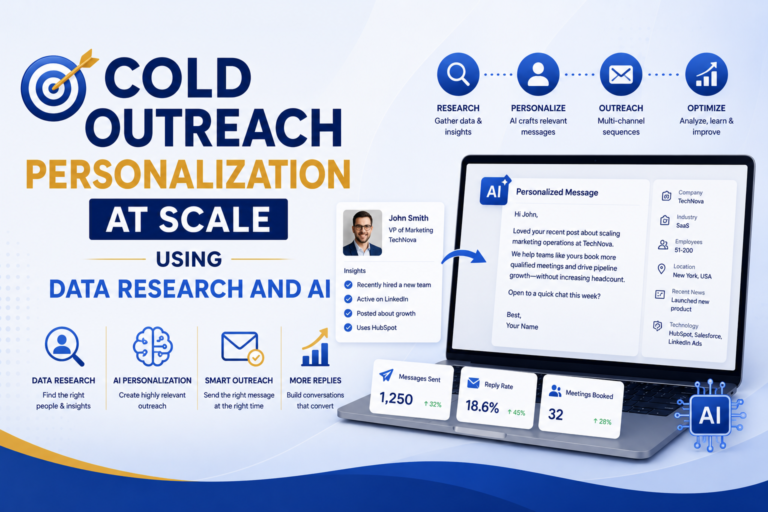
The emergence of AI-based personalization can be viewed as one of the most significant innovations of the modern B2B cold calling. Previously, personalization consisted of typing in a name or company of a prospect in a script. Incidentally, AI personalization engines consider behavioral data, firmographic indicators, purchase intent, CRM history, and even digital footprints of people to produce in-depth and contextual insights that can be accessed by the rep during a call. The result? Discussions that are more related, more human, and much more apt to turn.
Real-time script personalization is one of the most revolutionary features. Intelligent technology can be used to generate call openers automatically, specific to each prospect- mentioning new company news, new product releases, new funding announcement, new hiring trends, or pain points based on online behavior. This technique entirely transforms the call energy. The rep appears to sound knowledgeable, ready, and valuable in the opening sentence rather than generic. Research indicates that the chances of the prospects remaining on the phone increase by 70 percent in an event where the call is contextualized.
AI B2B cold calling software also combines various sources of data, such as CRM data, marketing automation tools, email interactions, online actions, and LinkedIn actions, to reveal information that can be applied in real-time by the rep. To illustrate, when a prospect has visited the pricing page two times within the span of a week, AI will mark this as an intent trigger and suggest positioning in line with the evaluation-stage messages. Human beings would almost have found it difficult to compile such a level of data-driven relevance manually.
Dynamic call sequencing is another effective technique of personalization. AI evaluates the channels that are the most significant to every prospect and modifies messages. A social-led introduction can be proposed by the AI engine in case a person communicates primarily on LinkedIn. In case a prospect reacts to email intensively, the AI may propose call scripts that mention emails they have read.
The application of AI in multi-channel teams is invaluable since it makes the message in email, LinkedIn, and cold calling coherent and contextual. Personalization engines do not exist as individual touchpoints, but rather ensure that each channel reinforces the other.
It is this change that causes AI approaches to sales to become now the centerpiece in outreach. It is no longer a dream to make personalization at scale a reality, but a must-have competitive necessity.
4. AI Conversation Intelligence for Sales Optimization
The AI conversation intelligence is now among the most influential AI strategies in sales, changing the way the teams analyze, coach, and optimize B2B cold calling. AI is scalable: it analyses every call, following tone, sentiment, pacing, keyword prompts, objection patterns, and talk-to-listen ratios instead of using subjective feedback. These lessons help leaders to determine winning talk tracks, how to make a script better, and enhance rep performance.
Coaching in real-time is also given by AI, which implies more appropriate wording, questions, or emotional adaptations in conversations in real-time. Cold calling is more purposeful and sensitive since it has the capacity to recognize the signals of buyers. This boosts dramatically connected rates, quality of follow ups and conversions of meetings. In the case of maximum sales with AI, teams increase close rates by 2540 percent since teams are informed of what works based on data, rather than guesses.
All in all, AI conversation intelligence is a significant factor that can assist an organization to increase its cold calling success rates with AI and establish predictable, scalable, and high-performing outreach systems.
5. AI-Assisted Automation to Increase Speed & Efficiency
The teams that want to increase the effectiveness of cold calling with AI need to automate as much as possible and improve the outreach, which can only be made possible through AI-assisted automation. AI does not overrule manual work such as data entry, scheduling, dialing, CRM updates, and task creation, enabling reps to talk more and less time in administration.
Scheduling of calls with predictive analytics fills in the gaps in the prospects, placing them at the right time to guarantee higher connect rates of 30-50. Bad numbers filtered by smart dialers, and the sanctioned outbound workflows are minimized, which minimizes errors and wastage of effort. Follow-up emails and logs are also automatically written by AI, allowing pipelines to run faster and providing a higher consistency of outreach. The scaling capability that AI B2B cold calling offers allows teams to increase scale without increasing the number of people, making AI-facilitated cold calling significantly more strategic and cost-effective.
When used in conjunction with multi-channel outreach, automation which is guaranteed delivers timely, accurate and customized communication to each prospect, each of which has been linked to enhanced performance and more foreseeable sales results.
6. AI-Optimized Messaging & A/B Testing for Cold Calls
By using AIs to optimize messages, B2B cold calling is being redefined by using dynamic data-driven talk tracks instead of the previously used static ones. With generative AI, teams can immediately generate custom scripts to personas, industries, objections, and buying stages. To determine which messages keep the prospects on the phone and which convert more, AI is continuously conducting A/B tests on openers, hooks, CTAs, and objection responses.
This knowledge can enable groups to create messages that are highly impactful and minimize preliminary stalling. The real-time AI analysis shows the most effective lines to overcome the budget issues, the emotional tones that bring more trust, and the words that the top reps apply to secure additional prospects to accept the meeting. This is where AI-optimized messaging has a significant performance boost (42 more meetings and 50 fewer hang-ups) depending on the companies using AI to optimize messaging as a critical AI sales optimization tool.
Finally, AI makes the cold calling messaging not only smarter and relevant but also effective, as it will be developed based on actual buyer behavior, rather than assumptions.
7. Integrating AI Strategies into Your B2B Outreach Stack
Using AI strategies in your outreach stack is essential to any organization that intends to modernize AI B2B cold calling and create a cohesive, smart sales process. Instead of bringing together the fragmented tools, it is aimed at developing a coherent system that entails predictive analytics, personalization engines, AI dialers, and conversation intelligence.
The power of AI-based workflow is based on an intelligent workflow:
- intent data
- predictive scoring
- personalized messaging
- AI-driven cold calls
- conversation intelligence
- automated follow-up
This has prospects progressing through the funnel with a steady stream of messages and at the right intervals. The problem of data silos, resistance to adoption, and over-automation may be eliminated with the help of CRM integration, educating AI, and human compassion on the phone.
The main indicators, such as the connect rate, sentiment score, meeting conversion, and revenue influence enable teams to evaluate the actual AI-sales optimization performance. With appropriate integration, AI will form the basis of scalable predictable B2B outreach.
Conclusion
AI has now turned into the foundation of contemporary B2B cold calling, and it has turned the art of reaching out to a guess into a foreseeable and data-driven organism. Through AI-based personalisation, conversation intelligence, predictive analytics to do cold calling, and automated workflows, sales teams are able to get in touch more quickly, personalise more deeply and get more consistent conversions. These sales AI plans do not substitute the human element, it enhances it. By entering each conversation with more knowledge, better timing, and messages that reflect actual buyer behavior, Rep will walk stronger. The firms who have adopted AI early enough are already experiencing a rise in connection rates, reduced sales cycles, and a discernible increase in the quality of the pipeline.
In case you are willing to increase cold calling rates with AI and would like to get professional assistance in developing or optimizing your AI-powered outreach infrastructure, Ideaify Solutions will be able to assist you in configuring the appropriate tools, approaches, and procedures. Be it scaling outbound or modernizing your tech stack, you can count on our team to help you with it all.