Most startup websites look good, but very few actually generate leads consistently.
Founders invest months designing the perfect homepage, adding product pages, and publishing blog content. Traffic starts coming in from ads, SEO, or social media. But something frustrating happens. Visitors arrive, they browse for a few seconds and then they leave.
No signup, no demo request and no inquiry.
This is where website CRO (Conversion Rate Optimization) becomes critical. It separates websites that simply exist from those that actively generate leads and grow a business. Before you pour more money into traffic, the smartest founders do something else first. They optimize the conversion engine.
This guide walks through a practical conversion checklist founders can use to transform their website into a reliable lead-generation machine before 2026.
Why CRO Matters Before Scaling Traffic
A common mistake among early-stage companies is focusing heavily on traffic acquisition before fixing conversion issues.
Founders assume:
- “More traffic will solve the growth problem.”
- But traffic only amplifies what already exists.
- If your website converts at 1%, sending 10,000 visitors produces 100 leads.
- If it converts at 4%, the same traffic produces 400 leads.
- That difference comes entirely from SaaS website optimization, not additional marketing spend.
CRO helps founders:
- Increase conversions without increasing ad spend
- Turn existing traffic into more leads
- Improve product messaging
- Reduce customer acquisition cost (CAC)
- Build trust with new visitors
For startups and SaaS companies, this is crucial. Marketing budgets are limited, and every visitor needs to count. Optimizing conversions first ensures that when traffic scales, revenue scales with it.
Signs Your Website Is Not Converting
Many founders assume their website is performing fine simply because it looks polished. However, design quality and conversion performance are two different things. Here are the most common indicators that your lead generation website needs CRO improvements.
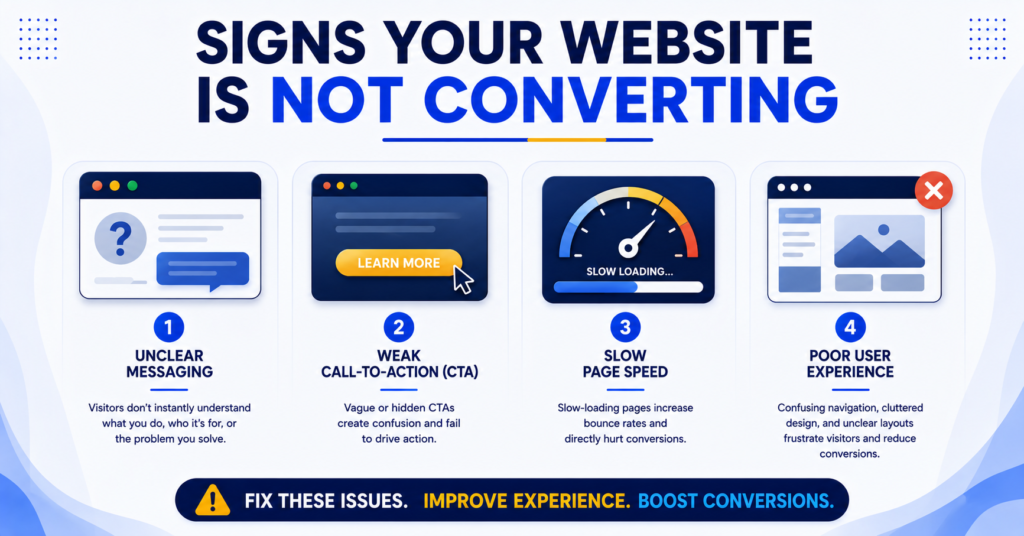
1. Unclear Messaging
Visitors should understand what you do and who it is for within five seconds. If your homepage headline is vague or filled with buzzwords, visitors become confused and leave.
Example of weak messaging: “Empowering digital transformation with innovative technology solutions.”
Clear messaging should instead answer:
- What is the product or service?
- Who is it for?
- What problem does it solve?
Clarity converts while complexity repels.
2. Weak Call-to-Action (CTA)
Many websites hide their call-to-action or use vague language such as:
- Learn More
- Explore
- Click Here
Strong conversion-focused CTAs are direct and benefit-driven.
Examples:
- Book a Demo
- Start Free Trial
- Get Your Free Audit
- Schedule a Strategy Call
A strong CTA removes friction and tells the visitor exactly what happens next.
3. Slow Page Speed
Speed directly impacts conversions.
Research consistently shows that even a one-second delay in page load time can reduce conversion rates.
Slow pages often result from:
- Large images
- Excessive scripts
- Poor hosting infrastructure
- Unoptimized website frameworks
Fast-loading pages are a critical part of SaaS website optimization.
4. Poor User Experience
Visitors should be able to find information quickly.
Conversion problems often come from:
- Confusing navigation
- Cluttered layouts
- Overwhelming text blocks
- Unclear product explanation
A well-optimized website CRO strategy simplifies the user journey from landing page to conversion.
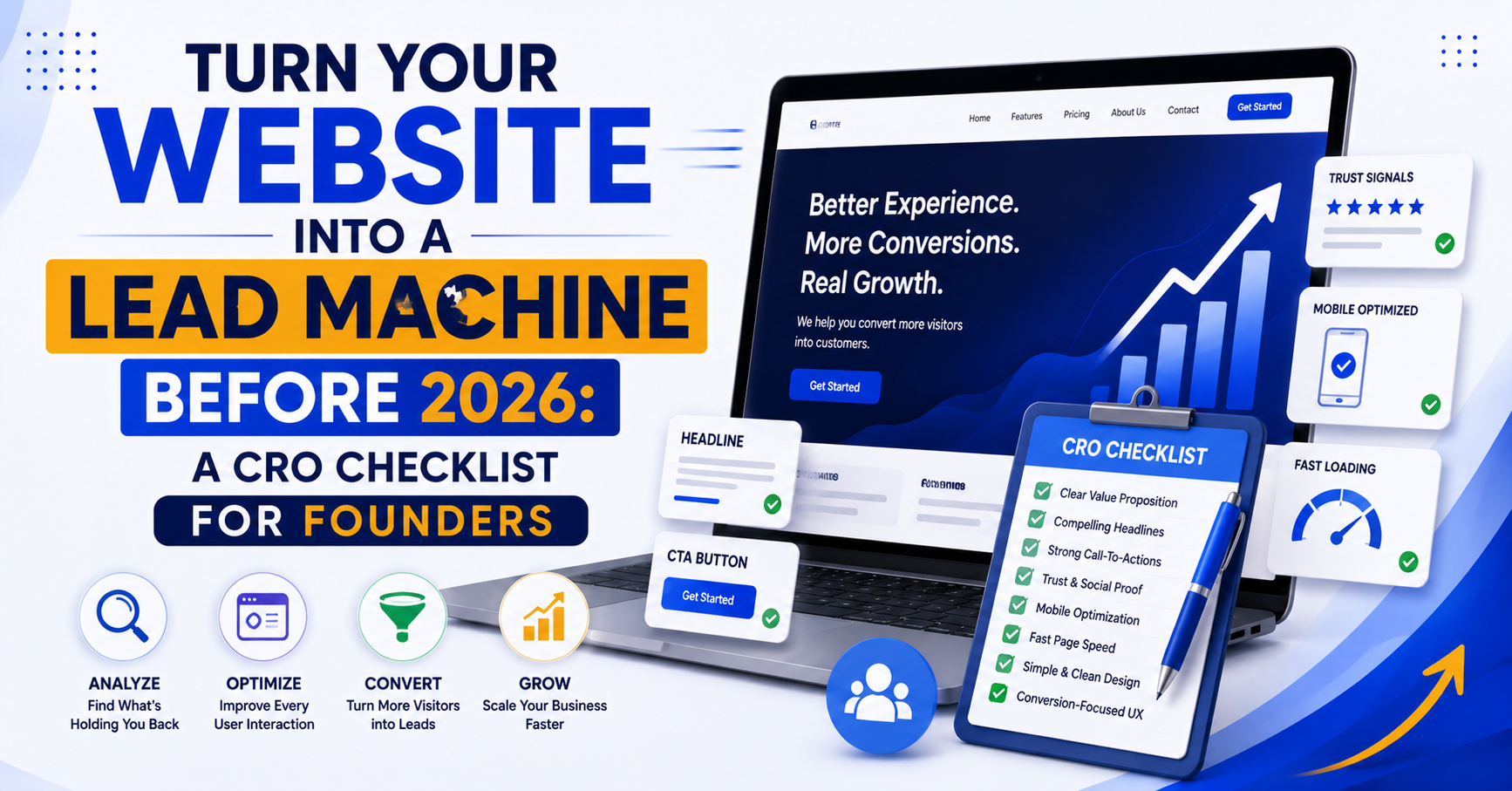
The Founder’s CRO Checklist
Now let’s look at the core conversion checklist founders should use to improve their website performance. These elements form the foundation of a high-converting lead generation website.
1. Clear Value Proposition
Your homepage headline should clearly answer three questions:
- What do you offer?
- Who is it for?
- What result does it deliver?
Strong example:
“Scale Your SaaS Sales Pipeline With Dedicated SDR Teams.”
Weak example:
“Innovative Solutions For Modern Businesses.”
Visitors should instantly understand why they should stay on the site.
2. Strong Above-the-Fold Messaging
The section visitors see before scrolling is critical.
This area should include:
- A strong headline
- Supporting subheadline
- Primary CTA
- Visual demonstration or product illustration
This section alone often determines whether visitors continue exploring or exit.
3. Optimized Call-to-Action Buttons
Effective CTA buttons share a few common characteristics:
- Clear action language
- Strong contrast color
- Placed in multiple sections
- Visible on mobile
Examples of high-converting CTAs:
- Get a Free Demo
- Book a Discovery Call
- Start Your Free Trial
Never make visitors search for how to take the next step.
4. Trust Signals
Trust dramatically increases conversions, especially for startups.
Include visible credibility indicators such as:
- Client testimonials
- Case studies
- Customer logos
- Industry awards
- Media mentions
- Verified reviews
These signals reassure visitors that others have already trusted your solution.
5. Lead Magnets
Not every visitor is ready to buy immediately.
Lead magnets capture interest earlier in the funnel.
Examples include:
- Industry reports
- SaaS growth guides
- Free audits
- Product comparison sheets
- Templates or toolkits
Lead magnets help transform casual visitors into qualified leads.
6. Simplified Forms
Forms are a major friction point in CRO.
If your form asks for too much information, visitors abandon it.
Best practices:
• ask for minimal information initially
• use progressive profiling later
• remove unnecessary fields
In many cases, a simple name + email + company form converts far better than a lengthy questionnaire.
7. Mobile Optimization
Mobile traffic now represents a major share of website visits.
Yet many startup websites are designed primarily for desktop.
Key mobile CRO practices include:
• responsive layouts
• easy-to-click buttons
• simplified navigation
• fast loading speed
Mobile usability is now a fundamental part of website CRO.
8. Fast Loading Speed
Page speed influences both SEO rankings and conversion rates.
Optimizing speed typically involves:
• compressing images
• minimizing scripts
• using content delivery networks
• optimizing hosting infrastructure
Even small improvements can dramatically increase conversions.
9. Landing Page Clarity
Landing pages should focus on one goal only.
Avoid distracting navigation links or multiple offers.
A high-converting landing page typically includes:
- Problem statement
- Solution explanation
- Benefit highlights
- Proof elements
- Single clear CTA
This focused approach significantly improves conversion rates.
SaaS Website Optimization Strategies
SaaS companies face unique conversion challenges.
Prospects often need more information before committing to a product.
Here are specific SaaS website optimization strategies that improve conversion performance.
Product-Led Demonstrations
Instead of explaining features with long text blocks, show the product in action.
Effective methods include:
- Product screenshots
- Interactive demos
- Short explainer videos
- Feature walkthroughs
Seeing the product builds confidence and reduces hesitation.
Free Trial or Freemium Entry Points
For many SaaS companies, the fastest way to convert users is through product experience.
Offering:
• free trials
• freemium tiers
• demo access
allows potential customers to evaluate the product with minimal risk.
Dedicated Use-Case Pages
SaaS products often serve multiple industries.
Creating pages such as:
• “CRM for Startups”
• “Marketing Automation for SaaS Companies”
• “Customer Support Tools for E-commerce”
helps attract highly targeted traffic and improves conversions.
Social Proof From Real Customers
Case studies are especially powerful for SaaS conversion.
Strong case studies typically highlight:
• the customer’s challenge
• how the product solved it
• measurable results
Real-world outcomes reduce skepticism.
Tools Founders Can Use for CRO
Several tools can help founders analyze user behavior and improve website conversions.
Popular options include:
Analytics Tools
• Google Analytics
• Mixpanel
• Amplitude
These tools reveal traffic sources, user journeys, and conversion patterns.
Heatmap Tools
Heatmaps show where visitors click, scroll, and interact.
Common platforms include:
• Hotjar
• Microsoft Clarity
• Crazy Egg
These insights reveal usability problems that traditional analytics miss.
A/B Testing Tools
A/B testing allows you to experiment with different headlines, layouts, or CTAs.
Popular tools:
• Google Optimize alternatives
• VWO
• Optimizely
Testing removes guesswork from CRO.
Quick CRO Wins You Can Implement This Week
Founders often assume CRO requires complex redesigns. In reality, a few small improvements can quickly boost conversions.
Here are fast actions you can implement immediately.
• Rewrite your homepage headline to clearly state the value proposition
• Add testimonials near your main call-to-action
• Reduce the number of fields in signup forms
• Improve page loading speed by compressing large images
• Add a CTA button in the website header
• Highlight one primary action instead of multiple competing options
• Add product screenshots or visual demonstrations
These simple adjustments often deliver measurable results within weeks.
Conclusion
In 2026, competition in the startup and SaaS ecosystem will only intensify. Traffic acquisition is becoming more expensive, and attention spans are shrinking. The companies that win are not always those with the biggest marketing budgets. They are the ones with the best conversion engines. A well-optimized lead generation website ensures that every visitor has a clear path toward becoming a customer.
By following this conversion checklist and focusing on practical website CRO improvements, founders can dramatically increase leads, improve customer acquisition efficiency, and build sustainable growth.
Want to Turn Your Website Into a Lead Generation Engine?
If your website is attracting visitors but not generating enough leads, it may be time to optimize your conversion strategy. Improving messaging, user experience, and trust signals can transform an underperforming website into a powerful growth asset for your startup. Start by implementing the checklist above and refining your SaaS website optimization strategy one step at a time. Small improvements today can drive significant growth tomorrow.